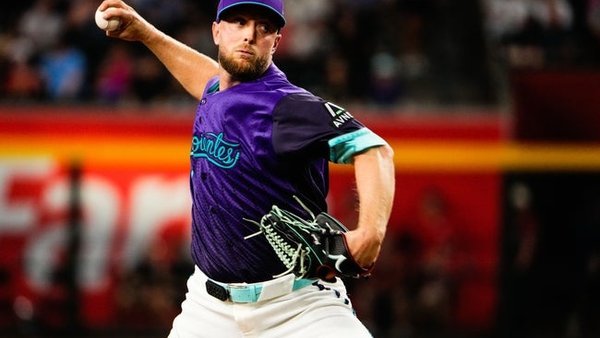
Mason Adams makes his second career MLB start against an Arizona lineup carrying an aggregate xwOBA north of .370 at the top — and when he exits, Colorado’s 5.58-ERA bullpen takes over at the most run-friendly park in baseball. The total is posted at 11.0 with the over at just -115, a number that barely blinks at a 1.38 park factor and genuine starting pitcher uncertainty on one side.
Merrill Kelly vs. Mason Adams: Arizona Diamondbacks at Colorado Rockies Betting Preview
After Arizona’s 7-2 dismantling of Colorado on Tuesday, the pitching matchup shifts dramatically. Michael Soroka struck out nine over seven innings of one-run ball in that game. Tonight, the Diamondbacks send Merrill Kelly to the mound — a legitimately good arm — but on the other side, Colorado counters with Mason Adams, making his second MLB start with a 5.09 ERA and essentially zero track record against major-league lineups.
The total is posted at 11.0, with the over at -115 and the under at -105. That pricing is telling. The market is nearly split on a game happening inside Coors Field — the most run-friendly environment in baseball, carrying a 1.38 park factor — with a pitcher on the mound for Colorado who has almost no data to support run suppression across multiple times through the order. The numbers project a combined score of 12.9. The math points to the over, and the price doesn’t punish you for taking it.
Game Info & Betting Lines
- Date/Time: Wednesday, September 23, 2026 | 8:40 PM ET
- Venue: Coors Field, Denver, CO — Park Factor: 1.38 (most hitter-friendly in MLB)
- Probable Starters: Merrill Kelly (ARI) vs. Mason Adams (COL)
- Moneyline: Arizona Diamondbacks -160 / Colorado Rockies +132
- Run Line: Colorado Rockies +1.5 (-112) / Arizona Diamondbacks -1.5 (-107)
- Total: 11.0 (Over -115 / Under -105)
Why This Number Is Off
The legitimate case for the under: Merrill Kelly carries a 2.89 ERA this season with a 1.23 WHIP over 183.2 innings. That’s a real number. If Kelly dominates early and goes six-plus innings, the scoring burden falls entirely on Colorado’s offense and whoever Arizona trots out of the bullpen — not a guaranteed disaster. The market knows this, which is why the under is priced at -105 rather than something heavier.
But here’s where the market gets it slightly wrong: the under at -105 is essentially saying this game is a toss-up on total direction, at Coors Field, with Colorado starting a pitcher in his second career MLB appearance. That framing doesn’t hold up. The over at -115 is minimal juice for a venue that historically inflates run environments by 38% above league average. You’re paying a small premium for what is structurally a high-run-environment game with genuine starting pitcher uncertainty on one side.
The projection sits at 12.9 combined runs — nearly two full runs above the posted total. Even if you discount that conservatively, a landing spot of 10-12 runs is well within reach, and any game finishing in double digits cashes the over. The market is not wrong to respect Kelly; it’s just mispricing the risk created by Adams on the opposite side.
What Separates the Pitching
This is not a symmetric matchup, and the over thesis depends heavily on understanding exactly how asymmetric it is.
Merrill Kelly is the superior arm by a wide margin — his 2.89 ERA reflects a full season of competence. But his profile raises legitimate Coors concerns. Kelly’s four-seam fastball sits at 92.1 mph with a 39.6% usage rate, generating a .315 xwOBA against and a 19.4% whiff rate — functional, not dominant. His best pitch is the changeup (26.5% usage, .276 xwOBA against, 26.5% whiff rate), but his K/9 is only 6.86. Kelly is a contact-heavy pitcher, and at altitude, weak contact still travels. His sinker — used 8.2% of the time — surrenders a .416 xwOBA against, the worst of any pitch in his arsenal. Against a Rockies lineup with a .738 OPS and Hunter Goodman carrying a .435 xwOBA with a 6.9% barrel rate, Kelly’s ball-in-play profile is a concern. That said, Goodman is just 1-for-16 (.062) against Kelly in 17 career plate appearances with 7 strikeouts — a dominant historical edge for the Arizona right-hander — though that 31.8% whiff rate cuts both ways when Goodman does make contact at 5,280 feet.
Mason Adams is the real variable. A 5.09 ERA in his first start, no established pitch mix data, and no demonstrated ability to navigate a major-league lineup multiple times. Against an Arizona offense with Corbin Carroll (.399 xwOBA, 6.6% barrel rate), Gabriel Moreno (.381 xwOBA), and Jordan Lawlar (.410 xwOBA leading the lineup in quality of contact), Adams is walking into a buzzsaw with no blueprint to follow. The gap between Kelly and Adams isn’t just ERA — it’s track record, repertoire depth, and the certainty that Adams will hand things to Colorado’s bullpen early, dragging in a relief corps operating under a team ERA of 5.58. That bullpen exposure is where the over gets its real runway.
The Pushback
The honest concern here is that 11.0 is already a high number. The market has not ignored Coors Field — it has priced it in. A total of 11.0 reflects an above-average run environment, and if Kelly goes six innings allowing two or three runs while Adams settles in for four, you could easily land in the 8-10 run range and lose the over cleanly.
Arizona’s recent offensive context adds another layer of friction. Tuesday’s 7-2 win came against Kyle Freeland, who surrendered five earned runs in three innings. The D-backs can score — but they’ve done it in spots, not as a relentless machine. Corbin Carroll’s .240 average and the bottom of their order (Tawa, Fernandez) offer legitimate outs for Adams to collect if the rookie can locate early. Kelly’s career competence also means Arizona may genuinely hold Colorado to four or five runs on their own. That’s a real scenario where this game ends 6-4 or 7-4 and the over sits in the window but doesn’t close.
I’m not dismissing that path. I’m just not betting on it.
Run Environment & Game Shape
Coors Field isn’t a gimmick in this analysis — it’s the structural foundation. A 1.38 park factor means run totals at this venue are 38% above league average by design. That doesn’t guarantee an over every night, but it fundamentally changes the margin-of-error equation. A pitcher who gives up four runs anywhere else gives up five or six here. A soft single that dies on the warning track in a sea-level park carries to the wall at altitude. Kelly’s contact-heavy profile — 6.86 K/9, a sinker with a .416 xwOBA — is especially vulnerable to this inflation. The Rockies’ lineup, led by Goodman’s .435 xwOBA and Jake McCarthy hitting .295 with a .361 xwOBA, will put balls in play against him all night.
On the other side, Adams making his second MLB start means Arizona’s lineup — which carries an aggregate xwOBA over .370 at the top — gets to attack a pitcher with no in-season adjustment data and no history of navigating a second or third time through the order. When Adams exits, Colorado’s bullpen enters at a team ERA of 5.58. That relief exposure compounds an already run-friendly environment. A projected combined total of 12.9 runs isn’t a fantasy — it’s what you get when you stack a 1.38 park factor, a rookie starter, a contact-heavy veteran arm, and two thin bullpens into the same game shape.
Bet: Over 11.0 at -115, 2 units, moderate confidence. Coors Field plus a rookie’s second MLB start plus Kelly’s contact-heavy profile plus two leaky bullpens is a structural over setup. The market has priced Kelly correctly and largely ignored the run-environment multiplier Adams creates on the other side. At -115, you’re getting a number that should be higher. Take it.