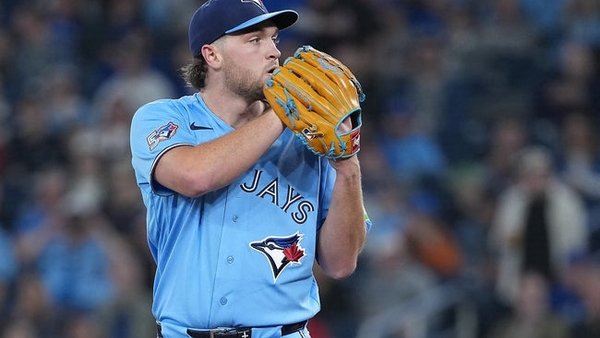
Yesavage’s 0.96 ERA sits on just 9.1 innings — the pitching gap is real but the -184 price treats him like an established ace against a lineup that destroys small samples.
Jack Kochanowicz vs Trey Yesavage: Angels at Blue Jays Betting Preview
The market’s charging premium juice on Toronto after they snapped their four-game losing streak with a 2-0 shutout victory over these same Angels last night. At -184, the Blue Jays are priced like a significant favorite, but the core thesis remains sound — Trey Yesavage brings a massive starting pitching advantage over Jack Kochanowicz that justifies the directional lean, even if the price makes this more of a parlay component than a standalone play.
Toronto’s 4.11 team ERA sits 0.31 runs better than the Angels’ 4.42 mark, while their superior control shows in a 1.291 WHIP compared to Los Angeles’ bloated 1.417. The Angels arrive at 15-24 and just 3-7 in their last 10 games, though their offensive struggles have been overblown — they scored 8 runs against Chicago just two games back and managed 4 runs the game before that.
Game Info & Betting Lines
- Date/Time: Saturday, May 9, 2026 | 3:07 PM ET
- Venue: Rogers Centre (Park Factor: 1.00)
- Probable Starters: Jack Kochanowicz (2-1, 3.05) vs Trey Yesavage (1-1, 0.96)
- Moneyline: Los Angeles Angels +154 / Toronto Blue Jays -184
- Run Line: Toronto Blue Jays -1.5 (+116) / Los Angeles Angels +1.5 (-140)
- Total: 8.0 (Over -110 / Under -110)
Why This Number Is Steep But Directionally Right
The market’s pricing Toronto as a heavy favorite based on multiple factors working in their favor. Last night’s momentum shift matters — the Blue Jays got dominant pitching from Dylan Cease while the Angels managed just five hits and scored 2 runs in their previous game. Toronto also has the superior team pitching metrics and better recent form at 5-5 in their last 10 compared to the Angels’ dismal 3-7 stretch.
What justifies the Angels getting +154 is their significantly superior offensive firepower. Mike Trout is hitting .260 with a .979 OPS and 11 home runs, while Jorge Soler adds another power threat at .818 OPS. Toronto’s lineup lacks that same punch — their highest OPS belongs to Myles Straw at .844, hardly the type of middle-of-the-order thump that can change games quickly.
But where the market seems slightly off is undervaluing the pitching gap. Yesavage’s 0.96 ERA creates a massive 2.08-run advantage over Kochanowicz’s 3.05 mark, and that differential in a neutral park environment should carry more weight than the offensive imbalance.
What Separates the Pitching
Trey Yesavage has been dominant through his limited 9.1 innings, generating a 19.1% whiff rate with his 93.7 mph four-seam fastball that comprises 54.5% of his arsenal. His split-finger at 36.5% usage creates serious swing-and-miss at 33.3% whiff rate while holding opposing hitters to just .178 xwOBA. The combination gives him multiple ways to attack the zone while maintaining an 8.68 K/9 rate that suggests the early-season numbers aren’t fluky.
Jack Kochanowicz presents a different profile entirely. His sinker-heavy approach at 37.7% usage and 95.9 mph generates weak contact but allows a concerning .350 xwOBA against. His changeup provides his best weapon at 38.7% whiff rate, but his overall 6.53 K/9 suggests he’s more dependent on his defense and sequencing than overpowering stuff.
The Angels’ lineup features dangerous power — Trout’s .555 xwOBA and Soler’s .417 mark create legitimate home run threats. But Yesavage’s early-season work suggests he can limit hard contact, particularly with his split-finger generating such weak contact metrics. Kochanowicz faces a tougher test against Toronto’s more disciplined approach, especially with Vladimir Guerrero Jr. posting .381 xwOBA and excellent plate discipline.
The Real Risk: Variance and Sample Size
Here’s what’s keeping me up at night about this bet: Yesavage’s microscopic 9.1-inning sample makes any projection a statistical house of cards. We’re talking about fewer than two starts of work, and variance can absolutely demolish small-sample heroes. Look at what happened to other early-season darlings — guys who looked unhittable through 10 innings before regression hit like a freight train.
The Angels’ power core represents exactly the type of lineup that can expose sample-size flukes. Trout’s .555 xwOBA isn’t a mirage — this is a generational hitter who’s proven he can adjust to any pitcher’s strengths within an at-bat. Soler brings the same explosive potential, and both have faced enough quality pitching to separate real stuff from early-season luck.
Then there’s the market efficiency question. If Yesavage is genuinely this dominant, why aren’t the sportsbooks pricing Toronto closer to -220? The current number suggests they’re building in serious regression risk, and these aren’t guys who leave money on the table. That +154 on the Angels feels like it’s accounting for more than just their recent struggles.
Why the Run Line Doesn’t Work
I spent considerable time analyzing the run line at Toronto -1.5 (+116), thinking that plus-money might offer better value than laying heavy juice on the moneyline. The math initially looked attractive — Toronto’s superior pitching paired with the Angels’ recent offensive inconsistencies suggested blowout potential.
But digging into the game scripts reveals why this number exists. The Angels’ offense operates in feast-or-famine mode, but when they feast, it happens quickly. Their 8-2 win over Chicago two games back showcased their ability to pile on runs in bunches — five runs in the second inning alone. Even in losses, they’ve shown late-inning rally potential that keeps games close.
More critically, Toronto’s offense lacks the sustained punch to build large leads. Their 2-0 win last night represented their typical victory margin — grinding out low-scoring affairs rather than pulling away. With Myles Straw leading their OPS rankings at just .844, they’re more likely to win 4-2 or 3-1 than 7-2. The run line requires Toronto to do something they rarely accomplish: score enough runs to cover a significant margin.
The Angels’ bullpen, while inconsistent, has enough quality arms to keep games competitive once they get past the starter disadvantage. Taking Toronto to win by multiple runs demands too many things to go right in a sport where single swings can change everything.
Run Environment & Game Shape
Rogers Centre’s neutral 1.00 park factor removes any venue bias, making this purely about talent and matchups. The total sits at a reasonable 8.0, reflecting the market’s expectation of a pitcher-friendly affair where Yesavage’s dominance meets the Angels’ recent offensive inconsistencies.
Game shape favors Toronto’s style — they’re built to win low-scoring games through superior pitching and timely hitting. The Angels need to get to Yesavage early before he settles into a rhythm, but their recent plate discipline issues suggest they might be overaggressive against premium stuff.
The weather and dome conditions eliminate external variables, putting the focus entirely on execution. Toronto’s familiarity with Rogers Centre provides a subtle edge, particularly for Yesavage making just his third start of the season.
The Play: Blue Jays Moneyline (-184)
Despite my reservations about Yesavage’s sample size and the market’s aggressive pricing, the pitching advantage remains too significant to ignore. The Angels have managed just 2 runs total in their last two games against quality pitching, and Kochanowicz’s .350 xwOBA allowed suggests Toronto’s disciplined hitters can manufacture enough offense.
This isn’t a max-confidence play — the price demands respect, and variance could easily make this look foolish. But the fundamental edge exists, and sometimes you have to pay for quality when the market correctly identifies it. Toronto wins a low-scoring affair, probably 3-1 or 4-2.
Pick: Toronto Blue Jays -184