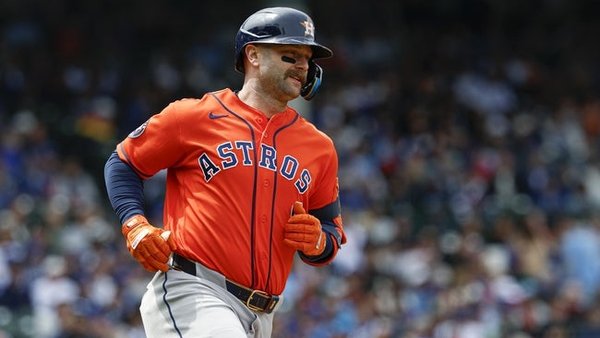
Teng’s 2.61 ERA and 1.097 WHIP stack up against Rea’s 4.98 ERA and -0.26 WAR — a nearly 2.4-run gap the Cubs’ -146 moneyline does not come close to reflecting. The number is built on Chicago’s home-field reputation, not on who is actually taking the mound today at Wrigley.
Kai-Wei Teng vs. Colin Rea: Houston Astros at Chicago Cubs Betting Preview
The market sees a Cubs team at home, playing inside a park where they’d won 15 straight before this week, and instinctively prices them as a meaningful favorite. That instinct isn’t wrong in a vacuum — home field, a top-ten NL Central club, and a Chicago offense that’s walked 233 times on the season are all legitimate weights on the scale. But the market is balancing all of that against a starter who is actively costing his team wins by advanced metrics, and pricing Houston’s ace as the inferior arm. That’s where the number breaks down.
Friday night’s result — Astros 4, Cubs 2 — sets the table for today’s matchup, which presents a different construction but the same underlying edge: Teng at the top of the lineup card against a Cubs club that has collapsed to 2-8 in their last ten and gone 0-for-9 with runners in scoring position in a single game. The Cubs’ freefall is real, the pitching gap is real, and +124 on the side with both is a number worth playing.
The core thesis is simple: Kai-Wei Teng (2.61 ERA, 1.097 WHIP) is a demonstrably better pitcher than Colin Rea (4.98 ERA, 1.426 WHIP), and in a game projected this close, you should be getting plus money on the team with the better arm — not laying it.
Game Info & Betting Lines
- Date/Time: Saturday, May 23, 2026 | 2:20 PM ET
- Venue: Wrigley Field | Park Factor 1.02 (marginally hitter-friendly)
- Probable Starters: Kai-Wei Teng (HOU, 2-3, 2.61 ERA) vs. Colin Rea (CHC, 4-2, 4.98 ERA)
- Moneyline: Houston Astros +124 / Chicago Cubs -146
- Run Line: Chicago Cubs -1.5 (+150) / Houston Astros +1.5 (-182)
- Total: 7.5 (Over -104 / Under -118)
Why This Number Is Off
Chicago at -146 is defensible on the surface. The Cubs are at Wrigley, they own a legitimate home-field edge historically, their offense has more walks (233 vs. Houston’s 175) and a higher OBP (.337 vs. .321). The market is looking at a Cubs team that, two weeks ago, had the best home record in the NL and pricing in a rebound. That’s not irrational.
But here’s the problem: the price doesn’t reflect who’s pitching. When two starters are separated by nearly 2.4 ERA points — and the advanced metrics confirm the gap rather than explain it away — the team with the better arm shouldn’t be a plus-money underdog. Teng’s WAR sits at +0.85. Rea’s is -0.26. By wins-above-replacement, Rea is actively subtracting value from Chicago’s chances of winning today’s game. The market is pricing Cubs home-field bias while largely discounting a pitching matchup that sharply favors Houston.
The Cubs’ 2-8 L10 isn’t noise either — this is a team that lost to Milwaukee by five runs while committing three errors two days before blowing a bases-loaded, two-out opportunity in the eighth inning Friday night. The number at -146 is built on what Chicago was, not what they are right now.
What Separates the Pitching
The gap between these two starters shows up everywhere you look, and the Statcast profiles make it concrete. Teng leads with his sweeper — thrown 35.7% of the time at 84.6 mph, generating a 34.3% whiff rate and holding hitters to a .263 xwOBA. His curveball (10.5% usage) is even nastier: 38.1% whiff rate and a .228 xwOBA against, with a 36.8% put-away rate that makes it a genuine out pitch in two-strike counts. His four-seam fastball sits 94.2 mph and draws a 16.4% whiff rate — not elite, but it sets up the breaking ball arsenal effectively. Across 31 innings, he’s surrendered only 3 home runs. The profile is a pitcher who creates weak contact and avoids the big inning.
Rea’s picture is nearly the inverse. His primary weapon is a 40.1% four-seam fastball at 93.8 mph — but it only generates a 12.2% whiff rate and surrenders a .379 xwOBA. His sinker, deployed 9.4% of the time, posts a .526 xwOBA against, and his cutter sits at an alarming .528 xwOBA. He does have a functional split-finger (29.5% whiff, .283 xwOBA) and a slider (.235 xwOBA), but they come behind a primary fastball hitters are squaring up at a concerning rate. The 6 home runs allowed in just 47 IP is the result of a pitch mix where the most-used offering is getting hit hard.
That matters directly for the betting outcome. Yordan Alvarez — sitting at a .554 xwOBA with a 9.3% barrel rate — is the most dangerous hitter in this game against a pitcher who is already giving up fastballs at a .379 clip. Rea’s four-seamer against Alvarez is a mismatch the box score hasn’t punished yet, but one that creates real run-scoring upside for Houston. Meanwhile, Ian Happ’s .455 xwOBA and .493 clip against right-handers represents Chicago’s best threat against Teng, but Teng’s sweeper-curveball combination plays directly into that matchup — Happ’s 31.0% strikeout rate tells you he expands the zone, and Teng’s .228 xwOBA curveball exploits exactly that tendency.
The Pushback
I’m not going to pretend there’s no case for Chicago. Rea is 4-2 on the season — wins and losses are real outcomes, and a pitcher with a 4.98 ERA who keeps getting decisions in the right column is telling you something about run support and sequencing that ERA doesn’t capture. The Cubs offense, even in a 2-8 slide, features legitimate hitters: Seiya Suzuki at .802 OPS, Michael Conforto at 1.009 OPS, and a lineup built on getting on base. These aren’t empty-average threats.
The Houston injury situation also deserves honest treatment. Carlos Correa is on the IL with an ankle issue, which removes a .279/.787 hitter from the lineup. Per the projected lineup, Braden Shewmake starts at SS in his place — and Shewmake has actually been productive in limited time (.286/.780 in 56 ABs), so the drop-off isn’t catastrophic, but it’s real depth lost in a lineup already missing Jose Altuve (oblique) and Yainer Diaz (oblique). Teng himself is 2-3 despite the ERA — he’s not getting run support, and the Houston bullpen has posted a team ERA of 5.28, which means any lead needs to be large enough to survive the back end. These are legitimate drags on the Houston win probability.
The mean reversion argument for Chicago is also real. Teams don’t go 2-8 forever, and Wrigley Field has genuinely been a fortress for this roster. The market knows all of this, which is part of why -146 exists. The question isn’t whether Chicago can win — they absolutely can — it’s whether -146 fairly prices that probability given who’s taking the mound.
Houston’s Offensive Case
Houston’s lineup isn’t deep, but it’s dangerous at the top. Yordan Alvarez hitting third with a .554 xwOBA and a 9.3% barrel rate is the kind of threat that can single-handedly flip a game against a pitcher whose primary offering is being squared up at a .379 xwOBA clip. Christian Walker (.808 OPS, 11 HR) follows at cleanup, and Jeremy Peña has shown real competence against right-handed pitching (.337 xwOBA vs. RHP). It’s worth noting that Braden Shewmake (.286/.780) steps in for the injured Correa at shortstop in the projected lineup — not a like-for-like replacement, but Shewmake has held his own in limited action and the lineup doesn’t collapse without Correa the way it might without Altuve or Alvarez.
The contextual edge here is Rea’s pitch mix versus Houston’s contact quality. His four-seamer is the pitch, and Alvarez is the matchup — a .554 xwOBA hitter versus a fastball-first pitcher surrendering a .379 xwOBA on that offering. Christian Vazquez’s fourth-inning homer Friday was a reminder that even the bottom of this Houston order can punish a pitcher who leaves balls over the plate. Houston doesn’t need a big inning to win this game; they need two or three well-timed hits against a starter who gives up hard contact at a high rate.
Run Environment & Game Shape
Wrigley Field carries a park factor of 1.02 — marginally hitter-friendly, but not a stadium that dramatically reshapes outcomes on its own. The total is set at 7.5, and the implied run environment is a moderate-scoring game. That framing actually benefits the team with the better starting pitcher in a meaningful way: Teng’s ability to suppress hard contact and avoid the big inning means Houston’s path to a win runs through keeping the game tight in the early frames and letting the lineup work against a starter who profiles as hittable.
The key variable is Teng’s ability to limit damage through five or six innings, keeping Houston within striking distance long enough for the offense to capitalize on Rea’s fastball vulnerabilities. If Teng posts a quality start — or close to it — Chicago’s offense has to produce against a bullpen that, while inconsistent, has been leaned on heavily this week. The Cubs’ 0-for-9 RISP performance Friday and three-error effort against Milwaukee aren’t isolated events; they’re symptoms of a team that has lost its competitive edge in the short term. Wrigley’s crowd will be loud, but it hasn’t been enough to stop a 2-8 skid, and it won’t change the fact that Rea is the wrong pitcher to be backing at -146.
The bottom line: Teng holds a clear and measurable edge over Rea by every advanced metric that matters, the Cubs are in genuine freefall at 2-8 over their last ten, and Houston is available at plus money in a game the overall numbers peg as nearly a coin flip. That combination — pitching edge, opponent collapse, and plus-money price — is exactly the kind of spot worth pressing at 2 units. Take the Houston Astros moneyline at +124.
Bet: Houston Astros Moneyline +124 — 2 Units — Moderate Confidence