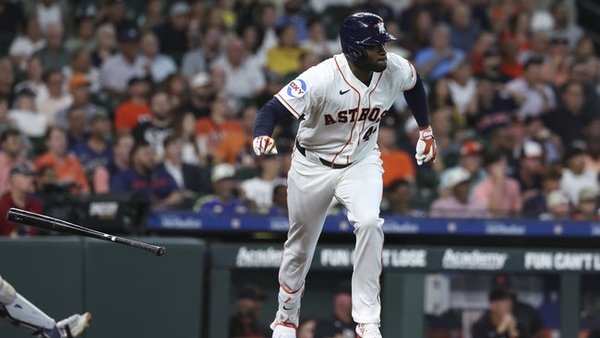
Framber Valdez brings nearly 30 more innings pitched than Kai-Wei Teng into a matchup where both offenses sit below the league average in OPS. The under is juiced to -112 on an 8.5 total that only barely clears the projected run environment — a number that hasn’t fully accounted for the gap between a proven innings-eater and a rotation spot with a pitch-count ceiling and a leaking changeup.
Kai-Wei Teng vs Framber Valdez: Houston Astros at Detroit Tigers Betting Preview
After yesterday’s Astros loss — a brutal 8-0 shutout that had more to do with Spencer Arrighetti getting shelled in three innings than Detroit’s offense suddenly finding another gear — the series resets with a significantly different pitching profile. Framber Valdez is the story today, and he’s a fundamentally different proposition than what Houston sent to the mound Friday night.
The core argument here isn’t complicated: two below-average offenses, a neutral park, and a total set at 8.5 that the numbers project to land at 8.9 combined runs. That’s barely clearing the number — not an argument for the over, and enough signal to lean toward suppression at a price that’s still workable.
Neither lineup inspires confidence. Houston’s OPS sits at .726 on the season and Detroit checks in at .704 — both below-average units that generate runs in singles and walks more than they blow games open. The exception, and it’s a significant one, is Yordan Alvarez. We’ll get to him.
Game Info & Betting Lines
- Date/Time: Saturday, June 27, 2026 | 1:10 PM ET
- Venue: Comerica Park | Park Factor: 0.99 (essentially neutral)
- Probable Starters: Kai-Wei Teng (HOU) vs Framber Valdez (DET)
- Moneyline: Houston Astros +114 / Detroit Tigers -134
- Run Line: Detroit Tigers -1.5 (+155) / Houston Astros +1.5 (-188)
- Total: 8.5 (Over -108 / Under -112)
Why This Number Is Close
The market is doing its job here. The 8.5 total reflects a genuine balancing act: Framber Valdez is a proven innings-eater against an Astros offense that’s been ice cold, but Teng’s bullpen exposure is a real variable, and Houston has gone 7-3 in their last 10 games. The market has already priced in some suppression — the -112 juice on the under tells you the book slightly leans toward a lower-scoring game but isn’t confident enough to shade it harder.
The legitimate case for the over runs through Teng’s pitch count ceiling and Houston’s bullpen ERA of 4.72. If Teng exits after five innings — which his 60.1 innings pitched this season suggests is plausible — Houston arms are in the game against a Tigers lineup with real contact threats in Dillon Dingler (.268 AVG, 19 HR, .879 OPS) and Riley Greene (.292 AVG, .826 OPS). That’s where the over lives.
The under lives in Valdez logging six-plus innings against an Astros lineup missing its best hitters — Carlos Correa is on the 60-Day IL, and the projected order lacks any consistent middle-of-the-order threat outside of Christian Walker. The numbers project 8.9 combined runs barely clearing the 8.5 line — that’s not an over signal, it’s a whisker, and whiskers belong to the under at this price.
What Separates the Pitching
Framber Valdez is operating at a 3.91 ERA over 89.2 innings pitched — nearly 30 more frames than Teng has thrown this season. That durability matters today because it means Valdez can realistically work into the seventh inning and limit Houston’s exposure to the Detroit bullpen. His arsenal is built around a sinker that he throws 45.6% of the time at 93.9 mph — it generates weak contact but doesn’t miss bats (10.8% whiff). The real weapon is his curveball, deployed nearly 28% of the time at 78.6 mph, generating a 31.0% whiff rate and a suppressive 0.271 xwOBA against. When Valdez is getting his curve over, he’s limiting damage in ways the ERA doesn’t fully capture.
Against the Astros’ projected lineup, the matchup signals are muted. Christian Walker carries a .348 xwOBA overall but checks in at .315 against left-handed pitching — manageable for Valdez. Brice Matthews posts a .370 xwOBA overall with a 5.4% barrel rate, but his .410 xwOBA against lefties is largely a product of elevated strikeout risk (32.5% K rate, 35.3% whiff) — exactly the profile Valdez’s curveball exploits. Jeremy Peña is the most dangerous bat in this projected order against a southpaw, carrying a .512 xwOBA vs. LHP, but his overall xwOBA sits at .380 and his 2.3% barrel rate limits the ceiling. Valdez’s sinker-heavy approach keeps extra bases suppressed across the board.
Kai-Wei Teng is the more swing-and-miss profile — 9.25 K/9 compared to Valdez’s 7.53 — and his sweeper (34.0% usage, 31.4% whiff) and curveball (10.2% usage, 42.1% whiff, .218 xwOBA) give him genuine put-away ability. The concern is that his changeup, thrown 10.2% of the time, is generating a .453 xwOBA-against — a real vulnerability if Detroit’s lefty-heavy middle of the order identifies it early. Dingler’s Statcast line is a flag: .476 xwOBA overall, 29.5% hard-hit rate, and a .504 xwOBA against right-handed pitching. Teng is right-handed. That’s the matchup the over bettors are circling.
The gap between these arms favors Valdez — more innings, more proven suppression, more command of his secondary stuff. Teng can keep it close, but he can’t match Valdez’s floor.
The Pushback
The strongest argument against the under starts with one name: Yordan Alvarez. He’s hitting .318 with a 1.055 OPS and 25 home runs — that’s not a lineup concern, that’s a game-altering bat who can single-handedly invalidate a pitching narrative in one swing. Alvarez against Valdez’s sinker-heavy approach is a genuine mismatch. Valdez’s sinker generates weak contact in aggregate, but Alvarez doesn’t give you aggregate results — he gives you outlier events. One swing changes the run environment entirely, and if Alvarez is in the lineup today, that risk is real and it has to be priced into your confidence level.
Beyond Alvarez, Houston’s 7-3 stretch over their last 10 games isn’t noise — it’s a team playing well enough to beat a number. And Teng’s strikeout profile (9.25 K/9) gives him a legitimate path to limiting the damage even if his pitch count shortens his outing.
I’m not dismissing these concerns. They’re why this is a moderate-confidence play, not a strong one. But neither of them overturns the core thesis: Valdez is a more reliable innings-eater than the market seems to reflect, the Astros’ projected lineup without Correa is thin in the middle, and 8.5 is a number that requires genuine offensive execution from both sides to clear.
The Under Thesis, Summarized
Valdez’s durability is the anchor. If he works six-plus innings — which his 89.2 IP and 3.91 ERA suggest is a realistic floor — he limits Houston’s exposure to Detroit’s bullpen and controls the scoring ceiling on his side of the ledger. Teng’s swing-and-miss arsenal can keep the Tigers in check through four or five innings, especially against a lineup where Ben Malgeri (.499 xwOBA, 44.4% K rate) and Hao-Yu Lee (29.6% whiff) are swing-and-miss candidates. The park factor of 0.99 is essentially neutral — Comerica isn’t adding runs to this equation.
The run environment that amplifies the under thesis is one where Valdez works six-plus innings, limits Detroit’s exposure to Houston’s volatile bullpen, and keeps the game in a range where one Yordan Alvarez moment might decide it rather than a scoring avalanche that overwhelms the total from both directions. That scenario — a tight, low-scoring game decided late — is where this number lives, and it’s the most likely outcome given what these two pitching staffs have shown all season.
The Pick
Under 8.5 (-112) | 2 Units | Moderate Confidence
Valdez’s durability edge over Teng is real, both offenses are structurally limited, and 8.9 projected combined runs barely grazes the total. The under at -112 is the play — state it plainly and bet it accordingly.
Bet: Under 8.5 at -112 | 2 Units