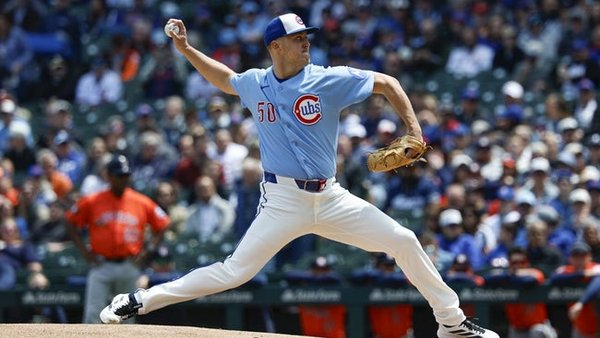
Gage Jump carries five major league innings into Wrigley Field against a Cubs lineup with multiple hitters projecting well against right-handed pitching — yet Jameson Taillon’s 2.83 HR/9 rate keeps the Athletics’ power core relevant at +102. Both rotations are broken; the question is whether the 53-run differential gap between these rosters is enough to settle a messy coin flip.
Gage Jump vs. Jameson Taillon: Athletics at Chicago Cubs Betting Preview
The Cubs are not a team you want to back blindly right now. Jameson Taillon has been one of the more punishable starting pitchers in the National League — a homer machine on a bad trend with a 5.37 ERA and 19 home runs allowed in just 60.1 innings. That’s a legitimate liability at Wrigley. The -120 price accounts for some of that, but it doesn’t fully explain the lean.
The real argument for Chicago is structural. The Cubs enter this game at 32-28 with a +19 run differential. The Athletics come in at 28-31 with a -34 run differential. That’s a 53-run gap between these clubs — not noise, but a systemic quality separation that shows up in the pitching staff numbers too: Cubs ERA of 4.19 and WHIP of 1.239 against the A’s 4.48 ERA and 1.426 WHIP. Oakland is also sending Gage Jump to the mound — a rookie with 5 innings of major league experience and a 7.20 ERA — into a road game at Wrigley.
This isn’t a strong-side bet. Both clubs are 3-7 in their last ten games, both offenses have run cold recently, and both bullpens are depleted. The thesis is simple: the Cubs are the less broken team at a price that doesn’t require them to be great.
Game Info & Betting Lines
- Date/Time: Tuesday, June 2, 2026 — 8:05 PM ET
- Venue: Wrigley Field | Park Factor: 1.02 (essentially neutral)
- TV: MLB.TV, Marquee Sports Net, NBC Sports CA
- Probable Starters: Gage Jump (Athletics, 0-1, 7.20 ERA) vs. Jameson Taillon (Cubs, 2-4, 5.37 ERA)
- Moneyline: Athletics +102 / Chicago Cubs -120
- Run Line: Chicago Cubs -1.5 (+160) / Athletics +1.5 (-194)
- Total: 7.5 (Over -114 / Under -106)
Why This Number Is Close
The market is doing real work at Cubs -120. The case for the A’s side isn’t imaginary: they’re a +102 underdog at home price for a road game, their power core is legitimate, and they’re facing a pitcher who has been giving up fly balls at an alarming rate all season. When you can get the Athletics near even money, the value optics are there.
But here’s the problem — the market is also pricing in Gage Jump, a pitcher with five major league innings on his ledger. That sample is essentially meaningless as a predictive tool, but the underlying profile matters. Jump’s four-seam fastball sits at 91.3 mph and generates only an 11.0% whiff rate — below-average velocity with below-average swing-and-miss numbers. His slider produces a better 23.7% whiff rate, and his changeup is genuinely interesting at 39.3% whiff, but a 22.3% changeup usage against a major league lineup is a thin foundation.
The line is set close because the starters are symmetrically flawed. Where I think the market is slightly wrong is in weighting roster depth. The A’s are missing two shortstops — Max Muncy and Jacob Wilson both on the IL — plus a depleted rotation (Severino, Civale out with shoulder injuries) that forced Jump onto the mound in the first place. Chicago’s injury list is longer in raw numbers but less damaging to their competitive core for this specific game. At -120, the Cubs represent the cleaner side of a messy coin flip.
What Separates the Pitching
There’s no ace here — but there is a real gap in experience and track record, and it matters.
Jameson Taillon has genuine problems. His four-seam fastball at 93.8 mph generates a 15.0% whiff rate but carries an alarming .378 xwOBA against — hitters are squaring it up. His cutter is the most troubling pitch in his arsenal: 6.9% usage with a .528 xwOBA against and only an 11.1% put-away rate. His curveball isn’t much better at .575 xwOBA. The bright spots are his split-finger (.283 xwOBA, 28.2% whiff) and slider (.261 xwOBA, 31.2% whiff), which give him legitimate weapons when he locates them. The HR rate — 19 allowed in 60.1 innings (2.83 HR/9) — is the defining flaw. Taillon is a contact-management arm who has lost the ability to manage contact.
Against that, Gage Jump offers 91.3 mph heat, a changeup with good whiff numbers, and no meaningful track record against this lineup. The specific Cubs hitters who genuinely project well against right-handed pitching are Ian Happ, Pete Crow-Armstrong, and Seiya Suzuki. Happ carries a .489 xwOBA vs. RHP and is 3-for-4 in limited BvP exposure against Jump (.750 average in 4 PA). Crow-Armstrong posts a .435 xwOBA against righties. Suzuki brings a perfect 1.000 average with a homer in 2 PA against Jump. Jump’s sweeper is the wild card — a .450 xwOBA against with only 10.8% whiff — meaning it’s generating weak contact but not misses, which inverts the usefulness of the pitch.
The A’s counter with real offensive threats. Nick Kurtz carries a .570 xwOBA vs. RHP and a 9.2% barrel rate — he’s the most dangerous bat in this lineup against Taillon. Brent Rooker shows a .600 average with a homer in 5 plate appearances against Taillon in limited BvP exposure, and his .405 xwOBA vs. RHP with a 9.9% barrel rate makes him a genuine threat. These are real concerns for a pitcher giving up home runs at nearly a 3-per-9 clip.
Pushback: The A’s Have Teeth
I’m not going to paper over the risk here. Oakland’s lineup isn’t a pushover. Carlos Cortes (.933 OPS, .391 xwOBA vs. RHP) is having a legitimate breakout season. Kurtz has 10 home runs and a .939 OPS. Shea Langeliers is hitting .293 with 14 homers, and the whole top of this order has the power profile to punish Taillon’s fly-ball tendencies in one swing.
The recent schedule tells two stories. Oakland got blown up 13-8 by the Yankees but also won a game during that same series, taking the middle contest 6-4 behind Langeliers and Kurtz homers. They’re not a team that just rolls over. The issue is that their rotation has cratered — Severino is now on the IL, Civale is already there, and they’re turning to a rookie in Jump who has 5 innings of big-league experience to his name. That’s a structural disadvantage that doesn’t disappear because the offense is capable.
Chicago’s recent form is similarly uneven. They took a 5-1 loss to end the Cardinals series but won the middle game 6-1 behind Pete Crow-Armstrong’s four-hit performance. The Cubs are 3-2 since a 10-game skid — not a team firing on all cylinders, but a team stabilizing. At Wrigley, against a raw rookie arm, that’s enough to lean on.
The Play
The numbers project Chicago to win this game at roughly a 67% clip against a 45% implied probability at -120 — that’s a meaningful gap. The Cubs’ run differential advantage (+19 vs. -34), their superior pitching staff ERA, and the fundamental mismatch of sending a five-inning rookie into a road start at Wrigley all point the same direction. This isn’t a pound-the-table spot. Both teams are cold, both starters are flawed, and Taillon’s home run problem is real. But at -120, you’re getting the cleaner side of an uneven matchup.
Bet: Chicago Cubs -120 moneyline — 1 unit (lean).