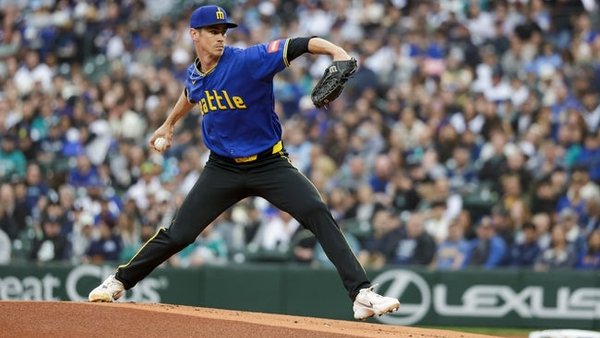
Hancock’s 9.51 K/9 rate versus Ginn’s 6.06 mark creates a strikeout gap — the -163 price treats this pitching matchup like it’s much closer than the swing-and-miss data suggests.
J.T. Ginn vs Emerson Hancock: Athletics at Seattle Mariners Betting Preview
Opening Day noise tends to obscure what really drives baseball outcomes, and this Monday night matchup in Seattle is a perfect example. The market has set the Mariners as moderate favorites at -163, which on the surface feels about right given home field and recent form. But when you dig into the starting pitching gap between Emerson Hancock and J.T. Ginn, the numbers reveal a more significant edge than the line suggests.
Both teams arrive with identical 6-4 records over their last 10 games, but they’re getting there in completely different ways. Seattle’s strength lies in their pitching depth – a 3.22 team ERA that’s nearly two full runs better than Oakland’s 4.82 mark. That gap becomes even more pronounced when you consider the dome environment at T-Mobile Park, where run scoring typically gets suppressed even further.
Game Info & Betting Lines
- Date/Time: Monday, April 20, 2026 | 9:40 PM ET
- Venue: T-Mobile Park (Park Factor: 0.92)
- Probable Starters: J.T. Ginn (3.31 ERA) vs Emerson Hancock (2.28 ERA)
- Moneyline: Athletics +135 / Seattle Mariners -163
- Run Line: Seattle -1.5 (+129) / Athletics +1.5 (-156)
- Total: 8 (Over -115 / Under -105)
Why This Number Is Close But Not Quite Right
The market is balancing several legitimate factors here. Seattle’s home record hasn’t been dominant this season, sitting at 10-13 overall despite that strong pitching staff. Oakland actually has the slightly better offense on paper – a .672 OPS compared to Seattle’s .667 – so there’s a reasonable case that the Athletics can scratch out enough runs to keep this competitive.
The line also factors in that both teams have been scoring at nearly identical rates recently, with neither offense particularly inspiring confidence. When you have two underwhelming lineups facing quality pitching, games tend to stay tight regardless of the favorite.
But here’s where I think the market is missing the mark: that pitching gap is more significant than a 35-cent line difference suggests. Hancock’s 9.51 K/9 rate compared to Ginn’s 6.06 K/9 represents a massive difference in swing-and-miss ability. In a projected low-scoring environment, strikeout dominance becomes exponentially more valuable because it eliminates the defensive variables that can derail even good pitchers.
What Separates the Pitching
This matchup comes down to command and swing-and-miss stuff, and Hancock holds decisive advantages in both areas. His 0.76 WHIP through 23.2 innings tells the story of a pitcher who’s locating precisely, while Ginn’s 0.98 WHIP suggests more traffic on the bases despite decent results.
The Statcast data reveals even sharper contrasts. Hancock’s four-seam fastball sits at 95.0 mph with a 25.8% whiff rate, compared to Ginn’s 90.4 mph heater that generates just 16.2% whiffs. That velocity gap matters significantly against major league hitters, but the swing-and-miss differential is what really drives outcomes.
Ginn relies heavily on his slider (24.3% usage) and cutter (20.0% usage) to get outs, but his cutter has been problematic with a .400 xwOBA against – essentially batting practice when he misses his spots. Hancock’s slider generates a much safer .310 xwOBA while producing similar whiff rates, giving him a more reliable secondary option.
The concern with Hancock is that he’s been slightly homer-prone (2 HR in 23.2 IP), which matters in a park like T-Mobile that can still reward well-struck balls despite its pitcher-friendly reputation. But Ginn has allowed the same number of homers in fewer innings, and his lower strikeout rate means more balls in play against a Seattle defense that’s been solid this season.
The Pushback
The strongest case against backing Seattle at this price centers on their offensive limitations. This Mariners lineup has been shut out four times already this season – as many times as they were blanked all of 2025. Luke Raley and Randy Arozarena have carried the load, but there’s legitimate concern about depth behind those two.
Oakland’s lineup, while not spectacular, has shown more consistent production throughout the order. Shea Langeliers has been their best hitter with a .948 OPS, and they’ve gotten solid contributions from unexpected sources like Max Muncy at designated hitter. If Ginn can limit the damage early and keep the game close, that Athletics offense might be better equipped to capitalize on late-inning opportunities.
The other worry is Seattle’s recent home struggles. Despite that strong pitching staff, they’re sitting below .500 at T-Mobile Park, which suggests they haven’t been maximizing their advantages in this environment. When you’re laying -163 on a team that’s struggled to win at home, you need to be confident they can execute in tight spots.
Run Environment & Game Shape
The total sits at 8 runs, and both the park factor (0.92) and pitching matchup support that conservative number. T-Mobile Park’s enclosed design typically suppresses offense, and dome conditions eliminate weather variables that might favor hitters on a given night.
This projects as a game where the first team to score 3-4 runs could control the outcome. Both bullpens have been solid relative to their respective team ERAs, with Seattle holding a significant advantage in overall relief depth. That becomes crucial in a tight game where one mistake pitch could decide the outcome.
The likely scoring range sits between 6-9 total runs, with most scenarios favoring the under. That low-scoring environment amplifies the value of superior starting pitching, which is where Hancock’s strikeout dominance becomes most pronounced.
Joe Jensen’s Pick
JENSEN’S PICK: Seattle Mariners Moneyline — 0 Units
I looked at the run line here, but this projects too close for multi-run separation. Both offenses are similarly limited (.667 vs .672 OPS), and the projected 4-3 score suggests we’re more likely looking at a one-run game than a comfortable Mariners victory.
The moneyline makes sense from a pure handicapping standpoint – Hancock’s strikeout advantage and Seattle’s bullpen depth should be enough to win this game more than 61.9% of the time. But at -163, there’s not enough value for a standalone play. This is better suited as a parlay leg or a small beer money wager rather than a confident unit investment. The edge is there, but the price requires near-certainty that I can’t quite muster in what should be a tight, low-scoring affair.