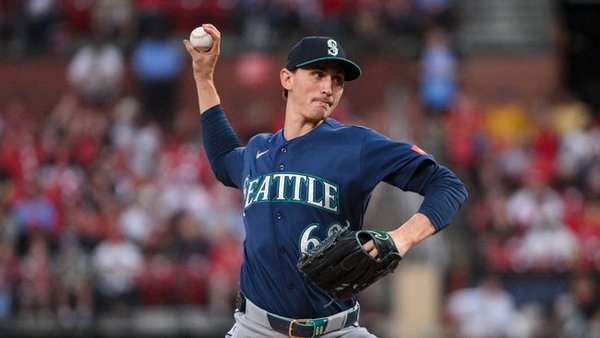
T-Mobile Park’s 0.92 park factor structurally suppresses run scoring — and that baseline pressure meets a George Kirby start featuring 31 walks in 148.1 innings against a depleted Oakland roster missing five hitters on the IL. The total sits at 8.0, but the in-series noise from back-to-back 7-run games is masking a starter-versus-lineup mismatch the number hasn’t fully absorbed.
Jeffrey Springs vs George Kirby: Athletics at Seattle Mariners Betting Preview
The Athletics just won 7-6 and 7-4 in the first two games of this series, and the scoreboard says offense is flowing freely at T-Mobile Park right now. That’s the market noise. The pitching matchup for Saturday night tells a different story — and a more reliable one. George Kirby takes the mound for Seattle with a command profile that genuinely limits base traffic and big innings. His counterpart, Jeffrey Springs, owns a 5.15 ERA on the season and is one command lapse away from a crooked number. T-Mobile Park’s park factor of 0.92 suppresses run scoring relative to league average. The total sits at 8.0, with the Under priced at -115. That’s the number worth attacking.
The core thesis here isn’t about who wins — Seattle at -257 prices in a dominant win probability, and the numbers agree at 77.1%. The thesis is about run environment. Kirby’s elite control sets a ceiling on Oakland’s offense. The Athletics are missing Nick Kurtz, Brent Rooker, Tyler Soderstrom, Jacob Wilson, and Shea Langeliers — all on the IL. What’s left is a patchwork lineup posting a .727 OPS, and that number gets worse when they’re facing a pitcher who doesn’t walk anyone. The Under 8.0 at -115 is the cleanest expression of this pitching gap.
Game Info & Betting Lines
- Date/Time: Saturday, September 5, 2026 | 9:40 PM ET
- Venue: T-Mobile Park (Park Factor: 0.92 — pitcher-friendly, domed)
- TV: MLB.TV, NBC Sports CA, Mariners.TV
- Probable Starters: Jeffrey Springs (Athletics) vs George Kirby (Mariners)
- Moneyline: Athletics +207 | Seattle Mariners -257
- Run Line: Seattle Mariners -1.5 (-126) / Athletics +1.5 (+104)
- Total: 8.0 (Over -105 / Under -115)
Why This Number Is Close
The market has this total at 8.0, and the pricing is honest about the tension. The legitimate case for the Over is sitting right in the recent results: Oakland scored 7 runs in each of the last two games at this exact ballpark, and they did it against Logan Gilbert — a quality arm — and a Mariners rotation that had rookie starters involved. The A’s offense, even gutted by injuries, has shown it can generate crooked numbers when Springs is on the mound for the other side.
But here’s where the market is slightly wrong: it’s weighting recent in-series scoring while underweighting the specific starter-vs-lineup mismatch tonight. Kirby’s command completely changes the offensive calculus for Oakland. The A’s don’t have the lineup depth to grind through a pitcher who averages fewer than 2 walks per 9 innings. Their best remaining hitters — Zack Gelof (xwOBA .373) and Henry Bolte (xwOBA .382) — carry legitimate contact grades, but Kirby’s sweeper is generating a 34.2% whiff rate and holding hitters to a .211 xwOBA. That pitch alone neutralizes the A’s contact-based attack.
The combined run projection sits at 8.4 — just over the number — and those projections tend to run optimistic on offense. At -115 juice, the Under offers reasonable value in a park that structurally suppresses run scoring.
What Separates the Pitching
The gap between these two arms is significant, and it shows up most clearly in the walk column. George Kirby has issued just 31 walks in 148.1 innings this season — a rate so low it functionally eliminates one of the primary ways opposing lineups manufacture runs. His 4-seam fastball sits at 96.0 mph and generates a 21.9% whiff rate, but the real weapon is his sweeper at 84.4 mph with a 34.2% whiff rate and a .211 xwOBA against. His changeup is even more devastating as a put-away offering, holding hitters to a .190 xwOBA. Against a depleted Oakland lineup that doesn’t have the plate discipline to work counts — their top healthy hitters like Gelof (24.7% strikeout rate) and Bolte (27.1%) will expand the zone — Kirby can work quickly and efficiently.
Lawrence Butler’s BvP line is particularly telling: in 23 plate appearances against Kirby, he’s hitting .095 with 6 strikeouts. Kirby simply owns him. The cleanup spot in Oakland’s lineup — which should be a run-production anchor — is functionally neutralized by this matchup history.
Jeffrey Springs is a different story entirely. His 4-seam sits at 96.2 mph with a 20.0% whiff rate, which is serviceable, but his sinker is generating a .508 xwOBA against — an alarming number that means hard contact when it’s put in play. His season ERA of 5.15 reflects genuine run-allowing risk, not bad luck. The Mariners don’t have a power-heavy lineup — Dominic Canzone (xwOBA .424, 7.1% barrel rate) and Julio Rodríguez (xwOBA .408) are the primary threats — but Springs gives up enough hard contact that Seattle should be able to score in the 3-5 run range without needing a blowup inning. The pitching gap isn’t zero, but it’s asymmetric: Kirby creates weak-contact, low-traffic innings; Springs creates hittable counts and base-traffic accumulation.
The Pushback Case (and Why It Doesn’t Change the Bet)
The honest pushback: Oakland just put up 14 runs in two games at this park. The bats are alive. And Springs, despite a bloated ERA, isn’t getting shelled every outing — his 9.62 K/9 shows he can miss bats when his stuff is working. If Springs keeps the sinker off the plate and leans on his curveball (.249 xwOBA against) and changeup (.302 xwOBA against), Seattle’s lineup — which posts a team .687 OPS and sits 11th in the AL in runs scored — isn’t guaranteed to score four or five runs either.
The lineup batting tonight features Jonah Heim, Denzel Clarke, and Alika Williams — hitters with sub-.800 OPS that don’t punish mistakes with power the way the middle of a healthy lineup does. Heim is the projected catcher per the lineup data; Clarke carries a 33.7% strikeout rate; Williams posts a .295 xwOBA that reflects genuine contact limitations against quality right-handed pitching. None of them scare you in a must-score situation.
But here’s the thing — Springs doesn’t need to be great for the Under to hit. He just needs to be average. If Seattle scores three and Oakland scores three, we’re at six. Kirby is good enough to hold a depleted lineup to two or three runs on most nights, and the park suppresses the outlier outcomes. The Over requires Springs to implode and Kirby to have an unusually bad night simultaneously. That’s a low-probability parlay of events.
Run Environment & Game Shape
T-Mobile Park is a dome with a 0.92 park factor — that’s a structural run suppressor that doesn’t care about momentum or in-series scoring trends. The combined team strikeout totals (Oakland 1,218, Seattle 1,237 on the season) suggest both offenses are swing-and-miss heavy, which plays directly into a pitcher-controlled game shape. Kirby’s 149 strikeouts in 148.1 innings confirm he’s generating those outcomes himself, not just benefiting from weak contact.
The game shape favors pitcher-driven innings on the Seattle side. Kirby’s command profile — 31 walks in 148.1 innings, a sweeper generating 34.2% whiffs, and a changeup holding hitters to a .190 xwOBA — points toward a low-traffic, high-strikeout outing against a lineup already missing five key contributors to injury. Oakland may cobble together a couple of runs on contact, but grinding a four- or five-run inning against Kirby requires the kind of plate discipline and lineup depth this A’s roster simply doesn’t have right now. On the other side, Springs’ sinker (.508 xwOBA against) and overall 5.15 ERA create real run-scoring opportunities for Seattle, but the Mariners’ .687 team OPS limits the ceiling. Add it up — a 3-4 run Seattle half, a 2-3 run Oakland half — and you’re looking at a game that lands comfortably under eight without needing a dominant performance from either bullpen.
Bet: Under 8.0 (-115) — 2 units — Moderate confidence