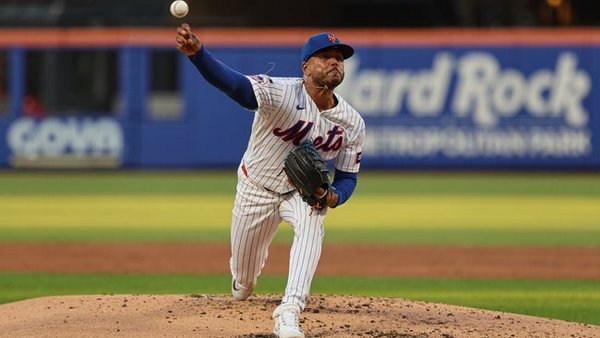
Freddy Peralta’s four-seamer is getting punished at a .325 xwOBA while Bryce Elder is quietly holding opponents to weak contact with a 1.05 WHIP — yet the market has the team with the better starter and best record in baseball priced as an underdog. The number at Braves +100 / Mets -118 is treating this like a coin flip that the pitching profiles simply don’t support.
Bryce Elder vs. Freddy Peralta: Atlanta Braves at New York Mets Betting Preview
The Braves arrive at Citi Field on Sunday sitting at 46-24 with a +114 run differential — the best record in baseball — and the market is asking you to lay juice to back the 31-39 New York Mets at home. Atlanta is priced at +100, a flat moneyline on a club that wins 66% of its games. That number deserves scrutiny.
The answer lives almost entirely in the starting pitching. Bryce Elder brings a 2.66 ERA and 1.05 WHIP across 84.2 innings — one of the quieter workhorses in the National League. Across the diamond, Freddy Peralta has posted a 4.04 ERA, 1.32 WHIP, and allowed 10 home runs in 78 innings. That’s a legitimate target for Atlanta’s lineup. The pitching gap is real, and the price doesn’t reflect it.
Atlanta covered yesterday in Game 2 of this series — a 3-1 win at Citi Field — and today’s matchup presents a different puzzle. The starter changes, the lineup shapes are slightly different, but the core structural edge points in the same direction.
Game Info & Betting Lines
- Date/Time: Sunday, June 14, 2026 | 1:40 PM ET
- Venue: Citi Field | Park Factor: 0.97 (slight pitcher’s lean)
- Probable Starters: Bryce Elder (ATL) vs. Freddy Peralta (NYM)
- Moneyline: Atlanta Braves +100 / New York Mets -118
- Run Line: Atlanta Braves -1.5 (+155) / New York Mets +1.5 (-188)
- Total: 8.5 (Over -118 / Under -104)
Why This Number Is Off
The Mets at -118 is a reasonable line on the surface. They have home-field advantage, Juan Soto is one of the most dangerous hitters in baseball, and the Braves are dealing with meaningful injuries — Ronald Acuña Jr. and Drake Baldwin are both on the IL, stripping two of Atlanta’s best bats from the lineup. The market is building in those absences, and that’s not irrational.
But here’s the problem: the market appears to be weighting home-field and recent series context more than the starting pitching gap. Citi Field carries a park factor of 0.97 — essentially neutral — so home-field isn’t amplified here. And while the Mets won Friday’s opener 7-5, that game saw Spencer Strider exit with elbow soreness and four Braves relievers absorb the damage. That was a unique game shape that doesn’t project forward.
The legitimate case for New York rests on Soto’s upside and a Braves lineup that is genuinely shorthanded. But Peralta’s 4.04 ERA and 10 home runs allowed in 78 innings tell you this isn’t a pitcher who suppresses damage reliably. Atlanta’s team OPS of .749 against New York’s .660 is an 89-point gap — substantial at any level of analysis. Getting plus-money on the superior club, in a neutral park, with the better starter on the mound is where the value sits.
What Separates the Pitching
Elder and Peralta represent two distinct pitcher profiles, and the gap between them is the clearest edge in this game. Elder works with a five-pitch mix that is deceptive rather than overpowering — his slider generates a 29.9% whiff rate with an xwOBA of .249, and his changeup is quietly his best weapon, sitting at a .146 xwOBA with a 30.0% whiff rate. He’s not going to pile up strikeouts at an elite rate — his 7.5 K/9 confirms that — but he generates weak contact consistently. The Mets’ top of the order will make contact against Elder; the question is whether it’s quality contact. His Statcast numbers say it usually isn’t.
Peralta is a different animal stylistically. He leans heavily on a 93.8 mph four-seamer at 53.4% usage, and that pitch is getting hit — .325 xwOBA against with only a 19.3% whiff rate. His slider, when he uses it (8.0% of the time), generates elite whiff at 48.8%, but he barely deploys it. His curveball at 34.4% whiff is legitimate, but the over-reliance on a fastball that plays more hittable than its velocity suggests creates real exposure against Atlanta’s lineup.
Matt Olson presents a specific matchup concern for Peralta. Olson carries an xwOBA of .456 overall and .478 against right-handers, and in 15 career plate appearances against Peralta, he’s hitting .273 with a home run. Austin Riley is the other focal point — .467 in 16 PA against Peralta with two home runs and only one strikeout. Elder’s Citi Field slate projects to look like a steady 5-6 innings of managed damage. Peralta’s projects to carry more volatility, especially in the middle of Atlanta’s order.
The Pushback
The injury situation deserves honest weight. Baldwin (.931 OPS, 13 HR) is on the IL with an oblique injury. Acuña (.793 OPS) is out with a hamstring issue. Sean Murphy, Atlanta’s primary catcher, has been on the 60-day IL all season. This is a lineup with three genuine contributors missing, and the Braves are running Sandy León at catcher and a patchwork outfield. That’s real, not cosmetic.
The concern is also Peralta’s strikeout upside. His 9.1 K/9 and the elite whiff numbers on his slider (48.8%) and curveball (34.4%) mean he’s capable of getting through Atlanta’s shorthanded lineup without significant damage. If he leans into those secondary offerings more than usual, the exposure on his four-seamer shrinks. That’s the version of Peralta you have to account for.
Rejected Angles
The run line at Atlanta -1.5 (+155) is tempting given the pitching gap, but I’m not chasing it with a lineup this thin. Baldwin and Acuña account for a significant chunk of Atlanta’s run-producing upside, and asking a shorthanded offense to win by two or more against a competent bullpen is a different ask than simply winning the game. The plus-money on the flat moneyline is the cleaner play.
On the total, the 8.5 sits right at the projected run environment. Elder’s profile — a 2.66 ERA, weak contact allowed, low walk rate — points toward a lower-scoring game from the Atlanta side. But Peralta’s 4.04 ERA and 10 HR allowed in 78 innings leave the door open for a crooked inning from the Braves. With the over juiced at -118 and no clear lean on either side, the total doesn’t offer actionable value. I’m staying away from both sides of 8.5.
Run Environment & Game Shape
Citi Field’s 0.97 park factor is a mild suppressor — nothing dramatic, but it nudges the expected run total slightly downward from a neutral context. Elder’s contact-management profile fits this environment well. His sinker (26.0% usage, 91.4 mph, .322 xwOBA) and slider (.249 xwOBA) are built to generate ground balls and weak fly balls rather than swing-and-miss sequences. Against a Mets lineup that ranks among the lower-OPS units in the NL at .660 as a team, that profile projects to hold.
The most likely game shape is a 3-1 or 4-2 outcome — close, low-scoring, decided by whether Atlanta’s middle-order bats can get to Peralta’s fastball before he pivots to his secondary mix. Olson’s .478 xwOBA versus right-handers and Riley’s .467 BvP mark against Peralta specifically are the two matchups most likely to decide this game. If either goes deep, Atlanta covers the moneyline cleanly.
The Pick
+100 on the best team in baseball, in a neutral park, with the better starter on the mound. The injury stack is real and worth respecting at 2 units rather than 3, but the structural edge here — pitching gap, offensive quality gap, pricing inefficiency — is clear enough to act on. I’ll take the Braves.
Bet: Atlanta Braves Moneyline +100 — 2 Units