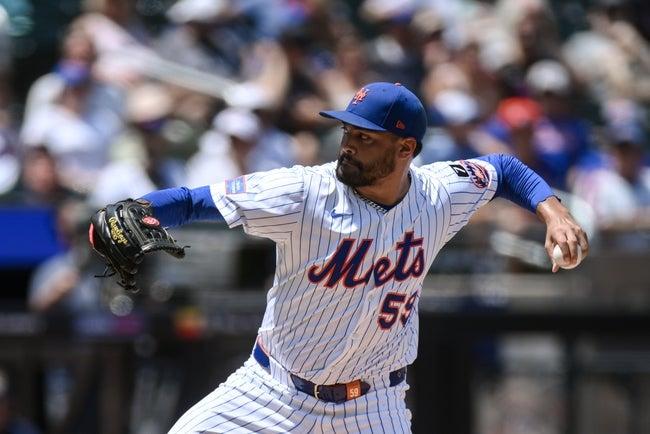
Atlanta’s +96 run differential and 17-game lead in the standings tell one story — a -122 moneyline and an analytically unknown starter returning from Tommy John surgery tell another. The Mets enter missing Juan Soto (.947 OPS, IL) while posting a .693 team OPS, yet the market hasn’t fully punished them for it. The number is right, but the wildcard is real.
AJ Smith-Shawver vs Sean Manaea: Atlanta Braves at New York Mets Betting Preview
A 17-game swing in the standings, a 147-run differential gap, and the market prices Atlanta at -122. That’s the tension here. Tuesday’s rainout pushed Manaea to Game 1 of a Wednesday doubleheader and thrust AJ Smith-Shawver into an unexpected first start back from Tommy John surgery — which adds real volatility to a game the Braves should be favored in regardless of who takes the mound.
The Braves sit at 62-44 with a +96 run differential. The Mets are 45-62 at -51. That 147-run swing between these two clubs is one of the starkest quality gaps in the NL East, and it doesn’t vanish because a rookie pitcher is getting his first start back from surgery. Atlanta’s systemic advantages — a 3.74 team ERA versus New York’s 4.18, a lineup with multiple .850+ OPS bats — exist independent of who is throwing the first pitch.
The core argument is straightforward: Atlanta is meaningfully better than New York by almost every measurable standard, and -122 clears the juice ceiling where this bet makes sense. The Smith-Shawver wildcard is the price of admission — and the question is whether the risk is worth it at this number.
Game Info & Betting Lines
- Date/Time: Wednesday, July 29, 2026 | 1:10 PM ET (Game 1 of doubleheader)
- Venue: Citi Field | Park Factor: 0.97 (slightly pitcher-friendly)
- Away Starter: AJ Smith-Shawver (2025: 3-2, 3.86 ERA, 1.421 WHIP — no 2026 MLB data)
- Home Starter: Sean Manaea (2026: 2-5, 4.52 ERA, 1.354 WHIP, 85.2 IP)
- Moneyline: Atlanta Braves -122 / New York Mets +104
- Run Line: Atlanta Braves -1.5 (+142) / New York Mets +1.5 (-172)
- Total: 8 (Over -115 / Under -105)
Why This Number Is Close
The market is doing a reasonable job of balancing two competing forces. On one side, you have Atlanta’s undeniable organizational superiority — the record, the run differential, and a lineup that generates consistent run creation. On the other side, you have an analytically unknown starting pitcher making his first MLB appearance since Tommy John surgery in May 2025, creating legitimate uncertainty about early-inning scoring and pitch count management.
The legitimate case for the Mets at +104: they just hung 14 runs on Atlanta Monday with 19 hits, they’re at home, and Smith-Shawver is a complete unknown quantity in 2026. If the Braves’ bullpen absorbs four-plus innings in a doubleheader opener, the quality edge compresses fast. The market knows this, which is why Atlanta isn’t priced at -145 or heavier.
But here’s where I think the line is slightly wrong: it’s still pricing the Mets’ offensive ceiling from Monday rather than their offensive floor without Juan Soto. Soto — the Mets’ best hitter at .947 OPS — is on the 10-Day IL with a calf injury. His absence strips New York’s most dangerous bat from a lineup posting a .693 team OPS. At -122, the Braves represent clear value given that lineup downgrade.
What Separates the Pitching
The gap between these two starters is real, but it cuts in an unexpected direction: Manaea is the known commodity, and what we know is not encouraging. His 4.52 ERA and 1.354 WHIP through 85.2 innings reflects a pitcher who has allowed 12 home runs and struggled to miss bats consistently. His arsenal data tells the story: the four-seam fastball sits at just 90.5 mph and generates only a 17.7% whiff rate, well below average. His best weapon is the sweeper — 30.4% usage, 29.0% whiff rate, .265 xwOBA against — but his sinker (.369 xwOBA) and cutter (.416 xwOBA) are genuinely hittable pitches that Atlanta’s lineup will target.
Against that profile, consider the Braves’ lineup matchup: Drake Baldwin carries a .450 xwOBA against this Mets starter, Matt Olson sits at a .441 xwOBA with a .470 xwOBA against right-handers, and Michael Harris II is at a .430 xwOBA with a 33.8% hard-hit rate. These aren’t paper advantages — they’re Statcast-backed mismatches against a pitcher giving up hard contact at an elevated rate.
Smith-Shawver is the honest counter-argument. He posted a 3.86 ERA and 1.421 WHIP in 44.1 innings in 2025 before undergoing Tommy John surgery, but those numbers are prior-season context only — he is analytically unknown for 2026. The Mets’ lineup without Soto still features Francisco Lindor (.382 xwOBA, 23rd career multi-homer game Monday) and Francisco Alvarez (.428 xwOBA, 8.4% barrel rate). If Smith-Shawver is on a 60-70 pitch limit, Atlanta’s bullpen enters early regardless of how the opener goes.
The pitching gap still favors Atlanta on the Manaea side of the equation — but the Smith-Shawver wildcard is the variable the market is correctly pricing in.
The Pushback
The Monday 14-3 blowout is the obvious objection, and it deserves a straight answer: that game had a completely different pitching matchup. Martín Pérez started for Atlanta, the Mets caught lightning in a bottle with 19 hits, and Francisco Lindor had one of those nights where everything he hit found a gap or left the yard. None of that is repeatable context for this game.
The more credible concern is the scenario where Smith-Shawver exits after three innings — either on a pitch count, or because the command isn’t there in his first start back from TJ — and a Robert Suarez-depleted Atlanta bullpen inherits a tight game against a lineup that just proved it can pile on. Suarez is on the 15-Day IL with an elbow issue, which removes one of Atlanta’s most reliable late-inning arms. If the Mets get a multi-run inning against Atlanta’s secondary relievers in the fifth or sixth, the quality edge that makes this bet sensible evaporates in a hurry. That’s a real outcome worth sitting with, not dismissing. The doubleheader format compounds it — Atlanta’s pen has to be managed across two games, and if Smith-Shawver can’t get through four, the math gets uncomfortable.
That’s the honest version of the risk. I’m still on the Braves, but this is a lean, not a lock. The run line at +142 is tempting given Smith-Shawver’s pitch cap, but it requires winning by two in a game where a bullpen-dependent blowout in either direction is plausible. At -172, the Mets’ run line asks too much juice for a team missing Soto. The moneyline at -122 is the right vehicle.
Run Environment & Game Shape
Citi Field’s 0.97 park factor is essentially neutral, and the total sitting at 8 reflects the market’s uncertainty around Smith-Shawver’s workload more than any conviction about offensive output. A short start from the Braves’ opener means this game’s scoring shape depends heavily on which team’s bullpen shows up cleaner — and Atlanta’s pen, Suarez aside, has posted a 3.74 team ERA that ranks among the better marks in the NL.
At -122, the Braves moneyline carries an implied probability of roughly 55%. Given Atlanta’s 52.7% win probability on the numbers, a 62-44 record, a +96 run differential, and a lineup with genuine Statcast edges against Manaea — that 55% threshold is one I’m comfortable paying. The Soto absence is the market mispricing signal that makes this price feel off by a few cents, and a few cents is enough at -122.
The Pick
Atlanta Braves moneyline -122, 1 unit, lean. The thesis is simple: Atlanta is the significantly better team by every measurable standard, Soto’s absence deflates the one offensive ceiling the Mets could realistically deploy against a shaky starter, and Manaea’s arsenal — a 90.5 mph fastball with a 17.7% whiff rate and two hittable secondary offerings — sets up directly into the teeth of a Braves lineup with multiple .430+ xwOBA bats. Smith-Shawver is a real risk, and I’ve priced it in. At -122, the Braves are still worth backing.
Bet: Atlanta Braves Moneyline -122 | 1 Unit | Lean