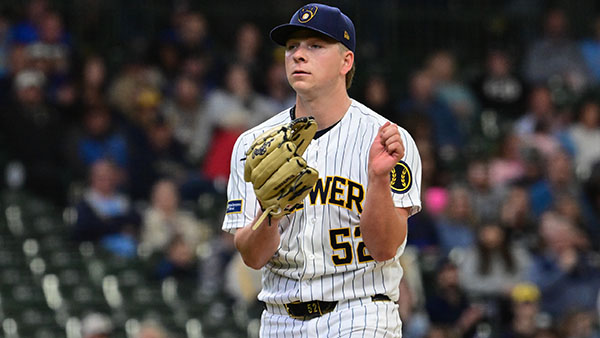
Harrison’s 11.4 K/9 dominance meets Griffin’s precision command, but Milwaukee’s 1.34-run bullpen ERA advantage tells the real story. The -134 line treats these relief corps like equals.
Kyle Harrison vs Foster Griffin: Milwaukee Brewers at Washington Nationals Betting Preview
After Milwaukee’s convincing 6-1 victory yesterday behind Jacob Misiorowski’s near no-hitter, today’s matchup shifts to a fascinating pitching duel between two starters who’ve been excellent this season. Kyle Harrison brings a 2.28 ERA and dominant 11.4 K/9 rate to Nationals Park, while Foster Griffin counters with his own strong 2.67 ERA and 3-0 record.
The market has Milwaukee favored at -134, which feels reasonable given their superior overall pitching depth, but this line doesn’t fully capture the gap between these bullpens. Washington’s 5.08 team ERA tells a different story than Griffin’s individual excellence, and that disparity creates the edge I’m targeting.
William Contreras continues his torrid stretch with back-to-back four-hit games, becoming just the seventh player in Brewers history to accomplish that feat. That kind of offensive momentum, combined with Harrison’s strikeout upside, sets up a clear path to victory.
Game Info & Betting Lines
- Date/Time: Saturday, May 2, 2026 | 4:05 PM ET
- Venue: Nationals Park (Park Factor: 0.98 – slightly pitcher-friendly)
- Probable Starters: Kyle Harrison (2-1, 2.28 ERA) vs Foster Griffin (3-0, 2.67 ERA)
- Moneyline: Milwaukee Brewers -134 / Washington Nationals +114
- Run Line: Washington Nationals +1.5 (-164) / Milwaukee Brewers -1.5 (+136)
- Total: 7.5 (Over -108 / Under -112)
Why I’m Going Against The Model’s Best Edge
The numbers tell a interesting run line story. My model projects Milwaukee winning by 1.7 runs with high confidence, and that +136 price on the -1.5 run line represents genuine value. The bullpen disparity (Milwaukee’s 3.74 ERA vs Washington’s 5.08) suggests blowout potential once starters exit.
But I’m rejecting that edge for two critical reasons: Griffin’s elite command metrics and early-season volatility in multi-run margins. Griffin’s 1.0693 WHIP and 1.27 WAR indicate he’s controlling games better than his fellow rookie Harrison (1.0563 WHIP, 0.75 WAR). When a pitcher is locating this precisely – and Griffin’s 30 strikeouts against just 10 walks shows remarkable strike-zone command – he can extend deep enough into games to neutralize bullpen advantages.
More importantly, we’re only 31 games into the season. That 1.7-run projection relies heavily on team-level metrics that include non-Griffin starts. Washington has been blown out by poor pitching performances, but Griffin represents their best case scenario. His ability to keep Milwaukee’s lineup in check through six or seven innings makes the moneyline the safer play, even if it means passing on the model’s strongest statistical edge.
What Separates the Pitching
The fundamental difference comes down to Harrison’s superior strikeout rate – his 11.4 K/9 compared to Griffin’s 8.0 K/9 creates different game environments entirely. Harrison’s four-seam fastball sits at 94.7 mph with a 28.8% whiff rate, while his slurve generates a devastating 34.3% whiff rate with just 0.197 xwOBA against.
Griffin relies more on location and command, featuring a cutter-heavy approach (28.4% usage) that produces a 16.8% whiff rate. His split-finger (9.3% usage) is his best strikeout pitch with a 38.2% whiff rate, but Harrison’s overall arsenal generates more swing-and-miss across the board.
The Statcast data reveals Milwaukee’s lineup advantages against Griffin’s arsenal. Brice Turang shows a .489 xwOBA this season with strong contact metrics, while James Wood (.626 xwOBA, 13.1% barrel rate) represents Washington’s biggest threat against Harrison’s fastball command.
Both pitchers limit walks effectively – Harrison with 8 BB in 23.2 innings, Griffin with 10 BB in 33.2 innings – but Harrison’s higher strikeout rate reduces the chances of extended rallies. When hitters make contact against Griffin, they’re more likely to put the ball in play and create opportunities for Washington’s aggressive baserunners.
The Pushback
Here’s what genuinely concerns me about this moneyline bet: Griffin’s peripheral numbers suggest he’s not just getting lucky. His 1.27 WAR significantly exceeds Harrison’s 0.75, and those aren’t empty stats. Griffin’s 2.67 ERA is backed by quality contact prevention – his diverse seven-pitch arsenal creates different looks that have consistently kept hitters off balance.
The early-season sample size works both ways. While Harrison’s 11.4 K/9 looks dominant, that’s built on just 23.2 innings. Griffin’s 33.2-inning sample provides more confidence in sustainability, and his superior WAR suggests he’s been the better overall pitcher when adjusting for context and luck.
Washington’s offensive ceiling also creates legitimate upset potential. James Wood (.626 xwOBA) and CJ Abrams (.960 OPS) represent the type of young power that can solve even elite strikeout pitchers on any given day. If Griffin matches Harrison for six innings, those Washington bats need just one big swing to flip the script.
That said, the bullpen math remains my deciding factor. Milwaukee’s 1.34-run ERA advantage in relief pitching trumps individual starter matchups. Even if Griffin keeps this close through six innings, I trust Milwaukee’s depth to finish the job in a way Washington’s 5.08 team ERA suggests they cannot.
Run Environment & Game Shape
The total of 7.5 suggests the market expects a lower-scoring affair, which makes sense given both starters’ strong ERAs and Nationals Park’s slight pitcher-friendly lean (0.98 park factor). This environment actually helps Milwaukee’s case – games decided by one or two runs favor the team with superior bullpen depth.
My Pick: Milwaukee Brewers -134 (Moneyline)
I’m banking on Harrison’s strikeout dominance and Milwaukee’s overall pitching depth to secure a road victory. While Griffin has been excellent, the surrounding cast gives Milwaukee too many late-game advantages to ignore, even if I’m leaving the model’s best edge on the table.