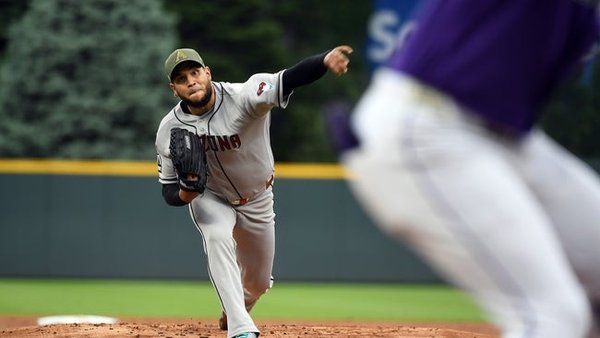
Eduardo Rodriguez’s 2.29 ERA and 4.26 WAR represent ace-level production — yet Arizona sits at only -120, a price that treats these two rotations as roughly interchangeable. Pallante’s contact-heavy profile and the Cardinals’ depleted bullpen leave a measurable gap the number has not absorbed.
Andre Pallante vs. Eduardo Rodriguez: St. Louis Cardinals at Arizona Diamondbacks Betting Preview
The surface-level read on this game is two competitive teams splitting a weekend series, heading into Sunday’s rubber match with everything even. But that framing ignores what the pitching matchup actually looks like. Eduardo Rodriguez is posting a 2.29 ERA and a 4.26 WAR through 114 innings — that’s an ace-level performance at an ace-level volume. Andre Pallante is a serviceable innings-eater at 3.96 ERA and a 1.27 WAR, but the gap between them is material.
The market has Arizona at -120. That’s a reasonable price for a coin-flip game between two .500 clubs, but it may not be respecting the starter edge enough. Arizona has won 5 of their last 6 games, and the momentum from Saturday’s 5-3 victory adds credibility to the lean, even if the projected scores — 4.5 to 4.3 — demand humility about the margin.
This isn’t a strong-opinion spot. It’s a value lean on the better pitcher in a neutral environment at a price that fits the thesis without requiring a comfortable win.
Game Info & Betting Lines
- Date/Time: Sunday, July 19, 2026 | 4:10 PM ET
- Venue: Chase Field, Phoenix (Dome | Park Factor: 0.97 — slight pitcher’s lean)
- Probable Starters: Andre Pallante (STL) vs. Eduardo Rodriguez (ARI)
- Moneyline: Cardinals +102 / Diamondbacks -120
- Run Line: Arizona Diamondbacks +1.5 (-210) / Cardinals -1.5 (+172)
- Total: 9 (Over -108 / Under -112)
Why This Number Is Close
The market is doing real work to set -120. The Cardinals entered this series having taken Game 1 on Friday — a 5-4 win that went to the ninth inning. Pallante carries a 10-6 record, and there’s legitimate reason to respect a starter who wins games even when his peripherals don’t dazzle. The Cardinals also post a slightly better offensive OPS (.707 vs. .693), and Jordan Walker — Home Run Derby champion, .880 OPS — gives them a genuine middle-of-the-order threat capable of erasing a lead in one swing.
But here’s the problem with the Cardinals’ case: Pallante’s 6.48 K/9 and 1.26 WHIP suggest a pitcher who allows a steady stream of baserunners and relies on soft contact and sequencing to survive. That’s a fragile profile against a D-backs lineup featuring Gabriel Moreno (.837 OPS) and Corbin Carroll (.825 OPS), two hitters who make consistent hard contact.
Where the market undersells Arizona is in the starter gap. A 1.67-run ERA differential and a 2.99-WAR gap between the two arms is meaningful. -120 feels like it’s pricing two interchangeable starters. The edge isn’t huge, but it exists.
What Separates the Pitching
Statcast gives us a clearer look at how these two arms actually function. Pallante’s best weapon is his slider — thrown 30.5% of the time, sitting at 87.6 mph, with a 31.0% whiff rate and a tidy .246 xwOBA. That’s a legitimate put-away pitch. His four-seam fastball, however, tells a different story: 95.0 mph with only an 11.8% whiff rate and a .352 xwOBA allowed. Hitters are squaring it up. His sinker (18.9% usage, .311 xwOBA) and knuckle-curve (.299 xwOBA) round out a profile that is contact-heavy and highly dependent on defenders and sequencing to limit damage.
Rodriguez works with a different toolkit. His four-seamer sits at 92.0 mph and accounts for 39.7% of his pitches — with an 18.7% whiff rate and .343 xwOBA, it’s a contact suppressor rather than a swing-and-miss bomb. The real weapon is his changeup: 27.0% usage, 85.8 mph, 19.6% whiff, .299 xwOBA. That two-pitch backbone — fastball up, changeup down — creates the kind of differentiated movement that generates early-count pop-ups and weak grounders. His 1.17 WHIP versus Pallante’s 1.26 reflects the command gap directly: Rodriguez keeps the bases cleaner. One caveat worth noting: when Rodriguez abandons that fastball-changeup backbone and leans on secondary options, the results get messier. His cutter (.415 xwOBA) and sinker (.434 xwOBA) are genuinely hittable pitches — real vulnerabilities if he gets away from his best stuff, even if they represent a small slice of his overall mix.
The innings Rodriguez creates — one-out grounders, lazy flies, the occasional strikeout — are low-leverage and manageable. The innings Pallante creates — baserunners, contact, sequencing dependency — carry more latent risk. In a game projected to be decided by a single run, that difference in inning quality matters. Rodriguez’s 8-3 record over 114 innings isn’t luck; it’s the product of consistent execution over a real sample.
The Pushback
The honest concern here is that the projected scores — Arizona 4.5, Cardinals 4.3 — are nearly indistinguishable. A near-coin-flip outcome baked into the numbers means Rodriguez needs to actually outperform his surroundings by a meaningful margin to cash this ticket. One bad inning — one Walker missile clearing the left-center wall — and the entire pitching edge evaporates.
Walker is the specific threat that keeps me from pressing harder. His .464 xwOBA against left-handed pitching is elite, and his 7.5% barrel rate gives him legitimate power to all fields. Rodriguez is left-handed. That handedness mismatch is real and it creates genuine exposure in every at-bat Walker gets against him.
And it’s worth being clear on the recent form: the Cardinals are 4-6 in their last 10, which is a mild tailwind for the Arizona side. Arizona, by contrast, is 6-4 in their last 10 — a mild positive that supports the lean rather than undermining it. The Cardinals’ recent skid isn’t cause for alarm, but it does suggest they’re not exactly rolling into this finale with momentum on their side.
The bullpen picture also tilts Arizona’s way. Paul Sewald has converted 23 of 24 save opportunities this season — an elite closer entering high-leverage situations with a legitimate track record. The Cardinals, meanwhile, are without JoJo Romero (abdomen, 15-Day IL) and Max Rajcic (elbow, 60-Day IL), two pieces who would normally eat middle innings. That asymmetry matters in a game where both starters are likely to need bullpen support by the sixth or seventh.
The Pick
I looked hard at Arizona -1.5 at -210. The case for the run line starts with Rodriguez’s edge and Arizona’s recent momentum — if you believe the better pitcher wins and wins clean, the cushion of a multi-run margin is appealing in theory. But in practice, the numbers don’t support it. The projected scores — 4.5 to 4.3 — show almost no meaningful separation between these two offenses. There’s no credible multi-run path here; this figures to be a one-run game decided late, not a comfortable Arizona win. Beyond the projection, Arizona’s -12 run differential on the season tells you something important: this is not a team that blows opponents out. They grind wins, they don’t manufacture them by two-plus runs on a consistent basis. Asking -210 juice for that profile in a near-coin-flip game is asking too much. The juice alone kills the value even if Rodriguez pitches a gem, because a gem that ends 3-2 doesn’t cover. The moneyline at -120 gets you the better pitcher, the better bullpen, and the home-field edge without requiring a margin the numbers don’t project.
Bet: Arizona Diamondbacks ML (-120) — 2 units — Moderate confidence