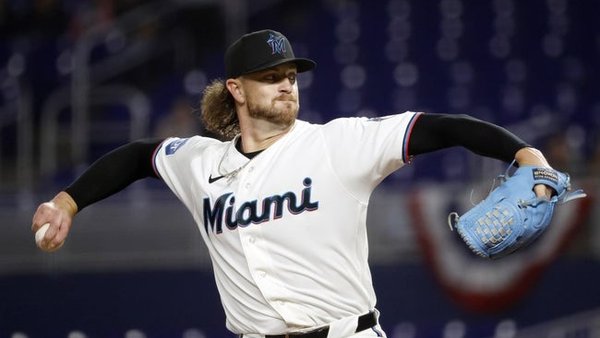
Both starters carry ERAs above 5.50 — the underlying metrics point in different directions. Paddack’s strikeout weapons and Miami’s team depth create value the market hasn’t fully recognized.
Dustin May vs Chris Paddack: St. Louis Cardinals at Miami Marlins Betting Preview
After snapping the Cardinals’ five-game winning streak last night, Miami finds itself in the unusual position of being favored again at -120 despite both starting pitchers carrying ERAs north of 5.50. The market seems to be pricing this as a coin flip with modest home field advantage, but digging into the underlying metrics reveals a more significant gap than the tight line suggests.
While both pitchers have struggled early in 2026, the nature of their struggles tells different stories. May’s 6.98 ERA comes with alarming peripherals that suggest continued problems, while Paddack’s 5.59 mark masks some encouraging underlying trends. Combined with Miami’s superior team ERA (4.01 vs 4.86) and home field advantage in the pitcher-friendly confines of loanDepot park, there’s value on the Marlins despite the surface-level similarities.
Game Info & Betting Lines
- Date/Time: Tuesday, April 21, 2026 | 6:40 PM ET
- Venue: loanDepot park (Park Factor: 0.95 – pitcher-friendly dome)
- Probable Starters: Dustin May (2-2, 6.98 ERA) vs Chris Paddack (0-3, 5.59 ERA)
- Moneyline: St. Louis Cardinals +100 / Miami Marlins -120
- Run Line: Miami Marlins +1.5 (-189) / St. Louis Cardinals -1.5 (+155)
- Total: 8.5 (Over -115 / Under -105)
Why This Number Is Too Close
The -120 price on Miami suggests the market views this as essentially a pick’em with minimal home field advantage. That assessment makes sense on the surface — both starters have been brutal, both offenses have been inconsistent, and the Cardinals were riding momentum before last night’s loss. The case for St. Louis at plus money is straightforward: Jordan Walker is red-hot with a 15-game hitting streak, they just swept Houston on the road, and getting plus money on any major league team is typically attractive.
But here’s the problem with that logic — it treats both pitching performances as equally bad when the underlying data suggests otherwise. May’s struggles come with concerning velocity drops and command issues that point to deeper problems, while Paddack has actually shown improved strikeout rates and better pitch mix utilization. The Cardinals’ recent offensive surge also masks some concerning trends, particularly their inability to sustain rallies against quality pitching.
The market is also undervaluing Miami’s home field advantage in a dome environment where they’ve been more comfortable, and the team ERA gap of nearly a full run suggests better overall pitching depth that could matter in a close game.
What Separates the Pitching
The tale of two struggling starters becomes clearer when examining their Statcast profiles. May’s arsenal has lost its bite — his 97.1 mph four-seam fastball generates just an 18.2% whiff rate and allows a concerning .356 xwOBA. More troubling is his changeup, which has been completely ineffective with a .526 xwOBA against, essentially becoming a batting practice pitch. His sweeper provides some relief with a 20.8% whiff rate, but hitters are sitting on his fastball and making him pay.
Paddack’s mix tells a different story of controlled aggression. His 93.2 mph four-seam generates a superior 20.3% whiff rate with better command, while his changeup has been genuinely effective at 32.8% whiffs and just .280 xwOBA against. The difference is stark — where May’s secondary pitches have abandoned him, Paddack’s changeup and cutter combination gives him legitimate swing-and-miss weapons to fall back on when his fastball command wavers.
The strikeout rates reflect this gap: Paddock’s 8.38 K/9 significantly outpaces May’s 6.98 K/9, and in a game where both pitchers will likely struggle with command, the ability to generate strikeouts becomes crucial for limiting big innings. May’s -0.56 WAR compared to Paddack’s -0.06 WAR captures the full picture — both have been below replacement level, but May has been significantly more harmful to his team’s chances.
The Pushback
The strongest case against Miami centers on recent momentum and lineup construction. The Cardinals enter this game having won five straight before last night, with Walker’s 15-game hitting streak providing legitimate offensive firepower. Masyn Winn has also been productive, and the Cardinals have shown an ability to manufacture runs even when their starting pitching struggles.
There’s also the concerning reality that Paddack is 0-3 despite his better peripherals, suggesting he hasn’t been able to translate improved stuff into actual results. Early-season variance cuts both ways — while May’s struggles look systemic, Paddack’s lack of wins raises questions about whether he can actually outpitch his metrics when it matters.
Miami’s offensive inconsistencies compound this concern. Despite strong individual performances from Otto Lopez (.338 average, .936 OPS) and Liam Hicks (.328 average, .926 OPS), they’ve managed just 105 runs through 23 games — virtually identical to St. Louis’s 106. The Cardinals also carry a significant edge in power with 25 home runs compared to Miami’s 16, and in a game where both starters figure to struggle, the team that can generate sudden offense often prevails.
The Cardinals’ recent road success in Houston also demonstrates their ability to win away from home against quality competition. Winn’s clutch hitting and Gorman’s power potential give them multiple ways to break through, even against better pitching. When facing uncertainty, taking plus money on a team with proven offensive weapons makes mathematical sense.
Run Line Analysis
The Miami -1.5 at -189 presents an interesting alternative angle, but ultimately lacks the value needed to justify the juice. While my analysis suggests Miami should win this game more often than the moneyline implies, asking them to win by multiple runs against a Cardinals lineup that’s been productive lately feels like pushing it.
The Cardinals have shown resilience in close games — they’re 5-0 in extra-innings this season and just completed a comeback-heavy series sweep in Houston. Even if Paddack outpitches May, the Cardinals have enough offensive talent to keep it close. Walker’s .589 xwOBA suggests he’s been legitimately locked in, not just lucky, and both Burleson (.408 xwOBA) and Herrera (.381 xwOBA) have shown consistent contact quality.
In a dome environment where weather isn’t a factor, games tend to play closer to expected totals, making blowouts less likely. The -189 price requires Miami to cover the run line roughly 65% of the time to break even, which feels optimistic given both teams’ offensive inconsistencies and the Cardinals’ proven ability to scratch out late runs. The moneyline provides cleaner exposure to the core thesis without needing margin of victory to cooperate.
The Bottom Line
Miami gets my action at -120 based on a cleaner pitching matchup than the surface numbers suggest and meaningful home field advantages that the market is underpricing. While Paddack hasn’t been great, his 32.8% whiff rate on the changeup and 20.3% whiff rate on his fastball give him legitimate weapons against a Cardinals lineup that’s been riding hot streaks rather than sustained quality contact.
May’s peripherals paint the picture of a pitcher whose stuff has genuinely deteriorated — the .526 xwOBA against his changeup is alarming, and his inability to generate swings and misses with his primary fastball leaves him vulnerable to the exact kind of patient, aggressive Cardinals hitters he’ll face.
Combined with home field advantage and a nearly full-run team ERA advantage, the Marlins present solid value at a short price that should be closer to -140 based on the underlying fundamentals.