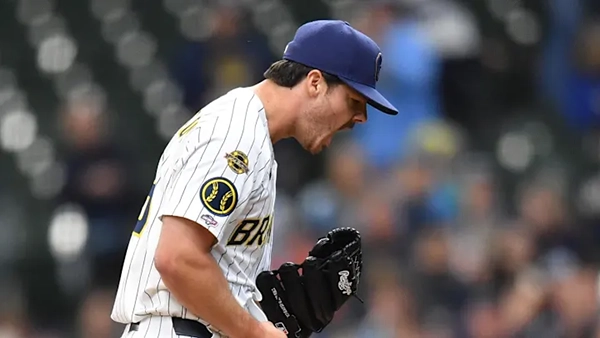
Chris Paddack enters Saturday’s matchup at 0-5 with a 7.07 ERA and a 1.63 WHIP — yet the moneyline treats this as a virtual toss-up, with the Cardinals priced at just -104. The run differential gap (-5 vs. -28) and a meaningful starter mismatch tell a different story than what the number reflects.
Andre Pallante vs. Chris Paddack: St. Louis Cardinals at Cincinnati Reds Betting Preview
The market sees a near-even game. The market hasn’t caught up. When the Reds send Chris Paddack to the mound — a starter sitting at 0-5 with a 7.07 ERA — and the Cardinals counter with Andre Pallante at a workable 4.04 ERA, pricing this as a coin flip isn’t market efficiency. It’s market inertia, anchored too heavily on home field and Cincinnati’s misleading 26-24 record.
The Reds’ run differential sits at -28. The Cardinals’ is -5. That gap tells you everything about which team has been outplaying its record and which hasn’t. Cincinnati has been propped up by sequence and timing. The underlying numbers point firmly to St. Louis.
Yesterday’s series opener between these two clubs was suspended with neither team scoring, so there’s no momentum to lean on — just the pitching matchup staring back at you, and it leans heavily in one direction. At -104, the Cardinals represent genuine value in a game the numbers project them to win nearly 60% of the time.
Game Info & Betting Lines
- Date/Time: Saturday, May 23, 2026 — 1:10 PM ET
- Venue: Great American Ball Park (Park Factor: 1.10 — hitter-friendly)
- Probable Starters: Andre Pallante (STL, 4-4, 4.04 ERA) vs. Chris Paddack (CIN, 0-5, 7.07 ERA)
- Moneyline: St. Louis Cardinals -104 / Cincinnati Reds -112
- Run Line: Cardinals -1.5 (+152) / Reds +1.5 (-184)
- Total: 9.5 (Over -114 / Under -106)
Why This Number Is Off
The market is balancing two legitimate forces: a hitter-friendly park with a 1.10 run factor and the genuine offensive volatility both lineups carry. Cincinnati’s home field bump is real, and oddsmakers know the Reds have dangerous bats in De La Cruz, Bleday, and Stewart. Those aren’t phantom threats — they’re legitimate power hitters capable of exploiting any starter in this environment.
But here’s the problem: the market appears to be pricing Cincinnati as though their rotation is functional. It isn’t. Paddack’s 1.63 WHIP and -0.58 WAR in 35.2 innings aren’t a slump — they’re a pattern. He’s allowed 6 home runs in those innings, and his sinker — thrown 8.2% of the time — generates an xwOBA of .459 against it. That’s not a pitch creating weak contact. It’s a pitch getting punished.
The Cardinals, meanwhile, are priced at -104 — under the -130 juice ceiling that typically marks the threshold where value evaporates on modest favorites. When a team with a better record, better team ERA (4.24 vs. 4.71), and a meaningful pitching edge is available for essentially even money, the pricing gap is real. The line accounts for the park. It does not adequately account for the starting pitcher gap.
What Separates the Pitching
The gap between these two starters is not subtle. Pallante works with a four-pitch mix anchored by a slider generating a 38.0% whiff rate and .245 xwOBA against it — that’s a genuine swing-and-miss weapon. His knuckle curve adds another layer of deception at .236 xwOBA. The four-seamer sits 94.7 mph and is hittable (.410 xwOBA), but paired with that slider, it plays up. Against a Reds lineup that strikes out 453 times on the season, Pallante’s ability to locate and sequence gives him a real path to managing innings even without dominant stuff. His 1.35 WHIP isn’t elite, but it’s workable.
Paddack is a different story entirely. His four-seamer — thrown 33.7% of the time at 93.0 mph — holds a .318 xwOBA, which is fine. The concern is his cutter, sitting at .387 xwOBA, and his sinker at a brutal .459 xwOBA. When contact-oriented lineups put balls in play against Paddack, they damage him. The Cardinals’ top of the order isn’t just dangerous on paper — the Statcast matchup data confirms it. Jordan Walker carries an xwOBA of .482 with an 8.2% barrel rate. Alec Burleson sits at .439 xwOBA and is hitting .667 in his small BvP sample against Paddack. Elly De La Cruz (.486 xwOBA) will test Pallante, but De La Cruz is 0-for-7 with 4 strikeouts in 23 career PA against right-handed starters who command like Pallante does.
The innings Pallante creates — low-walk, soft-contact sequences — are fundamentally different from the ones Paddack creates. Paddack’s 7.07 ERA in a 1.10 park factor environment isn’t coincidence. It’s what happens when a pitcher with command issues and a hittable arsenal pitches in a run-inflated setting.
The Pushback
The concern is real, and I won’t paper over it. The Cardinals just got shut out 7-0 and then held to 2 runs in back-to-back losses to Pittsburgh. Their recent offensive output is cold — 0 runs on May 20 and 2 runs on May 21 represent genuine funk, not noise. Jordan Walker is the engine of this lineup at .929 OPS, but he’s also carrying a 27.9% strikeout rate. Against a pitcher with a changeup generating a 27.0% whiff rate, there’s a real path for Paddack to navigate a lineup that’s currently stuck in a funk.
The Reds’ lineup has genuine danger, too. JJ Bleday’s 1.039 OPS across 77 at-bats is not a fluke — small sample, but the underlying Statcast profile (.467 xwOBA, 7.5% barrel rate, 34.4% hard-hit rate) suggests the production is real. Elly De La Cruz at .290/.881 gives Cincinnati a legitimate table-setter, and Sal Stewart’s 12 home runs make him a genuine threat in this park. If Pallante’s four-seamer — sitting at .410 xwOBA against — gets elevated in this environment, the Reds can flip this game in one inning. That’s the honest pushback, and it’s why this isn’t a three-unit play.
Run Environment & Why It Doesn’t Neutralize the Edge
Great American Ball Park’s 1.10 park factor inflates run expectations for both sides, and the total sitting at 9.5 reflects that. But high-scoring environments aren’t neutral when the pitching gap is asymmetric. If this game produces 10 or 11 runs, the distribution of those runs matters enormously — and the numbers strongly suggest the Cardinals are the more likely beneficiary against Paddack than the Reds are against Pallante.
Paddack has a 7.07 ERA in 35.2 innings. In a hitter-friendly park against a lineup that just produced 9 runs in Philadelphia two days ago, his floor for runs allowed is low. Pallante, by contrast, has worked through contact-heavy lineups all year with a 1.35 WHIP that, while not dominant, reflects consistent sequencing. The park amplifies both starters’ vulnerabilities — but Paddack’s vulnerabilities are significantly larger. A high-run game where the Cardinals score 5 or 6 is still a Cardinals win at -104. That’s the asymmetry worth betting.
Joe Jensen’s Pick
Bet: St. Louis Cardinals Moneyline (-104)
Units: 2 | Confidence: Moderate
Projected Score: Cardinals 5.3, Reds 5.1
The Cardinals win probability sits near 60% against a starter the numbers have flagged as one of the more exploitable arms in the National League. At -104, you’re getting that edge for essentially even money. The juice is right, the pitching matchup is right, and the run differential gap between these two teams tells you which club has actually earned its record.
I looked at the run line here, and while the price is attractive, I keep coming back to the Cardinals’ offensive cold streak — 0 runs on May 20 and just 2 on May 21 — combined with what this park does for Cincinnati’s floor. Great American Ball Park doesn’t just help the home team score; it prevents blowouts by giving any lineup a puncher’s chance, which means there’s no credible multi-run separation path you can bank on against the Reds at home. The Cardinals don’t need to win big tonight — they just need to win. Moneyline at -104 is the play.