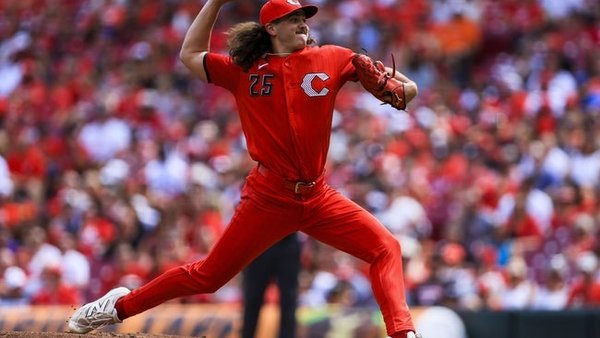
Rhett Lowder walks into Great American Ball Park with a 5.15 ERA against a Cardinals lineup that just dropped 19 runs on Chicago over two days — and the market has St. Louis at -112, barely a favorite. A 1.55-run ERA gap between starters on a hitter-friendly surface should cost more than near-even money.
Quinn Mathews vs. Rhett Lowder: St. Louis Cardinals at Cincinnati Reds Betting Preview
There are two kinds of pitching mismatches in baseball. The first is when one starter is clearly better than the other. The second — and often more exploitable — is when the market doesn’t fully price that gap. Monday’s game at Great American Ball Park is the second kind. The Cardinals are sending Quinn Mathews to the mound with a 3.60 ERA in 2026. The Reds are countering with Rhett Lowder, who is 4-8 with a 5.15 ERA on the season. The game recap from Sunday’s Marlins-Reds game makes it explicit: “Reds RHP Rhett Lowder (4-8, 5.15) starts Monday to kickoff a home series against St. Louis.” That’s not a mystery arm — that’s a known liability, and it is not being priced properly at -112.
The Cardinals arrive from Chicago having blitzed the Cubs 8-4 and 11-4 in back-to-back games, with Alec Burleson and Jordan Walker both homering in Sunday’s win. St. Louis is 7-3 in their last 10. The Reds just dropped two of three to the Marlins, including a 7-1 beatdown Sunday. The momentum gap is real. The pitching gap is realer.
At -112, this is essentially a pick’em. But the Cardinals are the better team by standings (63-61 vs. 59-64), by run differential (7 vs. -86), and by rotation quality on this particular day. A near-even price on a clear structural edge is where value lives.
Game Info & Betting Lines
- Date/Time: Monday, August 17, 2026 — 1:40 PM ET
- Venue: Great American Ball Park (Park Factor: 1.10 — hitter-friendly)
- TV: ESPN Unlmtd, MLB.TV, Reds.TV, Cardinals.TV
- Probable Starters: Quinn Mathews (STL, 0-1, 3.60 ERA) vs. Rhett Lowder (CIN, 4-8, 5.15 ERA)
- Moneyline: St. Louis Cardinals -112 / Cincinnati Reds +105
- Run Line: St. Louis Cardinals -1.5 (+129) / Cincinnati Reds +1.5 (-156)
- Total: 9.5 (Over +100 / Under -120)
Why This Number Is Off
The market is doing reasonable work here. GABP’s 1.10 park factor keeps the line compressed — books know scoring can spike in this environment, which artificially tightens moneylines because blowouts are harder to predict. The Reds also carry real lineup firepower: Elly De La Cruz (xwOBA .455, 8.4% barrel rate), Sal Stewart (26 HR, .409 xwOBA), and Tyler Stephenson (.436 xwOBA) make Cincinnati dangerous regardless of who’s pitching. That offensive threat is a legitimate reason to keep St. Louis closer to even money than -130 or -140.
But here’s the problem: Lowder’s 5.15 ERA is not a rotation-crisis emergency call-up — it’s a documented, season-long track record of getting hit. Cincinnati’s -86 run differential is the season-long receipt for a team that looks better in individual stat lines than it performs in aggregate. The Cardinals’ staff ERA of 4.04 and WHIP of 1.340 both beat the Reds’ marks (4.51 ERA, 1.400 WHIP) by meaningful margins.
The market is pricing this like an even contest between two flawed NL Central teams. The actual structure is a team with a known, effective arm, better run prevention, and superior momentum against a team starting a pitcher who has surrendered runs at a 5.15 clip all season in a hitter-friendly park. That’s not a -112 game — it’s a -125 to -130 game, and the Cardinals are available at a discount.
What Separates the Pitching
Quinn Mathews is not an ace, and I’m not treating him like one. His 3.60 ERA in 2026 covers a small sample, and his 0-1 record suggests he hasn’t dominated. But he is a known quantity — a pitcher with an established profile, a defined pitch mix, and a rotation slot the Cardinals planned around. That matters when the alternative is Rhett Lowder walking into GABP with a 5.15 ERA.
The 1.55-run ERA gap between Mathews (3.60) and Lowder (5.15) is meaningful on any surface. At a 1.10 park factor, it’s amplified. Lowder has struggled to get hitters out consistently all season, and now he draws a Cardinals lineup that just scored 19 runs over two days against the Cubs. The Reds’ rotation has also been decimated by injuries — Hunter Greene and Brandon Williamson both sit on the 60-Day IL — so there’s no depth cushion if Lowder gets roughed up early.
What makes this structure worse for Cincinnati is the Cardinals’ lineup construction. Burleson (.440 xwOBA, back-to-back HR) and Walker (.444 xwOBA, 24 HR) are the two most dangerous hitters in this order, and both are carrying genuine heat right now. Walker’s .504 xwOBA against left-handed pitching is a number that demands attention if the Reds mix in southpaws from the bullpen. Burleson’s .473 xwOBA against right-handers is equally punishing — and Lowder is a right-hander. Top-of-order contributor Everson Pereira adds a .427 xwOBA, giving St. Louis three legitimate threats in the first five spots.
On the Reds’ side, De La Cruz is the real equalizer — an .455 xwOBA with elite hard-hit rates (33.1%) that can hurt any pitcher. But Mathews is the one walking in with a 3.60 ERA against a lineup he can game-plan for. Lowder is the one absorbing a Cardinals offense that hasn’t cooled down since Chicago.
The Pushback Case
Here’s where I push back on myself, because you should always do this before putting money down.
First, Mathews’ small sample is real. A 3.60 ERA over a limited number of starts can evaporate quickly at GABP. If he’s been getting by on contact management and the park inflates a few fly balls, that ERA looks different in a hurry. Small samples lie in both directions.
Second, the Reds’ bullpen could render Lowder’s struggles irrelevant if Cincinnati treats this as a bullpen game from the jump. If Lowder goes three innings and hands it to a functional relief corps, the pitching mismatch narrows considerably. Mathews doesn’t get a free pass for six innings just because the other guy has a bad ERA.
Third, De La Cruz (.455 xwOBA, 33.1% hard-hit rate) and Stewart (.409 xwOBA, 91 RBI) represent genuine damage potential against any starter at any price. GABP amplifies mistakes, and Mathews — whatever his ERA — is not immune to the park.
I hear all of that. But pushback doesn’t change the structural case. Lowder’s ERA is what it is over a full season’s sample. The park factor cuts both ways, and the Cardinals have the hitters to take advantage of it too. And at -112, the market isn’t accounting for the full weight of a 1.55-run pitching gap.
Why I’m Passing on the Run Line and Total
The Cardinals -1.5 at +129 is tempting given the pitching edge, but I don’t want to pay for two wins of margin in a hitter-friendly environment with a bullpen-game scenario in play. If this turns into a 6-5 grind, the run line loses even with the right side. The juice doesn’t compensate for the added variance.
On the total: the numbers project this at 9.8 runs against a posted total of 9.5, which is about as close to neutral as it gets. The over is +100 and the under is -120 — the market leans toward the under, probably because Mathews has kept the ball in the yard and the Reds’ offense has been inconsistent. But a 0.3-run projected edge on a 1.10 park factor surface with a struggling starter on one side? That’s not a total I want to be in. Too much two-way risk for too little reward at these prices.
Run Environment & Game Shape
Great American Ball Park’s 1.10 park factor matters here, but not in the way most bettors assume. Yes, it inflates run totals relative to neutral parks — that’s why the total is set at 9.5 rather than 8.5. But the inflation cuts both ways. A Cardinals offense that just posted 8 and 11 runs in consecutive games walks into a park that rewards hard contact, and both Burleson and Walker are posting elite xwOBA numbers with real barrel rates to match.
The Reds’ offensive profile is built around power (161 HR) but undermined by a .226 team average and 1,166 strikeouts — the highest strikeout total in this matchup by a significant margin. Against a pitcher with Mathews’ control profile, that strikeout tendency is a problem. The Reds swing and miss at a team level, and a strike-throwing starter can exploit that even in a hitter-friendly park.
The projected score of Cardinals 5.0, Reds 4.8 supports a close, contested game — which explains why the over is sitting at even money (+100) while the under is priced at -120. The market leans under despite the hitter-friendly surface because both starters profile as run-suppressors relative to the total — Mathews through actual results, Lowder theoretically if he manages contact better than his ERA suggests. I don’t buy the Lowder efficiency argument given the season-long evidence. A Cardinals offense running hot, in a 1.10 park, against a 5.15 ERA starter, is more likely to crack five runs than not.
The Pick: St. Louis Cardinals Moneyline -112
Pull the threads together and the case is straightforward. The Cardinals are 7-3 in their last 10, riding back-to-back offensive explosions against the Cubs, with a run differential advantage of 93 runs over the Reds (7 vs. -86). They’re sending Quinn Mathews (3.60 ERA) to the mound. Cincinnati is countering with Rhett Lowder (4-8, 5.15 ERA) in a park that punishes pitching mistakes.
The pitching edge is 1.55 ERA runs in St. Louis’s favor. The momentum edge is real. The team-level ERA and WHIP both favor the Cardinals. And the price is -112 — essentially pick’em odds on a game where the structural advantages are clearly stacked on one side. That’s the definition of a mispriced line.
This isn’t a max bet — Mathews’ small sample, the GABP amplification risk, and the Reds’ legitimate power threats (De La Cruz, Stewart) keep this at moderate confidence. But at near-even money, you don’t need a blowout. You need the better-constructed team with the better starter to win one baseball game.
Bet: St. Louis Cardinals Moneyline -112 — 2 units — Moderate Confidence