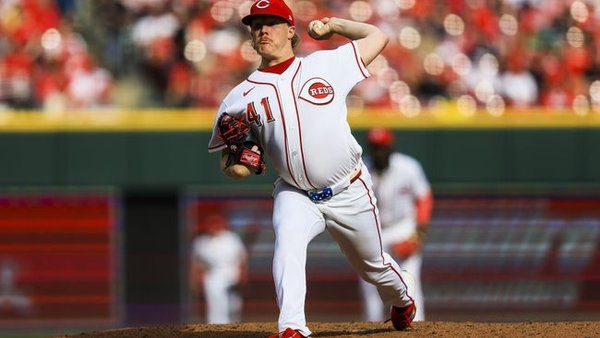
Great American Ball Park carries a 1.10 run factor, and the books have priced that in — but the venue tilt tells only part of the story when one starter is logging clean innings and the other has issued 64 walks in 133 frames. The total sits at 8.5 with near-flat juice at -105, a price that barely accounts for the gap between these two pitching profiles.
Kyle Leahy vs. Andrew Abbott: St. Louis Cardinals at Cincinnati Reds Betting Preview
After Monday’s doubleheader split — the Cardinals taking Game 1 behind five perfect relief innings before the Reds walked it off in Game 2 on Elly De La Cruz’s deflected single — we roll into Tuesday night at Great American Ball Park with a genuinely interesting pitching contrast. Kyle Leahy takes the mound for St. Louis with a 3.38 ERA and 1.34 WHIP in 117.1 innings, while Andrew Abbott counters for Cincinnati carrying a 4.13 ERA, 1.42 WHIP, and 64 walks in 133 frames.
The market has settled the total at 8.5 with the under priced at -105. That’s nearly flat juice — the books aren’t asking much to take what I believe is the structurally sounder side. The pitching gap is real, the Cardinals’ bullpen showed Monday it can lock games down, and both lineups have been playing cold baseball recently. The under isn’t a screaming edge, but at -105, it doesn’t need to be.
The numbers project a combined 10.1 runs — sitting above the posted number, and that’s the core tension here. I’ll address it directly rather than paper over it. The case for the under isn’t built on the projection agreeing; it’s built on what Leahy’s efficiency and St. Louis’s shutdown bullpen can actually do to a Cincinnati lineup that strikes out at an alarming rate.
Game Info & Betting Lines
- Date/Time: Tuesday, August 18, 2026 — 6:40 PM ET
- Venue: Great American Ball Park (Park Factor: 1.10 — hitter-friendly)
- Probable Starters: Kyle Leahy (STL, 9-4, 3.38 ERA) vs. Andrew Abbott (CIN, 6-7, 4.13 ERA)
- Moneyline: Cardinals -116 / Reds +108
- Run Line: Cardinals -1.5 (+135) / Reds +1.5 (-163)
- Total: 8.5 (Over -114 / Under -105)
Why This Number Is Close
The books have this game priced almost exactly where they should. Great American Ball Park carries a 1.10 run factor — it tilts hitter-friendly, and the market is weighting that appropriately. Both offenses rank near the bottom of the NL by OPS (both teams sit at .699), but the Reds have hit 163 home runs this season, more than enough pop to flip a tight game in an instant. The over at -114 isn’t an accident; there’s real scoring potential here.
The legitimate case for the over comes down to two things: Abbott’s walk rate creating traffic, and the Reds’ power ceiling being underrated against a Leahy who has allowed 12 home runs in 117.1 innings. If Abbott is chased in the fourth and Cincinnati turns to a bullpen already battered by injuries — Hunter Greene and Brandon Williamson both on the 60-Day IL — a late-game crooked inning from St. Louis becomes plausible.
Where I think the market is slightly wrong is in how much it discounts Leahy’s efficiency in suppressing innings volume. Abbott’s walk issues inflate pitch counts and shorten his outings, but the Cardinals’ .241 team average and .699 OPS may not generate the kind of consistent multi-hit frames needed to cash the over. The total is close — but the under at -105 is the cleaner price given the pitching asymmetry.
What Separates the Pitching
This matchup has a genuine gap, and it runs in one direction. Leahy’s arsenal works because he generates weak contact across multiple pitch shapes. His curveball sits at 82.9 mph and produces a 24.0% whiff rate with a .277 xwOBA against — that’s a legitimate swing-and-miss offering. His changeup is even sharper: 30.3% whiff rate and .290 xwOBA. He mixes those offspeed pitches off a 94.1 mph four-seamer that commands the zone without getting destroyed (.438 xwOBA against, but only 13.6% whiff — he’s not trying to miss bats with the heater, he’s setting up the softer stuff). The result is a pitcher who logs clean innings without walking the ballpark.
Abbott is a different profile and not in a good way. His four-seamer runs at 92.5 mph and makes up 45.6% of his usage — heavy reliance on a pitch holding a .403 xwOBA against and only a 10.8% whiff rate. The sweeper (.231 xwOBA, 25.9% whiff) and changeup (35.0% whiff, .281 xwOBA) are legitimate weapons, but he can’t get to them if he’s falling behind hitters. With 64 walks in 133 innings — a 4.33 BB/9 rate — Abbott consistently digs counts that force him into the fastball, which is exactly where the Cardinals’ top of the order can do damage.
Elly De La Cruz is the most dangerous matchup for Leahy. In 7 plate appearances against him, De La Cruz is hitting .429 with 2 home runs — that’s a small sample, but De La Cruz’s .456 xwOBA and 8.3% barrel rate are legitimate power markers. Leahy has to navigate carefully there. On the Abbott side, Jordan Walker carries an .000 average in 18 PA against Abbott with 6 strikeouts — that’s a meaningful sample suggesting Abbott has the Cardinals’ cleanup hitter’s number.
The gap isn’t enormous, but Leahy’s 3.38 ERA and cleaner peripherals give St. Louis a meaningful starting pitching edge that the total price is only barely pricing in.
The Pushback
The honest version of this analysis has to acknowledge what the numbers suggest: a combined 10.1 projected runs points over, not under. That’s a real disagreement, and anyone who tells you projections landing 1.6 runs above the posted total is a coin flip is selling you something. The over has a credible mathematical case.
The reason I’m fading it anyway comes down to how that 10.1 run total is distributed and whether the underlying assumptions hold at game speed. Projections at this run level typically bake in average bullpen performance — and the Cardinals’ bullpen Monday was anything but average. Four relievers threw perfect innings in Game 1. Riley O’Brien struck out the side for his NL-leading 31st save. That’s a shutdown unit operating at a high level, and it’s facing a Cincinnati offense that ranks 29th in team strikeout rate (1,190 punchouts, .227 average). The gap between projected run environment and actual run suppression is where unders live.
On the Abbott side, yes — his walk rate creates traffic. But the Cardinals’ .241 average and tendency toward strikeouts (973 as a team) means that traffic frequently goes nowhere. Abbott’s sweeper and changeup are genuine out-pitches against right-handed hitters, and St. Louis’s lineup leans right-handed. Walker going 0-for-18 with 6 K against Abbott is the kind of BvP data that actually holds up because it reflects a legitimate pitch shape disadvantage, not noise.
I’m also not buying the run line at either price. The Cardinals are projected to win by roughly 0.2 runs — that’s a coin flip on distance, not a -1.5 situation. And St. Louis’s offense hasn’t demonstrated the capacity to blow games open consistently; they scored 2 runs in Monday’s Game 1 win. The under is the play, not the run line.
Run Environment & Game Shape
Great American Ball Park’s 1.10 park factor is real and worth respecting — this venue inflates run totals on average. But park factors describe environments across full samples of games, not individual matchups. When you drop a pitcher with a 35.0% whiff changeup and a .277 xwOBA curveball into that park against a lineup striking out 1,190 times, the park advantage gets absorbed by the matchup.
Game shape here points toward a low-scoring first five innings and a question mark after that. Leahy’s efficiency — 117.1 innings at 3.38 ERA with only 35 walks — means he typically works deep into games without requiring the bullpen early. Abbott’s pitch-count issues work the other direction; he’s more likely to be pulled in the fifth or sixth, handing the ball to a Cincinnati relief corps already undermanned with Greene and Williamson on the 60-Day IL. That’s the primary over scenario: Abbott exits early, Cardinals pile on against a depleted pen.
The counter is that St. Louis’s offense simply hasn’t shown it can execute that scenario reliably. Their .699 OPS is identical to Cincinnati’s, and in Monday’s Game 1, they scratched out exactly 2 runs against a 34-year-old Triple-A callup. The Cardinals win games by keeping them close and letting their bullpen hold — and that’s precisely the game shape that cashes unders. When both starters are effective through five and neither lineup has the sustained hit volume to break open innings, the total stays low regardless of what the park factor suggests on paper.
The Pick
Two cold offenses, one genuinely efficient starter, and near-flat juice on the under. At -105, the price doesn’t require certainty — it requires an edge, and Leahy’s track record of clean innings against a lineup that strikes out in volume provides exactly that.
Bet: Under 8.5 (-105) — 2 units — Moderate Confidence