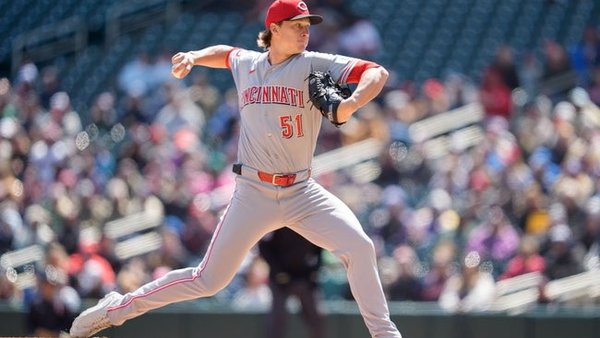
Brady Singer’s 1.72 HR/9 rate and a cutter with a 0.0% put-away rate are walking into Great American Ball Park — a venue with a 1.10 park factor — against a Cardinals lineup built around two hitters above .437 xwOBA. The total sits at 9.0, but the projected combined run output clears that number by a full run, and the pitching profiles on both sides point in the same direction.
Michael McGreevy vs Brady Singer: St. Louis Cardinals at Cincinnati Reds Betting Preview
Yesterday’s game ended 5-4 with the Reds completing a late comeback — five combined runs in the sixth inning and beyond doing most of the damage. Today’s pitching matchup doesn’t look like a recipe for tightening up. Brady Singer takes the ball for Cincinnati with a 4.66 ERA, 1.44 WHIP, and 24 home runs allowed in 125.2 innings — a 1.72 HR/9 rate that ranks among the most hittable profiles in this series. St. Louis sends out Michael McGreevy, who has been more respectable (3.48 ERA, 1.22 WHIP) but has still allowed 18 home runs in 132 innings of his own. Two flyball-prone starters, a hitter-friendly park, and thinned-out bullpens on both sides: that’s the architecture of an over.
The moneyline sits at -112 / +104 — essentially a coin flip. When the market prices a game this close, it’s acknowledging that neither starter dominates the run environment enough to tilt the outcome decisively. The numbers project a combined 10.1 runs against a posted total of 9.0. That gap is the thesis.
Game Info & Betting Lines
- Date/Time: Thursday, August 20, 2026 | 12:40 PM ET
- Venue: Great American Ball Park | Park Factor: 1.10 (hitter-friendly)
- Probable Starters: Michael McGreevy (STL, 5-9, 3.48 ERA) vs Brady Singer (CIN, 5-11, 4.66 ERA)
- Moneyline: Cardinals -112 / Reds +104
- Run Line: Cardinals -1.5 (+135) / Reds +1.5 (-163)
- Total: 9.0 (Over -108 / Under -111)
Why This Number Is Off
A 9.0 total at Great American Ball Park is already elevated — the market has priced in the park factor and both offenses. That’s the legitimate case for the under: the line isn’t ignorant of Singer’s struggles or the hitter-friendly setting. Bookmakers know all of this, and they’ve set the number accordingly.
But here’s the problem: the projection gap still comes out at roughly a full run over the posted total, and that gap is being driven by factors the line can’t fully absorb. Singer’s HR rate of 1.72 per nine innings against a Cardinals lineup featuring Jordan Walker (.442 xwOBA, 25 HR) and Alec Burleson (.437 xwOBA, 21 HR) isn’t just a warning sign — it’s a structural mismatch at a park that already plays above average for run scoring. McGreevy’s cutter generates a .416 xwOBA against, and his sweeper sits at .463 — two pitches that Elly De La Cruz (.456 xwOBA, 8.3% barrel rate, 33% hard-hit rate) and Tyler Stephenson (.430 xwOBA vs right-handers) are built to punish.
The market is balancing these concerns against both offenses’ recent cold stretches. That’s where the slight misprice lives — season-long structural vulnerabilities don’t disappear because both teams have been quiet recently.
What Separates the Pitching
The gap between these two starters isn’t enormous, but it’s real, and it runs in the same direction as the over.
Brady Singer relies heavily on a sinker that he throws 49.1% of the time at 91.4 mph — a groundball pitch that holds a .356 xwOBA and 14.7% whiff rate. His slider (26.8% usage, .311 xwOBA) and sweeper (14.7% usage, .285 xwOBA, 37.1% whiff) give him genuine swing-and-miss weapons, which explains the 7.45 K/9. But Singer’s cutter is a liability — a .463 xwOBA against with a 0.0% put-away rate — and his four-seam fastball (2.6% usage) is historically punishable at a .474 xwOBA. When he misses with his sinker or goes to the cutter in the wrong count, the ball carries at Great American Ball Park. Burleson owns a .556 average with 2 HR in 10 plate appearances against Singer in limited history — small sample, but aligned with the Statcast profile.
Michael McGreevy works with more pitch diversity — four-seam (24.9%, 91.7 mph, .383 xwOBA), changeup (19.4%, 26.4% whiff, .322 xwOBA), sinker (17.0%, .309 xwOBA), and curveball (12.1%, .249 xwOBA) — giving him legitimate neutralization tools. The changeup and curveball create genuine plus shape, and his 1.22 WHIP reflects a pitcher who limits free passes. But the sweeper (.463 xwOBA, 10.3% usage) and slider (.451 xwOBA) are put-away pitches that can get hit hard, and De La Cruz is one of the most dangerous matchups in baseball against right-handers at .454 xwOBA.
McGreevy is the better arm here — the ERA and WHIP gap is genuine. But Singer’s volume of home runs allowed (24 vs 18) in similar innings totals is the defining difference in a park built for fly balls.
The Pushback
The honest concern here is McGreevy. His 3.48 ERA isn’t a fluke dressed up by luck — his 1.22 WHIP reflects real command, and his changeup and curveball both suppress hard contact. If he goes seven innings and limits the Reds to two or three runs, the Cardinals would need Singer to implode unilaterally to push the game over 9. That’s a plausible path to the under.
Then there’s Sal Stewart — the MLB RBI leader at 94 RBI and 27 home runs, who hit a three-run bomb last night to flip this series. He’s the engine of this Cincinnati offense, and McGreevy will have to navigate him at the top of a lineup that also includes De La Cruz (.456 xwOBA, 8.3% barrel rate). That’s a dangerous one-two punch even for a command-oriented right-hander.
The Reds offense also isn’t fearsome on paper beyond those two. A team batting .226 with an OPS of .696 and 1,211 strikeouts on the season has real neutralization risk. McGreevy’s ability to mix speeds and work off his changeup could keep Cincinnati quiet in the middle innings if Stewart and De La Cruz don’t get to him early. Two of the three games in this series have finished under 9 combined runs. That’s not nothing.
But Singer’s cutter — 0.0% put-away rate — is a pitch that cannot close out at-bats, and the Cardinals’ three and four hitters (Burleson .437 xwOBA, Walker .442 xwOBA) are exactly the profile to exploit it. The structural case for runs outweighs the cold-streak narrative.
Angles I’m Rejecting
Cardinals moneyline (-112): The projected margin between these teams is essentially 0.1 runs in St. Louis’s favor. Laying juice on a coin flip with Singer’s home run problem in this park isn’t a value play — it’s just picking a side. Pass.
Reds moneyline (+104): McGreevy is the better pitcher on the mound today, full stop. Taking the plus money here means betting on Singer to hold up long enough for Cincinnati’s offense to do the work. Given his 1.72 HR/9 in a flyball park, that’s a fragile foundation. Pass.
Cardinals run line (-1.5, +135): Tempting number, but a 0.1-run projected edge for St. Louis doesn’t justify the exposure of needing a two-run margin. The coin-flip dynamics of this matchup make the run line too dependent on Singer imploding in a specific way. Pass.
Joe Jensen’s Pick
The series context is real — two of three games in this set have gone under 9 — but the conditions today are structurally different from the games that produced those totals. Singer is on the mound instead of Chase Burns or Andrew Abbott, and the Cardinals’ middle of the order features genuine power threats against his worst pitch. The Cardinals moneyline at -112 doesn’t offer enough value given how close the projected margin is, and there’s no reason to anchor the bet to one team winning when the real edge is in the run environment itself.
The Over 9.0 at -108 gets 2 units.
Bet: Over 9.0 (-108) — 2 Units