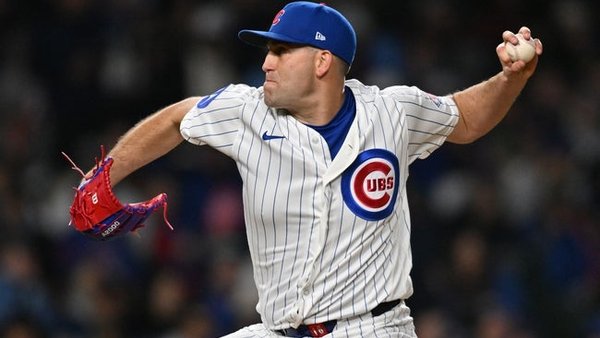
Boyd’s 4.05 ERA and superior secondary arsenal outperform Gasser’s 4.57 ERA across every meaningful category — yet the Cubs are still listed at plus money. A projected final of Milwaukee 4.9, Cubs 4.6 points to a near-coin-flip outcome, and the depleted state of both bullpens keeps the gap between these teams narrower than the -126 price implies.
Matthew Boyd vs. Robert Gasser: Chicago Cubs at Milwaukee Brewers Betting Preview
The Brewers are the better team by record — 88-56 to Chicago’s 81-63 — and they’re at home. None of that is in dispute. But the market is pricing this game like Milwaukee has a meaningful edge on both sides of the ball tonight, and the starting pitching says otherwise. Matthew Boyd has been the superior arm all season, and Robert Gasser is being handed a line that doesn’t fully account for the gap between them.
The Cubs arrive from Miami after Sunday’s blowout loss, while Milwaukee comes home off a Cincinnati series where they dropped two of three. Neither team is carrying momentum. Both sit 5-5 over their last ten games, which effectively neutralizes any hot-hand argument the market might be factoring in for the home side.
The core thesis here is straightforward: Chicago is getting plus money — +104 — in a game where the projected final score is Milwaukee 4.9, Cubs 4.6. That’s not a game where the home team has a clear advantage. That’s a coin flip, and coin flips should not be paying you plus money on one side.
Game Info & Betting Lines
- Date/Time: Monday, September 7, 2026 | 2:10 PM ET
- Venue: American Family Field (Dome) | Park Factor: 1.00 — neutral run environment
- Probable Starters: Matthew Boyd (CHC) vs. Robert Gasser (MIL)
- Moneyline: Chicago Cubs +104 / Milwaukee Brewers -126
- Run Line: Milwaukee Brewers -1.5 (+163) / Chicago Cubs +1.5 (-199)
- Total: 8.5 (Over -109 / Under -111)
Why This Number Is Off
The market is doing what it usually does: crediting the better team at home with a moderate price discount on their opponent. Milwaukee at -126 is not outrageous — the Brewers have a run differential of 168, a dominant 3.54 team ERA, and a seven-game lead in the NL Central. The line is set where it is because the Brewers genuinely are better.
But “better team” pricing in MLB assumes the better team’s advantages show up on a given night. Tonight, the pitching matchup partially neutralizes that. Boyd’s 4.05 ERA and 1.23 WHIP in over 102 innings outperforms Gasser’s 4.57 ERA and 1.29 WHIP in every meaningful category. Milwaukee’s team pitching excellence is real, but it doesn’t automatically transfer to Gasser’s individual performance in this start.
The concern with taking the Cubs at +104 is that the Brewers’ run prevention infrastructure — their bullpen depth, their overall staff quality — creates a ceiling on how much Chicago can exploit Gasser if he stumbles early. That’s a legitimate market consideration. But the Cubs’ offense ranks significantly higher in power production (201 HR versus Milwaukee’s 133, .771 OPS versus .739), and that gap doesn’t disappear just because you’re playing in a dome. Plus money on the superior-starting-pitcher side in a near-coin-flip game is the edge.
What Separates the Pitching
Matthew Boyd operates with a four-pitch mix anchored by a four-seam fastball he throws 44.4% of the time at 92.8 mph. The heater generates a modest 13.2% whiff rate and carries a .393 xwOBA against — not a swing-and-miss pitch, but a pitch he uses to set up his secondary arsenal. The real weapons are his slider and curveball: the slider posts a 36.5% whiff rate with a .243 xwOBA against and a 25.0% put-away rate, while the curveball sits at a 26.4% whiff rate and a .230 xwOBA against. His changeup, used 26.4% of the time at just 78.7 mph, is a genuine out pitch with a 25.0% whiff rate. Boyd doesn’t miss many bats with the fastball, but his breaking and off-speed stuff creates weak contact and put-away counts that explain why his ERA stays in the low fours despite limited strikeout volume.
Robert Gasser profiles as the higher-strikeout arm — 8.52 K/9 against Boyd’s 6.95 — and his sweeper is the reason why. At 80.6 mph with a 27.6% whiff rate and a .257 xwOBA against, it’s his best pitch. But the rest of his arsenal carries exposure: his sinker (22.3% usage) holds a .374 xwOBA against, and his cutter (18.7% usage) sits at .393 xwOBA against. Against a Cubs lineup that features Pete Crow-Armstrong — whose season xwOBA of .465 and .488 xwOBA versus right-handed pitching make him one of the most dangerous bats in baseball — those contact-permissive pitches are a vulnerability. Crow-Armstrong’s 40 home runs and .946 OPS represent the kind of single-swing threat that Gasser’s elevated ERA already reflects. The gap between these two starters isn’t enormous, but Boyd wins the matchup on ERA, WHIP, and overall run prevention, and that gap is enough to question why Chicago is the underdog here.
The Pushback
Here’s where this bet almost falls apart: the Cubs’ bullpen is a wreck. Porter Hodge, Hunter Harvey, Ben Brown, Riley Martin, and Phil Maton are all on the IL — that’s five relievers unavailable, several of them on 60-day designations. The Brewers’ pen has its own issues (Brian Fitzpatrick, Rob Zastryzny, Angel Zerpa, and Bryse Wilson are all out), but Milwaukee’s deeper pitching infrastructure means they can absorb those losses better than Chicago can. If Boyd exits early and the Cubs have to piece together innings from a depleted ‘pen, the Brewers’ lineup — led by Jake Bauers (.452 xwOBA, 8.1% barrel rate) and Jackson Chourio (.410 xwOBA) — can do real damage.
The record gap is also real. Milwaukee’s seven-game lead in the NL Central didn’t happen by accident. Their 3.54 team ERA is legitimate, their run differential advantage over Chicago is substantial, and American Family Field is their home. The market already sees all of that — it’s baked into the -126 price. The question isn’t whether Milwaukee is better; it’s whether they’re better enough at tonight’s price to justify laying juice when Boyd is on the hill.
Before moving on: the run line deserves a direct look and a direct pass. Milwaukee -1.5 at +163 is genuinely tempting given the record gap, and Cubs +1.5 at -199 is the safer cover on paper. But the projected score — Milwaukee 4.9, Cubs 4.6 — points squarely to a close game, not a blowout. A 2+ run Milwaukee win is not the likely outcome when the numbers expect less than a half-run separating these teams. And laying -199 on the Cubs +1.5 eliminates the entire reason to be on Chicago in the first place: the plus-money value. If I’m taking the Cubs, I’m taking them at +104 on the moneyline, not handing back all of that edge to get an extra base of cushion I probably won’t need.
Run Environment & Game Shape
American Family Field plays as a perfectly neutral run environment — park factor of 1.00 — so there’s no environmental thumb on the scale either direction. The total is set at 8.5, and the projected combined run total of 9.4 suggests a slight lean toward the over, but the more relevant takeaway for moneyline bettors is the game shape: this figures to be a mid-scoring, competitively close game from start to finish. Neither starter is a shutdown ace who will dominate for seven innings, and neither bullpen is fully healthy. That combination tends to produce games that stay within a run or two throughout — exactly the kind of environment where a plus-money underdog with a strong starter has maximum value. When games are decided by one run, the team paying you +104 wins roughly as often as the team priced at -126. The coin-flip nature of this game, hidden behind a misleading record differential, is precisely what could swing the result in Chicago’s favor — and the market is giving you a bonus for taking that side.
The Pick
Boyd outpitches Gasser on the numbers, the Cubs’ power advantage is real, and the projected score makes this a genuine coin flip. The market is offering plus money on a side that should be closer to even. That’s the edge, and it’s enough to act on.
Bet: Chicago Cubs Moneyline +104 — 1 unit — Lean