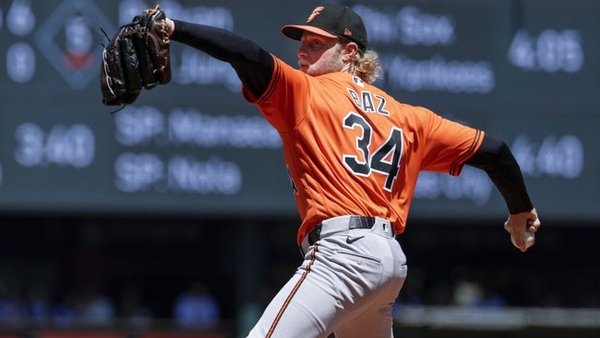
Boyd’s four-seamer sits at 92.7 mph with a .377 xwOBA against — a pitch that flatters hitters like Pete Alonso in the middle of the Baltimore order. The total is posted at 9.5 with the Over at even money and the Under juiced to -122, a juice structure that signals where the books are nudging bettors while the projected run environment points somewhere else entirely.
Matthew Boyd vs. Shane Baz: Chicago Cubs at Baltimore Orioles Betting Preview
This game projects as a mid-range run environment — two below-average offenses, two flawed-but-functional starters, and a Camden Yards park factor so close to neutral (1.01) it provides no meaningful thumb on the scale. The numbers land at Baltimore 4.7, Chicago 4.6, for a combined 9.3 against a 9.5 total. That 0.2-run gap is not a hammer bet. But the juice structure validates the direction: the Under is priced at -122 while the Over sits at even money (+100), meaning the market has already partially corrected toward the Over — and yet the projected total still falls under the number.
The pitching matchup reinforces the lean. Shane Baz enters with a 4.19 ERA across 101 innings — a legitimate, full-season sample that reflects a real pitcher doing a real job. Matthew Boyd counters at a 5.08 ERA in just 33.2 innings — a small sample prone to volatility, but one that still represents a functioning rotation arm. Neither starter is shutting down lineups, but the combined starting pitching context doesn’t scream “both starters get lit up early.”
The Cubs arrive with six relievers on the IL. Baltimore has their own bullpen concerns. The total market knows this — and has still set the line at 9.5 rather than 10 or 10.5. That restraint matters. This is a lean, not a conviction play, and the price demands you treat it that way.
Game Info & Betting Lines
- Date/Time: Tuesday, July 7, 2026 | 6:35 PM ET
- Venue: Oriole Park at Camden Yards | Park Factor: 1.01 (neutral)
- TV: MLB.TV, Marquee Sports Net, MASN
- Probable Starters: Matthew Boyd (CHC) vs. Shane Baz (BAL)
- Moneyline: Cubs -112 / Orioles -104
- Run Line: Baltimore Orioles +1.5 (-166) / Chicago Cubs -1.5 (+138)
- Total: 9.5 (Over +100 / Under -122)
Why This Number Is Close
The market has priced this total thoughtfully. The Over is getting the benefit of the doubt — Boyd’s ERA is ugly, the Cubs bullpen is depleted, and recent game logs show Baltimore went for 8 runs against Cincinnati just two days ago. The books have reason to shade the number toward the Over, and they’ve done it through juice rather than line movement: Over at +100, Under at -122.
The legitimate case for the Over is real. Boyd’s 5.08 ERA across a small sample is genuine volatility risk. His four-seam fastball sits at just 92.7 mph with a 0.377 xwOBA against — a pitch getting hit hard when it catches the zone. If he runs into Pete Alonso (.810 OPS, 19 HR) or Samuel Basallo (.789 OPS, 14 HR, .432 xwOBA overall) early, innings could inflate quickly. Basallo is a legitimate contact-quality threat against left-handed pitching specifically — his vsLHP xwOBA drops to .323, but his overall barrel rate of 7.7% signals the kind of raw power that can punish a soft four-seamer in the right count. Add a shredded Cubs bullpen and a bad Boyd outing becomes a 6-7 run Baltimore game before the sixth inning.
But here’s where I come back to the Under: the edge isn’t built on Boyd being dominant — it’s built on the aggregate run environment. Camden Yards offers no inflation. Both offenses sit below league average. Baz’s workload advantage (101 innings vs. 33.2) creates meaningful stabilization on the Baltimore side. The 0.2-run gap isn’t large, but the juice structure makes the Under the value side of a number that’s already factored in most of the Over-side risk.
What Separates the Pitching
The gap between these two starters is real but narrower than the ERA difference suggests on first glance. Shane Baz owns the more credible profile — 4.19 ERA, 1.37 WHIP, 101 innings pitched, with a multi-pitch arsenal built around a 96.1 mph four-seamer (33.7% usage) and a knuckle curve at 85.3 mph that holds hitters to a .274 xwOBA with a 28.0% whiff rate. That knuckle curve is his strikeout weapon, showing up 32.8% of the time and generating a 23.1% put-away rate. His changeup is a concern — .452 xwOBA against at just 7.8% usage — but Baz is disciplined enough to limit its exposure.
Against the Cubs lineup, Pete Crow-Armstrong presents the biggest threat at a .448 xwOBA and a strong .468 xwOBA vs. right-handed pitching. The BvP sample is too small (2 PA) to lean on, but Crow-Armstrong’s underlying profile — 25.4% whiff rate that’s manageable but not extreme — suggests Baz can get through him without automatic damage.
Matthew Boyd works a changeup-heavy approach (27.8% usage, 33.7% whiff rate, .349 xwOBA against) that functions as his best weapon, and his slider generates an elite 45.7% whiff rate with a .220 xwOBA against — the one pitch where Boyd genuinely suppresses contact. The problem is his primary offering: the four-seamer at 92.7 mph is below-average velocity with a .377 xwOBA against and only 15.6% put-away. Pete Alonso carries a .458 xwOBA overall with a 6.4% barrel rate — and while his vsLHP xwOBA dips to .407, the soft four-seamer still gives him a hittable look. Boyd’s best path through the Baltimore lineup runs through his changeup and slider. The moment he leans on that fastball against the middle of the order, the run environment shifts.
Run Environment & Game Shape
The total is set at 9.5 in a game where the park is neutral, both offenses are below league average, and neither starter profiles as a high-strikeout, low-contact arm. The Cubs carry a .747 team OPS; the Orioles sit at .714. These aren’t lineups that pile on runs through sustained rallies — they’re streaky, boom-or-bust groups that can go quiet for stretches. Baz’s knuckle curve and Boyd’s slider-changeup combination give both pitchers legitimate weapons to generate weak contact when they’re on. When they’re not, the bullpens on both sides carry real risk — particularly the Cubs, who are burning through a depleted relief corps. But the total accounts for that risk at 9.5, and with the projected combined output sitting at 9.3, there’s no compelling reason to chase the Over at even money when the Under is the sharper side of a number the market has already shaded.
The Cubs are the better team here — 50-40 vs. Baltimore’s 42-49 — but this game isn’t being bet as a blowout candidate. The run line tells you that. The total tells you the same thing: the books expect a close, lower-scoring game with marginal run inflation risk. That’s exactly what the numbers support.
Bet: Under 9.5 (-122) — 1 unit lean. The projected total falls short of the posted number, the park offers no inflation, both offenses are below average, and the Under price, while not cheap, reflects a market that’s already leaning Over — giving us the value side of a number built around risk that may not materialize.