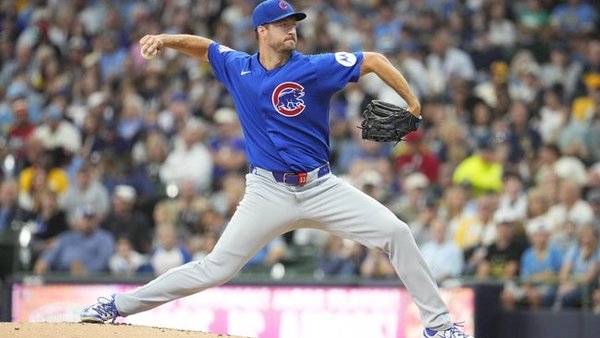
Dean Kremer’s 0.88 WHIP and 45.8% split-finger whiff rate represent a fundamentally different pitching profile than Colin Rea’s contact-heavy, .429-xwOBA sinker — yet Baltimore sits at just -130. The Cubs carry real momentum at 7-3 in their last ten, but tonight’s starter gap is wide enough to put that seasonal edge under pressure.
Colin Rea vs. Dean Kremer: Chicago Cubs at Baltimore Orioles Betting Preview
The Cubs are the better team. That sentence is true, and the market knows it — Chicago sits at 51-40 with a +49 run differential while Baltimore limps along at 42-50 and -31. The Cubs are 7-3 in their last ten. Normally, that’s where the conversation ends. But baseball pricing isn’t about who’s better overall; it’s about who’s better tonight, and tonight the starting pitcher gap is wide enough to flip the equation.
The Cubs are sending out Colin Rea, a below-replacement-level arm with a 4.74 ERA, a 1.43 WHIP, and a -0.14 WAR across 89.1 innings. Baltimore answers with Dean Kremer, who has returned from injury posting a 3.18 ERA, 0.88 WHIP, and 10.6 K/9 across 17 innings. That is not a slight edge. That is a structural advantage that the -130 price barely reflects.
The market is essentially offering the Orioles at a modest chalk price on what amounts to an elite-versus-mediocre pitching split. Matthew Boyd beat Baltimore last night 5-2, so there’s momentum against the home team — but Boyd isn’t on the mound tonight. Colin Rea is. The series result yesterday is background noise when the pitching matchup looks this different.
Game Info & Betting Lines
- Date/Time: Wednesday, July 8, 2026 — 6:35 PM ET
- Venue: Oriole Park at Camden Yards (Park Factor: 1.01 — neutral)
- Probable Starters: Colin Rea (CHC) vs. Dean Kremer (BAL)
- Moneyline: Chicago Cubs +110 / Baltimore Orioles -130
- Run Line: Baltimore Orioles -1.5 (+160) / Chicago Cubs +1.5 (-194)
- Total: 9.5 (Over +102 / Under -124)
Why This Number Is Close
The market is doing its job. Baltimore at -130 reflects the pitching edge, but it also bakes in a meaningful discount for the Orioles being a losing team on a slide. Chicago’s lineup (.747 OPS as a unit, better than Baltimore’s .711) is a genuine deterrent to pricing this higher, and the Cubs’ recent head-to-head win — Boyd shutting down Baltimore for six innings just 24 hours ago — gives the books cover to keep Baltimore reasonable rather than inflated.
The legitimate case for the other side: the Cubs are simply the better baseball team. They hit more, pitch better as a staff over the full season, and carry real momentum at 7-3. Rea has been inconsistent, but he’s also a 6-5 pitcher who eats innings. Underestimating a 51-win team on the road is easy to do when you’re chasing a pitching story.
Where I think the market is slightly wrong is on the degree of the pitching gap. Rea’s sinker produces a .429 xwOBA against and his cutter is at a .511 xwOBA — the two pitches he goes to when his four-seamer (already only a 14.6% whiff rate) isn’t locating. Kremer, meanwhile, has built his current stretch around a split-finger that generates a 45.8% whiff rate and a .132 xwOBA. That’s a true put-away pitch. The line acknowledges a Kremer edge; it may not fully account for how dominant that split-finger has been.
What Separates the Pitching
The contrast between these two starters isn’t subtle. Colin Rea leans heavily on a 93.8 mph four-seamer that he throws 41.2% of the time — a pitch hitters are producing a .379 xwOBA against. When that pitch isn’t working, he reaches for a sinker with a .429 xwOBA against and a cutter sitting at a startling .511 xwOBA. His most effective offering is his sweeper (.216 xwOBA), but he deploys it only 9% of the time. The arsenal profile is a pitcher who survives by volume and weak contact management rather than missing bats — and his 6.85 K/9 confirms it. Against a Baltimore lineup that features Pete Alonso — who carries a .458 xwOBA and a 6.4% barrel rate against right-handed pitching — that contact-dependent approach is a genuine liability. Alonso bats fourth for Baltimore tonight and has the profile to do real damage against Rea’s flatter stuff.
Dean Kremer operates from a completely different profile. His split-finger — used on 36.4% of pitches at 82.3 mph — has held hitters to a .132 xwOBA with a 32.7% put-away rate. He complements it with a sinker (.245 xwOBA, 30.0% put-away) and mixes in a four-seamer at 93.2 mph to keep hitters honest. His 0.88 WHIP in this stretch reflects genuinely clean execution, not just luck — the strikeout-to-walk split (20 K, 3 BB in 17 IP) is elite. The concern worth naming: he’s allowed 5 home runs in those 17 innings, a 2.65 HR/9 rate that is unsustainably high and points to a real vulnerability if he leaves the split-finger elevated.
The gap matters for the total as much as the moneyline. Rea creates hitter-friendly innings — high-traffic, gap-hunting, momentum-building. Kremer creates quick outs. One starter suppresses the run environment; the other expands it. In a neutral park at 1.01 factor, that asymmetry lands squarely on the side of the home team.
The Pushback
Here’s where I slow down, because this bet almost falls apart twice before it holds together once.
First: Kremer’s 17-inning sample is genuinely small. A 3.18 ERA and 0.88 WHIP over that stretch is encouraging, but it’s not a body of work you can lean on the way you’d lean on a 90-inning season. The 5 home runs allowed in those 17 innings aren’t just a footnote — they’re a signal that the split-finger elevation issue could turn a quality start into a 4-run game in a hurry. I’m not dismissing that risk; I’m discounting it at -130, not treating it as irrelevant.
Second: the Cubs are a legitimately hot team. Pete Crow-Armstrong is slashing .292 with a .910 OPS on the season, and against right-handers specifically his xwOBA jumps to .468 — a meaningful split that puts him in a dangerous spot against a pitcher whose four-seam xwOBA allowed is already .505. Ian Happ (.441 xwOBA vs. RHP) and Michael Busch (3-for-7 with a home run in limited BvP against Kremer) add real texture to the Cubs’ threat profile. This is not a lineup I’m dismissing.
So why does the bet hold? Because even with those concerns fully priced in, -130 on the better starter in a neutral park against a team whose primary advantage is seasonal record rather than tonight’s pitching matchup is a number I can live with. The Cubs’ momentum is real. Their lineup is real. But Rea’s contact-generation profile is also real, and Baltimore’s middle of the order — Alonso, Basallo, and Henderson — has the power to capitalize on it.
Angles I Rejected
Baltimore -1.5 (+160): Tempting price, but I can’t run it back. Kremer has only 17 innings pitched this return, and Baltimore’s offense (.711 OPS, 418 runs on the season) has been inconsistent enough that asking them to cover a run line against a pitcher who does eat innings feels like one bridge too far. The value is on the win, not the margin.
Over 9.5 (+102): Rea does inflate run environments — his WHIP of 1.43 and contact-heavy profile are real inputs. But Kremer suppresses the other half of this equation hard enough that getting to 10 runs in this game requires Kremer to have a bad night. At +102, the over is priced like a coin flip. It isn’t.
Under 9.5 (-124): I’d lean this direction on shape alone, but paying -124 for a total that depends on Kremer staying clean through six innings on a small sample is asking me to eat juice on a pitcher I can’t fully trust yet. I’d rather take the win probability angle at -130 than the total at -124.
Run Environment & Game Shape
The 9.5 total feels a half-run high given what Kremer’s arsenal does to contact rates. The numbers project this game closer to 9.2 combined runs — Kremer holds the Cubs to a low-traffic first five innings, and Rea generates enough baserunners on the Baltimore side to push the run environment modestly upward in the middle innings. Camden Yards sits at a 1.01 park factor, which is functionally neutral — no inflation, no suppression. Wind and weather are not factors worth flagging here.
The key game-shape question is how long each starter goes. Rea has averaged roughly 5.5 innings this season, and the Cubs’ bullpen is carrying significant injury attrition — Porter Hodge, Daniel Palencia, Hoby Milner, Phil Maton, Ben Brown, and Riley Martin are all currently on the IL. That is a decimated relief corps, and if Rea exits early, the Cubs are leaning on a very thin backend. Kremer, by contrast, has been efficient enough in his return that Baltimore’s bullpen should face less stress. The Cubs’ depleted bullpen creates enough late-inning exposure that a one- or two-run Baltimore lead in the sixth or seventh is more durable than the standings suggest. The game shape — Kremer going deep, Rea exiting by the fifth or sixth, Cubs’ relief depth stretched — favors the home team holding a lead rather than surrendering it.
The Pick
This comes back to one thing: Dean Kremer is a meaningfully better pitcher than Colin Rea tonight, and -130 is a price that respects that gap without overcorrecting for it. The Cubs are the better team over 162 games. They are not the better team tonight, and the market is offering the Orioles at a number that reflects uncertainty about a losing team rather than the reality of tonight’s matchup.
Kremer’s split-finger — 45.8% whiff rate, .132 xwOBA against — is the best single pitch in this game by a wide margin. Rea’s contact-dependent profile gets exposed by a Baltimore lineup with legitimate power in the middle. The Cubs’ bullpen is a wreck. The park is neutral. The price is at the ceiling of what I’ll pay for a home chalk, and it’s still a play.
Bet: Baltimore Orioles Moneyline -130 — 2 units — Moderate Confidence
The thesis is the starter edge. Kremer over Rea justifies every cent of the -130 ask.