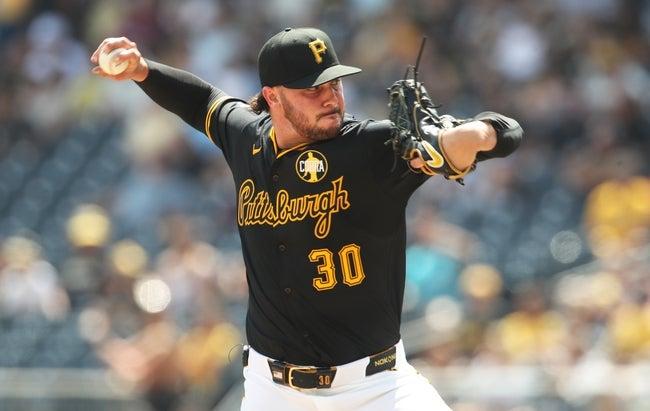
Imanaga vs. Skenes is a meaningful gap on the mound — the kind the total at 8 is already starting to reflect, with the under juiced to -120. The over isn’t dead, not with Imanaga’s 1.72 HR/9 facing a Reynolds-Valdez lineup, but the path to a crooked number runs directly through a starter posting a .155 xwOBA against his sweeper.
Shota Imanaga vs Paul Skenes: Chicago Cubs at Pittsburgh Pirates Betting Preview
Last night’s 3-2 Cubs win in 10 innings set the tone for this series — gritty, low-margin, resolved by a bases-loaded walk and an automatic runner. The game shape wasn’t a fluke. It was a reflection of what happens when two competent pitching staffs meet in a park that suppresses run scoring. Today, the pitching matchup gets meaningfully better on the home side, and that’s where the betting angle lives.
The market has posted this total at 8 with the under juiced to -120. That juice tells you the books already expect fewer runs — they’re charging a premium to bet low. The numbers project 8.6 combined, which barely clears the line. On the surface, this looks like a coin flip. But the coin is weighted by Paul Skenes, who changes the run environment in a way the raw total doesn’t fully capture. The Cubs come in with 879 strikeouts on the season — the highest in this matchup — and Skenes’ swing-and-miss profile is built to exploit exactly that kind of lineup.
This isn’t a play against the Cubs or for the Pirates outright. It’s a pitching-environment argument: Skenes caps Chicago’s ceiling, Imanaga’s HR-prone season creates some blowup risk on the Pittsburgh side, but PNC Park’s 0.96 run factor nudges that risk down. The under isn’t a lock — it’s a lean, and a specific one.
Game Info & Betting Lines
- Date/Time: Saturday, July 25, 2026 — 6:40 PM ET
- Venue: PNC Park | Park Factor: 0.96 (slight pitcher’s park)
- TV: MLB.TV, Marquee Sports Net
- Probable Starters: Shota Imanaga (CHC, 6-8, 3.91 ERA) vs Paul Skenes (PIT, 9-8, 3.43 ERA)
- Moneyline: Cubs +112 / Pirates -132
- Run Line: Pittsburgh Pirates -1.5 (+168) / Chicago Cubs +1.5 (-205)
- Total: 8 (Over -102 / Under -120)
Why This Number Is Close
The market is doing something deliberate here. Under -120 on a total of 8 is a signal, not noise — books don’t juice the under that heavily without reason. The case for the over is real: Imanaga has allowed 22 home runs in 115 innings (1.72 HR/9), Pittsburgh’s lineup carries legitimate power threats, and the Cubs’ bullpen is decimated enough that a short Imanaga outing could cascade into a multi-run inning. The over price of -102 is essentially flat, which means the market sees it as genuinely live.
But here’s where I think the market is slightly wrong in pricing the total this high at all: the numbers project 8.6 combined, which means even a mild regression toward the pitcher-friendly park context tips this under. PNC Park’s 0.96 run factor doesn’t dramatically suppress scoring, but in a game this close to the line, every fraction matters. The legitimate over case requires Imanaga to give up a multi-run inning AND the Cubs to score against Skenes — a two-variable requirement that gets harder when one of those variables is a pitcher with a 10.77 K/9.
The under at -120 isn’t value in the traditional sense. It’s the right side of a small edge in a tight market.
What Separates the Pitching
The gap between these two starters is real and measurable. Paul Skenes operates with a 96.9 mph four-seam fastball that he throws 40.9% of the time — and that pitch generates a 26.7% whiff rate with an xwOBA of .263 against. For context, that’s elite suppression on the pitch he throws most. His sweeper sits at 84.2 mph with a 26.9% whiff rate and a .155 xwOBA against — the lowest in his entire arsenal — and his changeup generates a 34.2% whiff rate. This is a three-pitch starter who misses bats at every level of the count.
Shota Imanaga is a quality starter, but the profile diverges significantly. His primary weapon is a split-finger that generates a 40.1% whiff rate and a .249 xwOBA — genuinely elite for that pitch. But his four-seam fastball sits at 91.8 mph (five full ticks below Skenes) with an xwOBA of .335 against, and his curveball is a liability at .460 xwOBA. Imanaga does have a sweeper (14.6% usage, 31.9% whiff, .291 xwOBA) that functions as a legitimate secondary weapon — but compared to Skenes’ sweeper at .155 xwOBA, the gap is stark. The splitter tunnels well off the four-seamer, but the overall arsenal depth still falls short of what Skenes brings to the table.
The BvP data adds texture. Crow-Armstrong is hitting .267 in 15 PA against Skenes with 6 strikeouts — he’s made some contact, but the strikeout rate is a consistent theme. Suzuki carries a .267 average and has even gone deep once in 16 PA against Skenes, but he’s also racked up 6 strikeouts in that sample — contact with risk baked in. Meanwhile, Bryan Reynolds carries a .424 xwOBA vs. left-handed pitching — his natural advantage against Imanaga — but in 14 BvP plate appearances he’s hitting .071 with 4 strikeouts. Esmerlyn Valdez is the mismatch: a .555 xwOBA overall with a 12.8% barrel rate, but also a 36.8% strikeout rate that Skenes doesn’t need to worry about on his side of the ledger.
The innings each pitcher creates are different in shape. Skenes produces quick outs and strikeouts — limiting baserunner accumulation. Imanaga creates more contact situations, and his HR rate means single mistakes leave the yard. But with Cruz and Horwitz on the IL for Pittsburgh, the lineup behind Reynolds and Valdez thins considerably.
The Pushback
The honest concern here is Imanaga’s home run rate blowing up the total in one swing. Esmerlyn Valdez has a 12.8% barrel rate and a 1.063 OPS — that’s a hitter who doesn’t just get lucky on fly balls. Bryan Reynolds has a .843 OPS and hits left-handed pitching particularly hard, posting a .424 xwOBA vs. LHP — Imanaga is a left-hander, and Reynolds is a legitimate threat every time he steps in the box. The over has a real pulse here, and I’m not pretending otherwise.
But consider the lineup context. With Cruz and Horwitz on the IL, Pittsburgh’s depth behind Reynolds and Valdez is genuinely thin — the projected order shows O’Hearn, Ozuna, Lowe, Triolo, and Davis rounding out the bottom half. On the Chicago side, Crow-Armstrong and Suzuki have both shown they can put the ball in play against Skenes, but neither has found consistent damage — six strikeouts apiece in limited samples tells you the swing-and-miss is real even when the average is respectable. And Bregman goes .111 in 9 BvP PA with 3 strikeouts. The Cubs’ lineup isn’t built to feast on a pitcher like this.
Run Environment & Game Shape
PNC Park plays at a 0.96 run factor — not a dramatic suppressor, but in a game parked right on the line, the directional nudge matters. Last night’s contest went 10 innings and finished 3-2; the day before, both pitching staffs held serve deep into games. The series has the feel of a low-run environment, and tonight’s starting pitcher quality jumps significantly with Skenes on the bump.
Imanaga’s 22 HR allowed in 115 innings is the legitimate wild card. One bad pitch to Valdez or Reynolds can flip this game in a hurry. But Skenes’ ability to strand baserunners and generate weak contact — a .263 xwOBA against his fastball, .155 against his sweeper — means Chicago’s path to a crooked number runs through him first, and that’s a narrow road. The under at -120 is already juiced because the market agrees. I’m on the same side.
Pittsburgh’s lineup without Cruz and Horwitz is shorter than it looks on paper, and the Cubs are facing a pitcher who has demonstrated he can dominate this roster even when hitters make occasional contact. The game shape points to a final score that stays under 8 combined runs more often than not in this spot.
Bet: Under 8 (-120) — 2 Units — Moderate Confidence. Skenes controls the Cubs’ ceiling, PNC Park keeps the floor reasonable, and the lineup attrition on Pittsburgh’s side means Imanaga doesn’t have to be perfect to keep this game manageable. Take the under, trust the pitching matchup, and let Skenes do the heavy lifting.