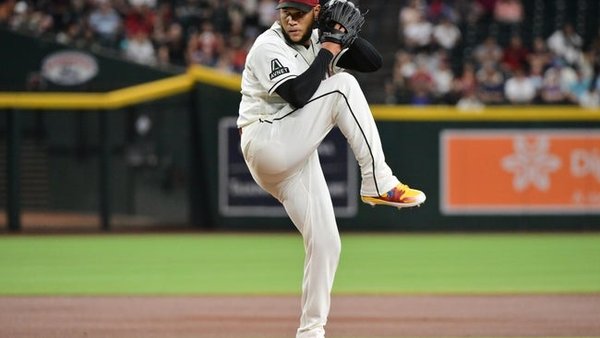
Eduardo Rodriguez carries an 11-4 record and a 2.70 ERA into Truist Park — and the market is offering him at +125. The projected margin between these teams is 0.3 runs, yet the price implies Arizona wins barely four times in ten. There is a measurable gap between Rodriguez’s sustained excellence and the probability the line is assigning him tonight.
Eduardo Rodriguez vs. Grant Holmes: Arizona Diamondbacks at Atlanta Braves Betting Preview
Arizona just shut out Atlanta 2-0 last night behind Brandon Pfaadt’s dominant seven innings. Tonight, the D-backs send out a pitcher who’s been even better — Eduardo Rodriguez, 11-4 with a 2.70 ERA over 143.1 innings. That’s an ace-tier performance. And the market is pricing him as a +125 road underdog, implying roughly 44% win probability. The projection says Atlanta wins 4.8 to 4.5 — barely a half-run gap. That gap between implied probability (~44%) and projected reality (~49%) is where this bet lives.
The market noise here is real: Atlanta is 73-49, one of the best records in baseball, at home, against a D-backs squad that’s fighting for its playoff life at 65-58. The Braves have a legitimate lineup and a staff ERA of 3.59. All of that justifies Atlanta being favored. What it doesn’t justify is the price pushing Arizona past +125 when Rodriguez is as good as he’s been all season.
The Braves counter with Grant Holmes, a 7-4 pitcher with a serviceable 3.47 ERA but a concerning home run rate that Arizona’s lineup is built to exploit. The pitching gap here is real, and the price doesn’t fully reflect it.
Game Info & Betting Lines
- Date/Time: Saturday, August 15, 2026 | 7:15 PM ET
- Venue: Truist Park | Park Factor: 1.01 (essentially neutral)
- TV: MLB.TV, FOX
- Probable Starters: Eduardo Rodriguez (ARI, 11-4, 2.70 ERA) vs. Grant Holmes (ATL, 7-4, 3.47 ERA)
- Moneyline: Arizona Diamondbacks +125 / Atlanta Braves -134
- Run Line: Atlanta Braves -1.5 (+142) / Arizona Diamondbacks +1.5 (-172)
- Total: 9.0 (Over -113 / Under -107)
Why This Number Is Off
The market’s logic is easy to follow. Atlanta is a 73-49 juggernaut at home, carrying a +122 run differential. They’ve gone 10-0 in Friday night home games this season — until last night. The Braves have Matt Olson (.882 OPS, 35 HR, xwOBA .451), Ronald Acuña Jr. (xwOBA .433), and Drake Baldwin (xwOBA .433) as the core of one of the most dangerous lineups in the NL. Pricing Atlanta at -134 at home is defensible on its face.
But here’s the problem: the engine projects this as a near pick-em game, 4.8 to 4.5. The starter component in that projection actually favors Arizona. When the numbers say one team has a slight starter edge and the market prices that team at +125, there’s a mechanical disconnect. You’re being offered a 5-point implied probability bonus — Arizona at ~44% implied versus ~49% projected — with a legitimate starter.
The market is correctly weighing Atlanta’s home dominance, lineup depth, and run differential. What it’s slightly underweighting is Rodriguez’s sustained excellence over 143 innings. This isn’t a sample-size mirage. Eleven wins, a 2.70 ERA, 1.23 WHIP — that’s a No. 2 starter performing like a No. 1, and he’s being priced like a back-of-rotation arm tonight.
What Separates the Pitching
Rodriguez and Holmes are not the same type of pitcher, and the gap between them matters in this matchup. Rodriguez relies on a four-seam fastball (39.3% usage, 92.0 mph) paired with an elite changeup (26.8% usage, 85.7 mph, 24.4% whiff rate, .288 xwOBA against). That changeup is his out pitch — a genuine swing-and-miss offering that tunnels off his fastball and suppresses hard contact. His curveball (12.5% usage, 19.4% whiff rate) gives him a second breaking option. Rodriguez isn’t missing bats at a high rate — his 6.34 K/9 is modest — but he limits damage. Thirteen home runs in 143.1 innings translates to a 0.82 HR/9, meaning he doesn’t give away big innings. The Atlanta lineup will make contact, but Rodriguez is built to keep them from stringing together the kind of multi-run frames that close out games.
Holmes is a different animal. His slider (36.1% usage, 85.2 mph) is genuinely elite — a 39.2% whiff rate and .301 xwOBA against make it one of the better breaking balls Arizona hitters will see. His 7.42 K/9 surpasses Rodriguez’s rate, and he can overpower lineups in stretches. But his four-seam fastball (29.3% usage, 94.1 mph) carries a .377 xwOBA against, and his sinker and cutter are leaking — .410 and .424 xwOBA against, respectively. Most critically, 18 home runs allowed in 114 innings is a 1.42 HR/9 rate. Against a lineup where Corbin Carroll posts a .396 xwOBA with a 6.7% barrel rate and Ketel Marte (if active) carries a .382 xwOBA, Holmes is a genuine fly-ball risk. Carroll’s BvP against Holmes (9 PA, .000 average, 3 strikeouts) cuts against him individually, but the underlying Statcast profile says Holmes is hittable for power regardless.
The gap: Rodriguez limits hard contact and suppresses home runs; Holmes misses bats but gives up the ball with regularity. In a game projected to score 9.3 combined runs, that distinction shapes who’s more likely to pitch deep and who’s more likely to get burned in a single sequence.
The Pushback
I’m not going to paper over the concerns here, because they’re legitimate. Atlanta’s top four hitters against Rodriguez are genuinely dangerous in a way the ERA doesn’t fully capture. Olson — xwOBA .451, 35 home runs, 7.5% barrel rate — has the power profile to turn one mistake into two runs instantly. His .421 xwOBA against left-handed pitching specifically means Rodriguez gets no platoon shelter. Baldwin (xwOBA .413 vs LHP) and Acuña (xwOBA .417 vs LHP) carry similar split-adjusted danger, which means the top of Atlanta’s order isn’t neutralized by the handedness matchup. Rodriguez will need to execute.
The Arizona injury situation adds genuine uncertainty. Ketel Marte left Friday’s game with left knee soreness and is day-to-day — without him, the D-backs’ lineup loses its most consistent on-base presence and a .382 xwOBA bat that Holmes would otherwise have to navigate. Lourdes Gurriel Jr., Jordan Lawlar, and Tommy Troy are also unavailable, leaving Arizona’s depth outfield and bench in rough shape. The lineup tonight is thin enough that a quality start from Holmes could be sufficient even without dominant stuff.
Atlanta’s bullpen has its own vulnerabilities — Reynaldo Lopez is on the IL — but the Braves still have options, and Arizona’s relief corps is also depleted with Drey Jameson and Ryan Thompson both unavailable. Neither side has a clean ‘pen advantage, which puts more weight on the starters. That actually reinforces the Rodriguez lean rather than undermining it, but it’s not without risk if he exits early.
What I Passed On
Atlanta at -134 was never in play for me. That’s too much juice to lay on a near-coin-flip game — when the numbers project a 0.3-run margin, I’m not paying -134 for it. The run line (-1.5 Atlanta) was dismissed for the same reason: a 0.3-run projected margin makes multi-run separation unjustifiable, and that’s before accounting for Rodriguez limiting big innings. Arizona +1.5 at -172 is equally unappealing in the other direction — the price is too steep for what amounts to a narrow-margin game. The total sits at a projected 9.3 against a posted 9.0, which is a slight lean to the over but not enough to act on at -113. The only number with enough mechanical separation to justify a bet is the Arizona moneyline.
Run Environment & Game Shape
Truist Park plays essentially neutral at a 1.01 park factor, so the venue isn’t tilting the run environment in either direction. The posted total of 9.0 is slightly below the projected 9.3, which suggests the market may be giving slight credit to the pitching matchup — or more precisely, to Holmes’s slider being a legitimate neutralizer for stretches of Arizona’s lineup.
What this run environment tells me about game shape: a game projected to finish 4.8 to 4.5 is not a blowout candidate. Both bullpens are shorthanded, which could inflate late scoring if either starter exits before the seventh, but the projected score still implies a competitive, lower-variance game where starter quality differential matters more than in a slugfest. In tight games — the kind that finish within two runs — the pitcher who limits damage in individual sequences carries more weight than the one who misses bats but leaks power. That’s Rodriguez’s profile over Holmes’s, and it’s the core of why the starter component in this matchup favors Arizona despite Atlanta’s overall team advantages.
The narrow projected margin also means Arizona doesn’t need to outperform expectations by much to cash at +125. They’re not being asked to win a game the numbers say they’ll lose — they’re being asked to win a game the numbers say is nearly even, at a price that implies they’re significantly less likely to do so.
The Pick: Arizona Diamondbacks +125 moneyline — 2 units, moderate confidence. The value thesis is straightforward: Rodriguez’s starter edge (0.82 HR/9, elite changeup, sustained 143-inning excellence) against Holmes’s leaky power profile (1.42 HR/9, .410-.424 xwOBA on secondary offerings) isn’t reflected in a price that implies only a 44% Arizona win probability when the projected margin is 0.3 runs. You’re getting paid +125 on a near-coin-flip with the better pitcher.