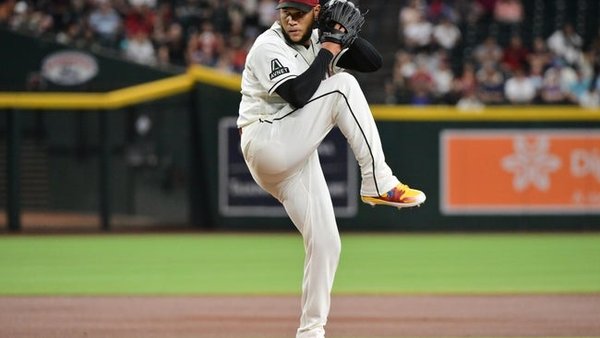
Eduardo Rodriguez (2.62 ERA, 3.77 WAR) lines up against Carson Palmquist (8.74 ERA in 11.1 innings), yet the moneyline sits at Arizona -120 — a price that treats a genuine starter mismatch like a near-even game. The Nationals’ lineup (.770 OPS) and an injury-thinned Arizona bullpen are doing real compression work on that number, but the pitching gap is as wide as it looks.
Eduardo Rodriguez vs. Carson Palmquist: Arizona Diamondbacks at Washington Nationals Betting Preview
The market has priced this game as a modest Arizona lean, and the case for that is straightforward: Eduardo Rodriguez is one of the better starters in the National League right now, while Carson Palmquist has been hammered in his limited big-league exposure. That’s the core of the bet. But Washington at +102 isn’t being ignored either — the Nationals carry a legitimate lineup (.770 OPS, 150 home runs as a team) and the Diamondbacks’ run differential on the season is a nearly flat +1, suggesting their 54-49 record is running slightly ahead of their true quality.
The market noise here is real. Arizona has won nine of their last 11 entering this series and just torched St. Louis for 10 runs Thursday — 16 hits in the makeup game after a 17-hit explosion against Oakland earlier in the week. Washington’s rotation is decimated with Irvin, Gray, and Waldichuk all on the 60-day IL. The surface narrative favors Arizona heavily. What the market is correctly doing is discounting some of that, because Palmquist’s 11.1 innings of sample is nearly meaningless, and the Nationals’ lineup can punish a struggling starter from the sixth inning onward regardless of who starts.
The edge I’m backing is narrow but clean: Rodriguez is a genuine difference-maker tonight, -120 clears the juice threshold I need to act, and Arizona’s offensive momentum — even with Ketel Marte’s back still a question mark — provides enough support to trust the starter mismatch without needing a multi-run margin.
Game Info & Betting Lines
- Date/Time: Friday, July 24, 2026 | 6:45 PM ET
- Venue: Nationals Park | Park Factor: 0.98 (neutral-to-slightly pitcher-friendly)
- Probable Starters: Eduardo Rodriguez (ARI, 8-3, 2.62 ERA) vs. Carson Palmquist (WSH, 0-1, 8.74 ERA)
- Moneyline: Arizona Diamondbacks -120 / Washington Nationals +102
- Run Line: Arizona Diamondbacks -1.5 (+136) / Washington Nationals +1.5 (-164)
- Total: 9.5 (Over -110 / Under -110)
Why This Number Is Close
The market is balancing two competing realities. On one side, Rodriguez’s 2.62 ERA, 1.217 WHIP, and 3.77 WAR in 116.2 innings represent genuine sustained excellence — this isn’t a hot streak, it’s a body of work. On the other side, Palmquist’s 8.74 ERA in just 11.1 innings is a sample so small that projecting it forward is almost irresponsible. The market is correctly applying regression to Palmquist rather than projecting him as a disaster, and that compression is why the line sits at -120 instead of -150.
The legitimate case for Washington is threefold: their lineup is objectively stronger than Arizona’s by OPS (.770 vs. .704), they just took two of three from Colorado, and Palmquist’s 11.12 K/9 in his limited time suggests the stuff is there even if the results haven’t been. The Nationals could absolutely steal this game if Palmquist survives three or four innings and hands it to a bullpen that, while depleted, still has functional arms.
Where I think the market is slightly off is in weighting Arizona’s rotation quality. Rodriguez is suppressing runs in a way that makes the Nationals’ lineup advantage partially irrelevant — you can’t score off a pitcher who isn’t giving you anything to hit. At -120, Arizona’s implied win probability is roughly 54.5%, and the numbers have them at 57.1%. That 2.6% gap is modest, but it’s consistent and real.
What Separates the Pitching
Rodriguez and Palmquist aren’t close, and the Statcast data confirms why. Rodriguez leans heavily on a four-seam fastball (39.4% usage, 92.0 mph) that generates a .345 xwOBA — solid contact suppression — and pairs it with a changeup at 26.9% usage that sits at just a .302 xwOBA against. The curveball (12.8% usage, .328 xwOBA, 20.9% whiff) gives him a third credible option, and when Rodriguez is in rhythm, he creates weak contact across the board rather than chasing strikeouts with a single put-away weapon. His 6.33 K/9 is unspectacular, but his ability to generate soft contact and avoid walks (41 BB in 116.2 IP) is what keeps his ERA at 2.62. Against a Washington lineup that leans right-handed and makes solid contact — Abrams at a .423 xwOBA vs. RHP, Garcia Jr. at .424 vs. RHP — Rodriguez’s changeup becomes the critical separator. It’s the pitch that neutralizes right-handed bats by generating early grounders and soft flyouts rather than hard-hit line drives.
Palmquist is sweeper-and-sinker dependent, with a liability four-seam fastball — and that distinction matters for how this lineup matchup actually plays out. His sweeper sits at 37.6% usage, 74.2 mph with an elite 35.4% whiff rate and a respectable .303 xwOBA — that’s a legitimate weapon. His sinker is his second-most-used pitch at 29.5% usage (90.7 mph, .290 xwOBA, 9.1% whiff) — a functional ground-ball offering that actually grades out better than his sweeper on contact quality. Together, those two pitches give Palmquist a real two-pitch combination that can get Arizona’s right-handed bats off-balance early; the sweeper tunnels effectively off the sinker, and that .290 xwOBA on the sinker means he doesn’t have to live with the sweeper exclusively to generate weak contact. The problem is what comes next: his four-seam fastball is a significant liability at a .466 xwOBA against when hitters catch up to it. Corbin Carroll’s .402 xwOBA and .410 mark against right-handed pitching, combined with Gabriel Moreno’s .403 xwOBA and .309 batting average, represent exactly the profile that feasts on fastball-heavy pitchers who can’t command the zone. Carroll has 3 PA against Palmquist in extremely limited history; Moreno went 1-for-2 with a strikeout. The sample is too small to lean on, but the underlying pitch-quality data says Arizona’s top of the order should eventually get to the fastball — and when they do, the damage will come.
The Pushback
The case against Arizona at -120 starts with the Nationals’ lineup. James Wood (.947 OPS, 28 HR) is legitimately one of the most dangerous hitters in the NL right now, and CJ Abrams has been on a tear — three homers in three games heading into this series, .423 xwOBA vs. right-handed pitching, and a .904 OPS on the season. Luis Garcia Jr. (.860 OPS, 21 HR) bats second and is a real problem for Rodriguez from the left side — his .424 xwOBA vs. RHP is the kind of number that gives even good starters trouble. These aren’t placeholder hitters padding a lineup card.
Marte’s status is the other legitimate concern. He was scratched Thursday with back stiffness, and without him at full strength, Arizona’s lineup loses its most impactful bat — .773 OPS, 18 HR, and the ability to drive the middle of the order. The Diamondbacks can still score without him, as Thursday’s 10-run output proved, but the ceiling drops meaningfully when he’s compromised.
Finally, Arizona’s bullpen carries real risk. With Drey Jameson on the IL and the rotation already stretched by Soroka, Gallen, and Nelson all unavailable, the depth behind Rodriguez gets thin fast if he’s not efficient. A short Rodriguez outing against Washington’s lineup would be a significant problem.
Why I’m Not on the Run Line
The run line at +136 is tempting, but I’m passing. Arizona’s season-long run differential is essentially flat at +1, which tells you this offense doesn’t routinely blow teams out even when the rotation is good. The numbers project a separation of only 0.2 runs between these teams (4.8 Arizona, 4.6 Washington) — that’s not the profile of a club you back to win by two. And Washington’s power threats are real enough that even a strong Rodriguez outing doesn’t guarantee a comfortable margin. Wood, Abrams, and Garcia Jr. can turn a 3-1 game into a 3-2 game with a single swing, and that’s all it takes to lose the run line. The edge on the moneyline is clean and properly sized. The run line asks me to pay for a margin I can’t reliably project.
The Pick
Rodriguez has earned his ERA over 116 innings. Palmquist hasn’t — and while his sweeper-sinker combination gives him a real path to keeping Arizona’s right-handed bats quiet early, the fastball liability and the microscopic sample mean the house of cards collapses the moment the Diamondbacks start timing his sequencing. Rodriguez doesn’t need to be dominant tonight; he just needs to be himself. Against a Washington lineup that has genuine pop but also swings and misses at a league-average rate, that’s enough. Arizona’s offense has been rolling — 26 runs in three games — and even a Marte-lite version of this lineup creates problems for a pitcher with a .466 fastball xwOBA.
The 2.6% gap between implied probability and the actual number isn’t a jackpot — it’s a working edge, the kind that compounds over a season when you apply it correctly. This is one of those spots. I’m taking Arizona on the moneyline.
Bet: Arizona Diamondbacks Moneyline -120 | 2 Units | Moderate Confidence