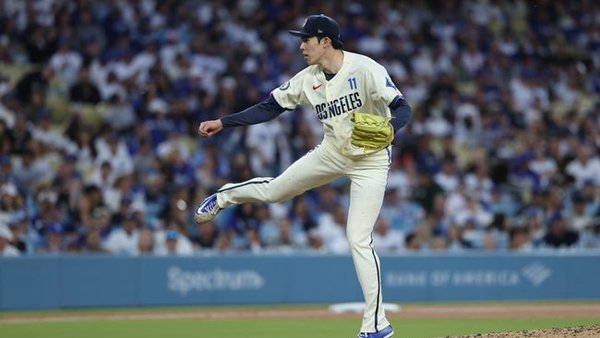
Roki Sasaki brings 116 innings of credibility to Truist Park while Atlanta counters with a pitcher carrying 8.2 innings of MLB work this season and a 6.23 ERA. The market has barely blinked — Dodgers -124 still treats this like a competitive toss-up when the starter gap says otherwise.
Roki Sasaki vs. AJ Smith-Shawver: Los Angeles Dodgers at Atlanta Braves Betting Preview
Atlanta took Tuesday’s opener 4-3, snapping the Dodgers’ six-game winning streak on an Ozzie Albies walk-off single in the eighth. The Braves earned that win. But the pitching matchup tonight shifts the calculus dramatically — Los Angeles counters with Roki Sasaki, while Atlanta answers with AJ Smith-Shawver, a pitcher with fewer than nine innings of work this season.
The market has priced this as a near-coin-flip: Dodgers -124, Braves +116. That pricing makes some sense given Tuesday’s result and Atlanta’s home environment. But the pricing doesn’t fully account for the starter quality gap — a gap that is not subtle. When one team deploys a legitimate rotation arm and the other sends out what amounts to an opener or emergency arm, -124 is a number I’m comfortable paying.
The Dodgers own a superior record (80-52 vs. 77-55), a larger run differential (+150 vs. +111), and the better offense by OPS (.761 vs. .722). The market noise around home-field momentum and Tuesday’s result is real, but it’s shading the line in Atlanta’s favor more than the underlying factors warrant.
Game Info & Betting Lines
- Date/Time: Wednesday, August 26, 2026 | 7:15 PM ET
- Venue: Truist Park | Park Factor: 1.01 (essentially neutral)
- Probable Starters: Roki Sasaki (LAD) vs. AJ Smith-Shawver (ATL)
- Moneyline: Los Angeles Dodgers -124 / Atlanta Braves +116
- Run Line: Los Angeles Dodgers -1.5 (+124) / Atlanta Braves +1.5 (-149)
- Total: 8.5 (Over -120 / Under -101)
Why This Number Is Off
The case for the line being where it is starts with Tuesday’s game. Atlanta won 4-3, the Dodgers couldn’t push Ohtani home from third in the ninth inning, and the Braves are playing with renewed energy after halting a damaging skid. Truist Park is 1.01 — barely a factor — but the home crowd will be energized. The market is legitimately accounting for all of that.
The concern is that the market may be overweighting the recency of Tuesday while underweighting tonight’s starter mismatch. Smith-Shawver carries a 6.23 ERA and 1.62 WHIP across just 8.2 innings — a sample so small it tells us almost nothing reliable, except that the Braves are not confident deploying a frontline starter here. That uncertainty alone should shift this line further in LA’s direction.
Where the market is slightly wrong is in treating this as a standard competitive matchup. It isn’t. One side has a functional rotation starter with over 116 innings of track record. The other has a pitcher whose primary role this season remains unclear. At -124, that gap isn’t fully priced in. The Dodgers are the better team by every meaningful metric, and the juice to back them is modest.
What Separates the Pitching
The starter gap here is the thesis, and the Statcast data sharpens the picture considerably. Sasaki’s arsenal is legitimate and diverse: his four-seamer sits at 97.8 mph (41.9% usage) but the pitch that defines his profile is the put-away trio — a split-finger at 34.1% whiff rate, a slider at 38.2% whiff, and a forkball at 37.5% whiff. His split-finger alone generates a .260 xwOBA against and his slider .236. These are not gimmick pitches — they’re swing-and-miss weapons that create soft contact when they don’t generate whiffs. His 8.84 K/9 and 1.30 WHIP over 116 innings establish him as someone who earns outs consistently.
The concern with Sasaki is real: a 4.42 ERA with 21 home runs allowed in 116 innings signals he is hittable. Matt Olson (.450 xwOBA, .467 xwOBA vs. RHP), Michael Harris II (.443 xwOBA vs. RHP), and Drake Baldwin (.444 xwOBA vs. RHP) are all dangerous against right-handed pitching. This is not a toothless Atlanta lineup.
But pivot to Smith-Shawver and the gap widens immediately. His four-seamer at 96.4 mph runs a 3.7% whiff rate and a .325 xwOBA — mediocre command numbers. More troubling: his curveball (10.4% usage) produces a .502 xwOBA and zero whiffs, and his slider (4.9% usage) posts a .661 xwOBA and zero whiffs. His sinker at 8.3% usage posts a .784 xwOBA — the hardest-hit pitch in his arsenal, with a 16.7% whiff rate that doesn’t come close to compensating for the contact quality it surrenders. The split-finger is his best offering (42.9% whiff, .253 xwOBA), but at 34.7% usage it can’t carry the start. Ohtani at .506 xwOBA overall and .519 xwOBA vs. RHP leads a Dodgers order that will be hunting fastballs from an arm that has not demonstrated the command to miss bats consistently. Freeman (.415 xwOBA vs. RHP) and Muncy (.443 xwOBA vs. RHP) follow, making Smith-Shawver’s path through the top three especially fraught.
The Pushback
The strongest case against this lean starts with last night’s result and the bullpen reality behind Sasaki. Treinen, Diaz, and Klein are all on the IL. If Sasaki doesn’t go deep — and his season-long track record includes plenty of hittable moments — the Dodgers are leaning on a depleted backend. Atlanta’s Raisel Iglesias saved Tuesday’s game (28 saves in 31 chances), and the Braves’ bullpen has held up better in this series.
I also looked hard at the run line. LAD -1.5 is sitting at +124, which is a tempting number on paper. But I passed on it. The scoring projections show a 4.9–4.7 split — close enough that a multi-run separation is never a clean expectation. Smith-Shawver’s short leash means Atlanta gets into a functional bullpen sooner, which tightens the game rather than blowing it open. And Tuesday’s 4-3 final is a reminder that this series has played close; backing the Dodgers to cover by two or more against a live home bullpen in a game that figures to stay tight felt like a step too far. The moneyline gives me the win without needing to sweat the margin.
Run Environment and Game Shape
The total is posted at 8.5, and the numbers point higher — a projected combined output of 9.7 runs in a 1.01 park factor environment. Smith-Shawver’s abbreviated start is the primary driver: this game is likely to be decided by run environment rather than a classic pitcher’s duel. When one starter figures to be pulled early, the game shape tends to cluster around the middle innings, where lead changes and momentum swings are more common. That dynamic actually supports the moneyline over the run line — it keeps the game live and within reach, but it doesn’t create the runway for a big LA blowout.
Joe Jensen’s Pick
The case is straightforward: the Dodgers are the better team by record, run differential, and offensive profile, and tonight they get a starter with 116 innings of credibility against an arm with 8.2. The market hasn’t moved this line far enough off center to account for that gap, which means -124 is still a price worth taking. The moneyline is the right expression here — it captures the starter advantage and superior team metrics without requiring LA to win by a specific margin in what figures to be a relatively high-scoring, bullpen-heavy game. The run line’s positive juice is attractive at first glance, but the game shape argues against needing that cushion.
Los Angeles Dodgers Moneyline (-124) — 2 Units.