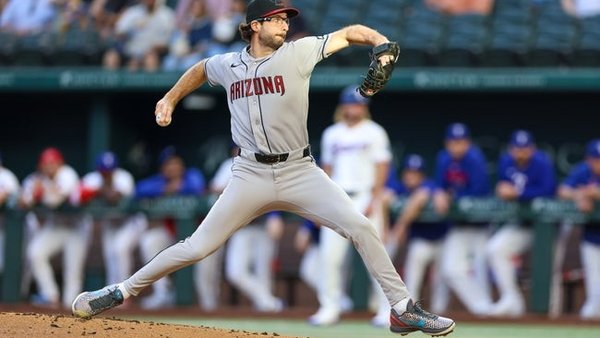
Shohei Ohtani’s 0.82 ERA meets a Diamondbacks offense carrying a .706 team OPS — and yet the total is posted at 9, a number that requires Arizona to generate runs they have shown little ability to produce. Chase Field’s dome eliminates weather as a wildcard, and the park’s 0.97 run factor keeps the ball honest, which means the over’s entire case runs through a Gallen meltdown and an Arizona rally that the numbers do not support.
Shohei Ohtani vs. Zac Gallen: Los Angeles Dodgers at Arizona Diamondbacks Betting Preview
The market has set this total at 9, which tells you the books are pricing in Gallen’s struggles and the Dodgers’ potent lineup while giving Ohtani credit for suppressing Arizona. That’s a reasonable framework — but the math doesn’t get there. The number sitting at 9 looks like the books leaning into recency bias off last night’s 6-5 game rather than a true reflection of what this pitching matchup projects to produce. The cleaner read is a combined 8.5 — a half-run gap that is small but consistent, and in a low-scoring environment that half-run is the entire argument.
The real tension here isn’t whether the Dodgers win — -200 on the moneyline makes that conversation moot before it starts. The tension is whether this game produces enough offense from both sides to crack 9. Ohtani is historically elite right now. Gallen is legitimately bad. But LAD scoring 5 or 6 against a struggling starter still doesn’t guarantee Arizona generates enough on their end to push the combined total over the line.
After yesterday’s 6-5 grinder — a game that flirted with this exact number — the market adjusted back to 9. That slight pull back is the window. The under is the play, and Ohtani’s arm is the anchor.
Game Info & Betting Lines
- Date/Time: Wednesday, June 3, 2026 | 9:40 PM ET
- Venue: Chase Field (Dome) | Park Factor: 0.97 — slightly pitcher-friendly, no weather variance
- Probable Starters: Shohei Ohtani (LAD) vs. Zac Gallen (ARI)
- Moneyline: Los Angeles Dodgers -200 / Arizona Diamondbacks +168
- Run Line: Arizona Diamondbacks +1.5 (-105) / Los Angeles Dodgers -1.5 (-114)
- Total: 9 (Over -110 / Under -110)
Why This Number Is Off
The legitimate case for the over runs through Gallen entirely. He owns a 5.16 ERA and 1.47 WHIP through 59.1 innings, with 10 home runs allowed — a rate that screams vulnerability against a lineup featuring Max Muncy (14 HR), Andy Pages (13 HR), and Ohtani-as-batter (10 HR, .909 OPS). Against Gallen’s four-seam fastball sitting 96.2 mph but producing an xwOBA-against of .367, the Dodgers’ power can do real damage. That’s the over’s entire argument: LAD scores 5 or 6, Arizona strings together 4 or 5, and suddenly you’re at 9 or 10.
But here’s the problem — that argument requires Arizona to actually generate runs against Ohtani, and nothing in their profile suggests they can do it consistently. The D-backs carry a team OPS of .706, 53 home runs, and 273 runs scored on the season. That’s one of the weaker offensive environments Ohtani will face all year. The numbers put LAD at 4.6 and ARI at 3.9 — combined 8.5, a clean half-run below the number, and that’s before you factor in how Ohtani historically tightens up in high-leverage spots.
The park doesn’t bail out the over either. Chase Field’s dome eliminates weather as a variable, but its run factor of 0.97 makes it marginally pitcher-friendly. There’s no wind blowing out, no humidity index jacking up carry. The ball plays honest tonight.
What Separates the Pitching
The gap between these two starters is one of the widest you’ll find on any given night in 2026. Ohtani carries a 0.82 ERA and 0.82 WHIP across 55 innings — numbers that belong in a different zip code from anything Gallen is doing. To put it in concrete terms: Ohtani has allowed 2 home runs all season. Gallen has allowed 10 in 59.1 innings. That’s not a gap — it’s a canyon.
Looking at the Statcast profiles, Ohtani’s four-seam fastball generates a .292 xwOBA-against at 49.7% usage and 94.0 mph, with his slider producing a .303 xwOBA. His changeup, thrown just 3.7% of the time, holds hitters to a remarkable .176 xwOBA — a genuine put-away weapon when he deploys it. Against Arizona’s top of the order, Ketel Marte (.417 xwOBA overall) and Corbin Carroll (.424 xwOBA overall) are the primary threats. Marte is a switch hitter whose right-handed splits are genuinely dangerous — a .401 xwOBA vs. RHP — but Ohtani’s ability to suppress contact limits how much that split can be exploited. Carroll bats left-handed and actually profiles similarly against both sides (.427 vsLHP, .422 vsRHP), so he’s not getting a favorable platoon advantage here. Carroll’s 27.6% whiff rate and Marte’s 19.3% whiff rate suggest Ohtani’s arsenal will generate swing-and-miss throughout the lineup regardless of handedness.
Gallen’s profile reads differently. His four-seam sits at 96.2 mph but is getting hammered to a .367 xwOBA-against. His cutter and sinker are even more exposed at .398 and .418 xwOBA respectively. The one pitch keeping him functional is his slider — a .283 xwOBA-against with a 29.8% whiff rate and 25.3% put-away rate. The problem is that slider usage sits at just 17.9%, meaning Gallen is leaning heavily on pitches that are actively getting hit hard. Freddie Freeman has seen Gallen 20 times in his career, hitting .300 with a home run and just 1 strikeout — that’s the kind of matchup that keeps Gallen’s ERA climbing.
The inning types these two create are fundamentally different. Ohtani generates soft contact and strikeouts, keeping runners off base. Gallen generates hard contact, walks, and the occasional big inning. That asymmetry defines the run environment: LAD scores in bunches while ARI is mostly suppressed.
The Pushback
The honest pushback here is Gallen — specifically, what happens if he gets shelled in the first two innings. The Dodgers’ lineup is built for crooked numbers. Freeman is hitting .300 in 20 career plate appearances against Gallen. Ohtani led off last night’s game with a double and has gone 12-for-26 over his last six games. If LAD hangs a 5-spot in the first three innings, suddenly Arizona needs 5 runs off Ohtani to push this over — and there’s essentially no version of events where that happens.
The other uncomfortable scenario: Betts has gone .357 against Gallen in 16 career PA with a home run. A single big inning from the Dodgers — three runs on a Freeman knock and a Betts homer — doesn’t doom the under by itself, but it tightens the margin considerably. This isn’t a lock. It’s a half-run edge in a game where one bad Gallen inning and one Arizona rally could easily flip the result.
What keeps me on the under: Arizona’s offense simply isn’t built to manufacture 4 or 5 against a pitcher this dominant. The D-backs’ team OPS sits at .706. Their most dangerous bat facing Ohtani is Marte, and even his overall xwOBA of .417 drops when Ohtani is locating his changeup (.176 xwOBA-against) and four-seam (.292 xwOBA-against). The over needs Arizona to have a genuine offensive night. The numbers say that’s the unlikely scenario, not the base case.
Rejected Angle: Moneyline
The Dodgers are -200. That’s real juice for a team I fully expect to win. But -200 implies a 66.7% win probability, and while LAD probably belongs around there, paying that price on the moneyline caps your upside in a way that makes it hard to build a sustainable edge. You’re risking $200 to win $100 on a game where even the best-case scenario doesn’t move the needle much. The run line at -1.5 (-114) is more interesting as an alternative, but the total under at -110 is the cleanest expression of the analytical edge here — you don’t need LAD to cover a spread, you just need the game to stay under 9 total runs.
Run Environment & Game Shape
Here’s how I see this game playing out: Ohtani goes 6 or 7 innings, allows 2 or 3 runs, and the Dodgers’ bullpen — even without Edwin Diaz — handles the back end cleanly enough. Gallen gives up 4 or 5 runs, probably including a Freeman knock and at least one extra-base hit from somewhere in the middle of the order. The Dodgers win by 2 or 3, the final looks something like 5-2 or 6-3, and the total lands comfortably under 9. The Arizona bullpen has been functional but not shutdown-caliber, and they shouldn’t need to be — if Ohtani does his job, Arizona’s offense never gets the sustained rally going that a big-total game requires. This is a pitching-dominant environment where one starter is historically good and the other is historically bad, and the books have priced in just enough Gallen chaos to inflate the total by half a run. That’s the edge. I’ll take the Under 9 at -110 for 2 units.
Bet: Under 9 (-110) | 2 Units | Moderate Confidence