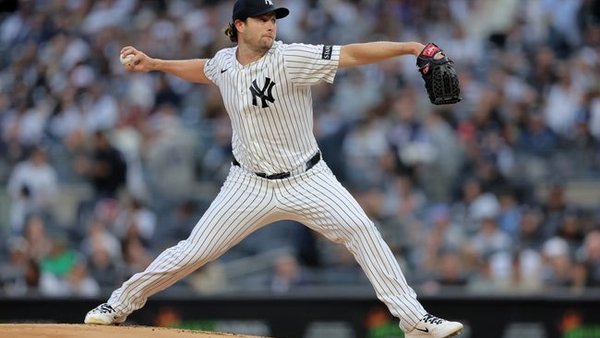
Gerrit Cole’s 4.04 ERA and 11 walks in 49 innings stand in sharp contrast to Roki Sasaki’s 5.33 ERA, 1.358 WHIP, and a fastball opponents are punishing to the tune of a .412 xwOBA — yet the moneyline is treating this as a virtual coin flip. The pitching gap is real, the venue amplifies it, and the price hasn’t adjusted to account for either.
Roki Sasaki vs. Gerrit Cole: Los Angeles Dodgers at New York Yankees Betting Preview
The public sees Dodgers and reflexively leans toward a 61-36 club with Ohtani, Freeman, and Betts in the lineup. That brand recognition is exactly what’s keeping this line tighter than it should be. But brand value doesn’t take the mound — Roki Sasaki does, and his numbers are alarming by any measure. A 5.33 ERA, a 1.358 WHIP, and 19 home runs allowed in just 81 innings (2.11 HR/9) paint the picture of a starter who gets hurt, and he’s walking into Yankee Stadium — a 1.05 park factor that doesn’t forgive fly balls.
Against him, the Yankees send Gerrit Cole: 4.04 ERA, 1.204 WHIP, 0.72 WAR versus Sasaki’s -0.43 WAR. That’s not a marginal edge — that’s a meaningful starting pitching gap being priced at near-even money. The Yankees at -104 on their home field represent the kind of pricing inefficiency that a sharp bettor recognizes immediately.
The Dodgers come in off a three-game sweep loss to Arizona, having committed nine errors over five games entering that series. Meanwhile, New York has won four straight and six of their last ten, with Ben Rice emerging as a legitimate power threat in Aaron Judge’s absence. The market hasn’t fully caught up to the rotation disparity here, and that’s where the value lives.
Game Info & Betting Lines
- Date/Time: Friday, July 17, 2026 — 7:05 PM ET
- Venue: Yankee Stadium (Park Factor: 1.05 — hitter-friendly)
- TV: MLB.TV, MLB Network, Sportsnet LA, YES
- Probable Starters: Roki Sasaki (LAD) vs. Gerrit Cole (NYY)
- Moneyline: Los Angeles Dodgers -112 / New York Yankees -104
- Run Line: New York Yankees +1.5 (-178) / Los Angeles Dodgers -1.5 (+146)
- Total: 9 (Over -122 / Under +100)
Why This Number Is Off
The market is doing its job — it sees the Dodgers’ lineup depth, their best-record-in-baseball status, and their offensive production (a .777 OPS and averaging over 5 runs per game — 506 runs scored across 97 games) and appropriately respects Los Angeles as a dangerous club on any given night. Ohtani at .953 OPS with 22 home runs alone justifies making the Dodgers a slight favorite in most environments. The -112 line is not irrational.
But here’s the problem: the line is treating this as a coin flip when the starting pitcher gap tilts decisively toward New York. Sasaki’s -0.43 WAR means he has actively cost his team value this season — that’s not a slump, that’s a starter who represents a liability every time he takes the ball. Cole, by contrast, sits at +0.72 WAR with a controllable 4.04 ERA and just 11 walks in 49 innings. The walk rate is the underrated separator: Cole is throwing strikes and keeping hitters honest. Sasaki’s 33 walks in 81 innings (3.67 BB/9) suggests he’s regularly in deep counts and elevated pitch counts that invite traffic.
The market is balancing Sasaki’s upside — when his arsenal is working, he can miss bats — against his catastrophic home run vulnerability. The Yankees’ power profile, a homer-friendly park, and Sasaki’s 2.11 HR/9 rate together create a scenario where the line should be meaningfully wider than what’s posted. At -104, you’re getting a genuine edge at near-pick’em pricing.
What Separates the Pitching
Sasaki’s arsenal has legitimate swing-and-miss potential on paper, and it’s worth understanding the full picture. He carries four distinct weapons beyond the fastball. His split-finger (22.5% usage, 90.1 mph) generates a 31.8% whiff rate with a .283 xwOBA against — a quality pitch. Separate from that, he also throws a forkball (12.0% usage, 85.3 mph) that produces an even sharper 39.8% whiff rate with a .242 xwOBA — that’s an elite bat-misser. His slider (21.6% usage, 86.6 mph) adds another 36.6% whiff rate with a .252 xwOBA. These are genuinely dangerous offerings when he’s locating them. The problem is what happens the other 43% of the time when he goes to his fastball.
His four-seam fastball sits at 43.0% usage and 97.6 mph, yet hitters are posting a .412 xwOBA against it. That is a brutal number for a pitch he throws nearly half the time. When Sasaki misses his spots with the heater — which his walk rate suggests happens regularly — he’s leaving plus-velo fastballs in hittable zones against a lineup built around home run hitters. The offspeed arsenal can’t carry him through an entire start when the fastball is that exploitable.
Cole’s profile is more balanced and harder to damage. His four-seam fastball at 44.0% usage and 96.8 mph holds hitters to a .295 xwOBA — 117 points better than what Sasaki’s fastball allows. Cole’s changeup (.228 xwOBA, 14.0% whiff) and slider (.241 xwOBA) form a complementary attack that suppresses hard contact rather than just chasing whiffs. The one concern in his arsenal is the sinker, which carries a .546 xwOBA against, but he’s deploying it at only 7.2% — a minor exposure he can manage.
The Statcast matchup data adds another layer. Shohei Ohtani carries a .519 xwOBA against right-handed pitchers and a .509 xwOBA overall — he’s Cole’s most dangerous at-bat. But in 16 plate appearances against Cole (BvP), Ohtani is hitting .062 with six strikeouts and one home run. That’s a small sample, but it’s directionally relevant. Freeman posts a .424 xwOBA against righties, while Betts sits at a modest .343 xwOBA. Cole’s profile plays better against this lineup than the Dodgers’ aggregate offensive numbers suggest.
Meanwhile, the Yankees’ top-of-order faces Sasaki — a right-hander — and the matchup numbers don’t favor the visitor. Grisham posts a .378 xwOBA vs. RHP, Domínguez sits at .371, and Bellinger checks in at .373. None of those are Ohtani-level threats, but against a starter with a 2.11 HR/9 rate, you only need a few good swings. The Yankees have connected for 142 home runs as a team this season — they don’t need elite individual performers to put crooked numbers on the board against a pitcher who consistently leaves fastballs over the plate.
The Pushback
The honest case for the Dodgers starts with their lineup depth. Even without a fully healthy roster, they’re running out Ohtani (.953 OPS, 22 HR), Freeman (.862 OPS), and Muncy (.842 OPS) — three legitimate threats that would stress any rotation. Ohtani’s overall .509 xwOBA and 9.6% barrel rate mean Cole cannot afford to miss over the middle of the plate, and his sinker (.546 xwOBA against) is a pitch he’ll need to bury or abandon entirely in this matchup.
There’s also the Aaron Judge injury factor to account for. Judge — a .907 OPS hitter with 17 home runs — is listed on the 10-Day IL with a rib injury. The Yankees’ lineup without their best hitter is meaningfully diminished, and that’s not a small thing when you’re making a case for New York to win a game where Sasaki’s home run vulnerability is central to the bet. Ben Rice has been excellent (29 HR, .971 OPS), but the lineup is thinner without Judge in right field.
The other legitimate counterpoint: Sasaki’s offspeed arsenal, when locating correctly, is genuinely elite. The combination of a 39.8% whiff forkball, a 36.6% whiff slider, and a 31.8% whiff split-finger gives him three distinct weapons capable of generating quick outs. On a night where he’s commanding those pitches and getting ahead in counts, the fastball exposure matters less. You can construct a scenario where Sasaki goes six innings of two-run ball and the Dodgers’ bullpen — despite the injury attrition — holds the Yankees offense in check.
These are real risks. They’re baked into the price at -104.
Run Environment & Game Shape
The total is set at 9, and the numbers project this game closer to 9.5 runs combined — a slight lean toward the over on paper. But I’m not touching the over at -122 juice. You’re laying a premium on a half-run edge in a game where one dominant start from Cole collapses the over in a hurry. That’s not a price worth chasing.
The under at +100 is more interesting in theory, but Sasaki’s HR vulnerability cuts against it hard. This is a pitcher giving up home runs at a 2.11 HR/9 clip at Yankee Stadium, a 1.05 park factor environment that was built for exactly this kind of damage. Even if Cole handles the Dodgers lineup efficiently, Sasaki’s exposure to the long ball keeps the floor on the total elevated enough that I’m not comfortable laying against it either.
The game shape points toward a moderate-scoring, contested contest where the pitching gap is the determining factor — not a blowout, but enough of an edge for New York to win the game outright at near-even money. The Yankees’ four-game winning streak, their home-field advantage, Cole’s demonstrable superiority over Sasaki on every measurable pitching metric, and the market’s over-reliance on the Dodgers’ brand all point in the same direction.
At -104, this is the kind of edge you take.
Bet: Yankees Moneyline -104 — 2 Units — Moderate Confidence