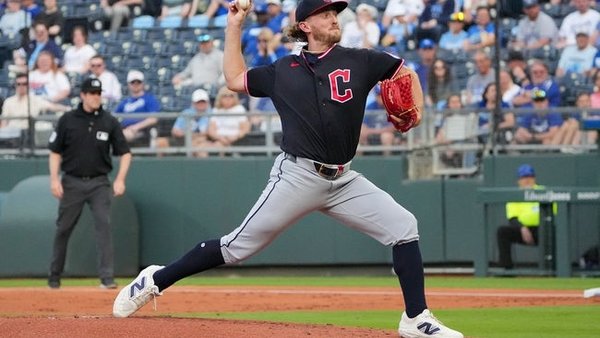
Brandon Young’s 3.42 ERA and Tanner Bibee’s 26 home runs allowed this season pull this total in opposite directions — and the market has landed at 8.5 with under juice sitting at just -106. Two offenses carrying negative run differentials, a neutral Camden Yards backdrop, and a 0.7-run gap between the projection and the posted number make this one harder to call than the price implies.
Tanner Bibee vs. Brandon Young: Cleveland Guardians at Baltimore Orioles Betting Preview
Baltimore won yesterday’s opener 6-4, with Coby Mayo going deep twice and Cleveland’s starter Joey Cantillo imploding early. Tonight the pitching matchup resets entirely — and that reset matters more than the series score. The teams meet again at Oriole Park with two starters who are meaningfully different from yesterday’s arms, and the total reflects a market that expects a cleaner, more controlled game.
The core case here isn’t about which team wins. It’s about whether two tepid offenses, each carrying a negative run differential on the season, can push past 8.5 combined runs against a pair of competent starters in a near-neutral park. Cleveland’s team OPS is .684 — bottom-tier in the American League. Baltimore checks in at .710, slightly better but hardly imposing. Neither profile screams over.
The -106 juice on the under is what makes this worth a look. You’re not laying significant vig to fade two cold offenses. The market is priced close to even, which means you don’t need to be dramatically right — you just need to be right more often than a coin flip. That’s the entry point.
Game Info & Betting Lines
- Date/Time: Tuesday, September 8, 2026 | 6:35 PM ET
- Venue: Oriole Park at Camden Yards | Park Factor: 1.01 (essentially neutral)
- Probable Starters: Tanner Bibee (CLE) vs. Brandon Young (BAL)
- Moneyline: Cleveland Guardians +109 / Baltimore Orioles -131
- Run Line: Baltimore Orioles -1.5 (+157) / Cleveland Guardians +1.5 (-191)
- Total: 8.5 (Over -113 / Under -106)
Why This Number Is Close
The market has set 8.5 for a reason. The numbers project a combined 9.2 runs — which technically leans over. The books see the same thing: two shorthanded bullpens, a Baltimore lineup with legitimate power threats, and a Cleveland starter in Bibee who has allowed 26 home runs in 166.1 innings. Those factors create real over pressure, and the -113 juice on the over reflects that the market isn’t ignoring them.
But here’s the problem with chasing the over at -113 in this run environment: the margin between the projection (9.2) and the total (8.5) is only 0.7 runs. That’s not a strong directional signal. It’s a coin flip dressed up as an edge. The over also requires you to trust that both bullpens crater in the middle innings — which is possible, but not guaranteed just because rosters are depleted.
Where the market feels slightly off is the under price. At -106, you’re getting near-even money to fade two offenses with negative run differentials against two starters with sub-4.10 ERAs in a 1.01 park factor environment. The risk is real, but the price doesn’t demand you be wildly confident — just marginally confident. That gap between the projected total and the line isn’t wide enough to make the over a comfortable swing, and the under price rewards patience.
What Separates the Pitching
Neither starter is elite, but Brandon Young has the clearly stronger profile. His 3.42 ERA and 9-3 record tell the story of a pitcher who limits damage — 110 strikeouts across 137 innings with only 19 home runs allowed. His 1.31 WHIP is the one blemish worth noting — he does allow his share of baserunners — but his ability to strand runners and suppress hard contact has kept that ERA well below what the WHIP might imply. His four-seam fastball sits at 94.4 mph and draws a 17.1% whiff rate, but the real weapon is his slider: used 15.5% of the time, it generates a 41.3% whiff rate and holds hitters to just a .268 xwOBA. Against a Cleveland lineup where Steven Kwan sits at an 8.1% hard-hit rate and Travis Bazzana at 22.5%, Young’s pitch mix is well-suited to suppressing quality contact. His splitter (18.7% usage, .294 xwOBA allowed) gives him another swing-and-miss option against righties in the middle of Cleveland’s order.
Tanner Bibee is the more volatile arm. His 4.06 ERA and 1.18 WHIP are functional — and that tighter WHIP compared to Young’s 1.31 is a genuine credibility point for the under — but a 5-15 record suggests his ERA may understate how often outings go sideways. His best pitch is a cutter — 25% usage, 30.2% whiff rate, .323 xwOBA allowed — and his changeup (14.8% usage) is legitimately nasty at 33.3% whiff and a .236 xwOBA. The concern is his sinker (20.5% usage, .360 xwOBA allowed), which gets hit hard when elevated or left over the plate. Baltimore’s Pete Alonso (.483 xwOBA, 7.0% barrel rate, 33.7% hard-hit) represents the biggest threat to Bibee’s night. Alonso has gone 3-for-6 in limited BvP exposure against Bibee, and Bibee has already surrendered 26 long balls this season. The gap between these two starters is real — Young controls innings; Bibee survives them.
The Pushback
I’m not going to pretend this is a clean under ticket. The concerns are legitimate. Pete Alonso (33 HR, .854 OPS, .483 xwOBA) is exactly the type of right-handed power bat who punishes the sinker-heavy mix Bibee leans on, and Coby Mayo (21 HR, .429 xwOBA, 30.6% hard-hit rate) and Samuel Basallo (17 HR, .404 xwOBA, 7.9% barrel rate) give Baltimore multiple ways to manufacture a crooked inning. Fading my own projection by 0.7 runs is not comfortable — I’ll be honest about that. But that discomfort is structural: both rotations are carrying high-WHIP profiles, both offenses strand runners at a clip, and a lineup built around contact-first hitters at the top doesn’t generate the sustained pressure needed to blow past 8.5 in a single game. This isn’t a matchup where one side dominates — it’s a matchup where the offensive and pitching balance points to a controlled, low-burst game that stays in range.
Run Environment & Game Shape
Camden Yards carries a 1.01 park factor — essentially dead neutral, nothing to juice or suppress run scoring beyond the matchup itself. Both teams are playing in the context of a wild card race, which tends to tighten defensive attention and bullpen usage in September. Cleveland’s team ERA is 3.76 despite the offensive struggles, and Baltimore’s bullpen — though shorthanded with Ryan Helsley on the 60-day IL — has leaned on high-leverage arms to protect late leads. The shape of this game points toward a close, lower-scoring contest where neither starter dominates but also neither gets blown out early.
A pitcher-driven, low-variance game environment amplifies the value of getting near-even money on the under. At -106, you’re not being asked to be right by a lot — just right enough. Two offenses with negative run differentials, a neutral park, and a combined pitching profile that keeps barrels in check is the right setup for this number to hold.
The lean is Under 8.5 at -106, 1 unit.