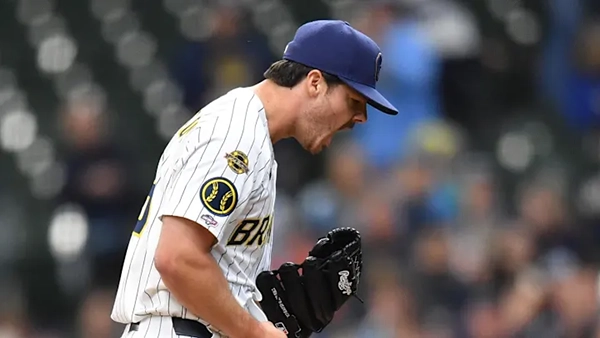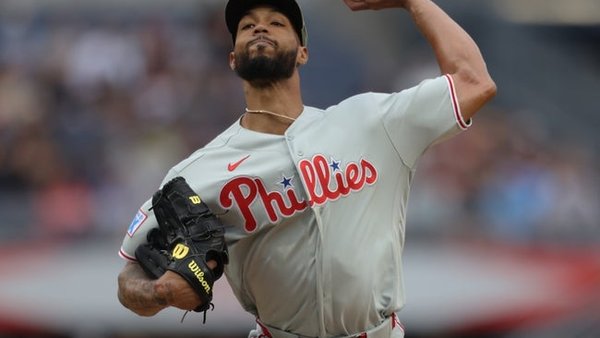
The matchup points to runs being at a premium — Sanchez’s 1.82 ERA and devastating changeup arsenal against two .231-hitting lineups. But the 7-total still assumes offensive environments that simply don’t exist here.
Gavin Williams vs Cristopher Sanchez: Cleveland Guardians at Philadelphia Phillies Betting Preview
The market has this priced like a typical early-season matchup where offenses find their rhythm and totals inflate. But these aren’t typical offenses working through April adjustments — both Cleveland (.231 average, .703 OPS) and Philadelphia (.231 average, .692 OPS) are legitimately weak at the plate, creating a run environment the 7-total doesn’t account for. When you layer Cristopher Sanchez’s dominant 1.82 ERA against Gavin Williams’ more pedestrian 3.67 mark, you get a pitching mismatch in a game where runs will already be at a premium.
The line builders are pricing this for league-average offenses that can punish mistakes and capitalize on favorable counts. Instead, we have two teams that struggle to string together quality at-bats against competent pitching, making this more about which starter can limit damage than which lineup can break through.
Game Info & Betting Lines
- Date/Time: Friday, May 22, 2026 at 6:40 PM ET
- Venue: Citizens Bank Park (Park Factor: 1.02 – neutral)
- Probable Starters: Williams (6-3, 3.67 ERA) vs Sanchez (5-2, 1.82 ERA)
- Moneyline: Cleveland Guardians +154 / Philadelphia Phillies -184
- Run Line: Philadelphia Phillies -1.5 (+118) / Cleveland Guardians +1.5 (-142)
- Total: 7 (Over +104 / Under -128)
Why This Number Is Too High
The market sees a Philadelphia home game with a quality starter and prices the total for typical offensive production. There’s logic there — Sanchez has been excellent, Citizens Bank Park plays neutral, and home teams often provide offensive boosts in favorable spots. The 7-total reflects what you’d expect from two average lineups facing average pitching in a neutral park.
But that framework breaks down when you examine what these offenses actually produce. Cleveland has scored just 225 runs through 52 games (4.33 per game), while Philadelphia sits at 209 runs in 50 games (4.18 per game). Neither team creates consistent offensive pressure, and both rely heavily on situational hitting that becomes even more difficult against quality arms. The line assumes these teams will approach their season averages, but those averages are already below what the total anticipates.
The pitching gap amplifies this disconnect. When you have a starter posting a 1.82 ERA facing lineups that struggle to generate consistent contact, the game shape shifts toward a pitcher’s duel that the market hasn’t fully absorbed.
What Separates the Pitching
The arsenal data reveals why Sanchez has been so effective and why this matchup favors run suppression. His changeup — thrown 37.4% of the time at 86.4 mph — generates a devastating 44.3% whiff rate while holding hitters to just .160 xwOBA. That pitch alone creates an environment where Cleveland’s contact-oriented approach becomes compromised, especially when Sanchez can command his 94.9 mph sinker (44.3% usage) for strikes early in counts.
Compare that to Williams’ more hittable profile. His primary four-seam fastball (29.5% usage, 96.3 mph) allows .399 xwOBA — a significant vulnerability that Philadelphia’s better hitters like Bryce Harper (.462 xwOBA, 7.2% barrel rate) can exploit. Williams does have a quality sweeper (25.7% usage, 47.3% whiff rate), but his inability to consistently locate his fastball creates favorable hitting environments that Sanchez simply doesn’t provide.
The Statcast matchups tell the story of two different run-creation environments. Philadelphia faces a pitcher whose primary offerings (.399 xwOBA on fastballs, .415 xwOBA on cutters) give them legitimate scoring chances. Cleveland faces a changeup-sinker combination that’s held hitters to minimal hard contact and creates weak contact even when they make connection.
The Pushback
The concern here is Cleveland’s recent surge — nine wins in their last 10 games — suggests they’re playing above their season statistics and finding ways to manufacture runs even against quality pitching. That hot streak included some late-game heroics and clutch hitting that doesn’t show up in season-long numbers, and those teams can sometimes carry momentum into tough matchups.
There’s also the Kyle Schwarber factor. He’s listed as day-to-day with illness, and if he returns to the lineup, Philadelphia suddenly has their best power threat (.980 OPS, 20 home runs) available against Williams’ vulnerable fastball command. That changes the offensive ceiling considerably, especially in a park that plays neutral but can reward mistake pitches.
Early-season ERA numbers can be misleading, and Sanchez’s 1.82 mark over 64.1 innings might be due for some regression. His peripherals support the performance, but even elite pitchers can have off nights, and one bad inning completely changes the math on a 7-total.
But I keep coming back to the fundamental mismatch: weak offenses facing a significant pitching gap in a neutral park. Even if Cleveland continues their hot streak and Schwarber returns, both teams still need to overcome their season-long contact issues against arms that limit hard-hit opportunities.
Run Environment & Game Shape
Citizens Bank Park’s 1.02 park factor means this environment won’t inflate or suppress runs beyond what the pitching and hitting create naturally. In a 7-total game, the market expects both teams to approach their seasonal run averages, putting the projected range around 3.5-4 runs each.
But the likely game shape points toward a lower-scoring affair. Sanchez’s dominance should limit Cleveland to 2-3 runs unless Williams has a poor outing, while Philadelphia’s offensive struggles against competent pitching suggest they’ll need Williams to make multiple mistakes to push across 4-5 runs. That creates a game where 6 runs feels more realistic than 8, especially with both bullpens capable of holding leads once established.
The run environment favors pitchers who can command their arsenals and force weak contact. That description fits Sanchez perfectly and creates doubt about Williams’ ability to navigate Philadelphia’s better hitters multiple times through the order.
Joe Jensen’s Pick
JENSEN’S PICK: Under 7 (-128) — 2 Units
The pick is Under 7 (-128), meaning the combined score must stay under 7.
I considered the moneyline here, but Philadelphia’s -184 price exceeds my -130 juice ceiling, making that angle unavailable regardless of Sanchez’s pitching edge. The pitching mismatch and weak offensive environment create the perfect storm for a low-scoring game that the total hasn’t fully absorbed.
My projected score is Philadelphia 4, Cleveland 3 — exactly the type of tight, pitcher-driven game where both teams struggle to generate consistent offense. Two units reflects strong confidence in the pitching analysis while acknowledging that baseball’s inherent variance can always produce unexpected offensive outbursts. The -128 price offers solid value on what should be closer to a 6.5-total based on the actual run-creation environment these lineups provide.