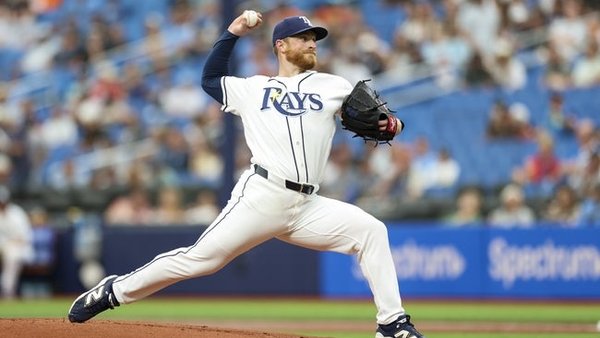
Rasmussen’s changeup is posting a .182 xwOBA against and a 36% whiff rate — and it’s drawing against a Guardians lineup that has managed three runs across three games in this series with a .684 OPS. The books settled on a flat 7 with equal juice on both sides, pricing the suppression case as if it’s already fully baked in. The pitching profiles and the cold offense say the number still has pressure on it.
Parker Messick vs. Drew Rasmussen: Cleveland Guardians at Tampa Bay Rays Betting Preview
Tampa Bay shut Cleveland out 3-0 on Saturday, with just five combined hits — and today’s matchup presents a structurally similar puzzle. The Guardians have now lost four consecutive games, and the common thread isn’t bad luck. It’s an offense that is genuinely broken right now: .232 average, .684 OPS, 884 strikeouts on the season, and the cold stretch has only deepened against Tampa Bay’s pitching.
The posted total of 7 with -110/-110 juice tells you the books respect the pitching matchup. They’re not inflating this number, and they’re not giving you a discount on either side. That market efficiency is the first pushback I have to work through — but when I look at Cleveland’s current offensive temperature and what these two starters are doing statistically, I still find enough suppression pressure to lean toward the under.
This is not a Tampa Bay team-side bet. The pitching matchup is the story. Two quality arms, a dome that suppresses, and an offense that cannot buy a run right now. That’s where the edge lives.
Game Info & Betting Lines
- Date/Time: Sunday, July 26, 2026 | 12:15 PM ET
- Venue: Tropicana Field (Dome) | Park Factor: 0.95 (slight run-suppressor)
- TV: Peacock
- Probable Starters: Parker Messick (CLE) vs. Drew Rasmussen (TB)
- Moneyline: Cleveland Guardians +120 / Tampa Bay Rays -142
- Run Line: Tampa Bay Rays -1.5 (+162) / Cleveland Guardians +1.5 (-196)
- Total: 7 (Over -110 / Under -110)
Why This Number Is Close — But Still Pressured
A total of 7 with flat juice is the market saying: we’ve done the work, we see the pitchers, we’re not giving you a bargain. And the books aren’t wrong to set it there. The numbers project 8.1 combined runs — above the posted total, but that figure sits comfortably within suppression range given the structural environment: a 0.95 park factor, two starters posting sub-3.30 ERAs with WHIPs under 1.06, and a Cleveland offense running a .684 OPS. The gap between 8.1 projected and 7 posted narrows considerably once you account for the dome, the cold offense anchoring the away side, and the elite contact-suppression both arms bring. I’m not fading this under because the raw number says so — I’m fading it because the conditions compress scoring outcomes below what a neutral environment would suggest.
The legitimate case for the over: Tampa Bay’s lineup is real. Junior Caminero (.923 OPS, 29 HR) and Yandy Díaz (.846 OPS) are threats against any starter, and Messick’s sinker generates a .378 xwOBA against — the softest offering in his arsenal. If Cleveland leaves anything elevated against this Rays lineup, runs can materialize quickly.
But here’s the problem — the over case depends on Cleveland’s bats contributing too, and that offense has produced three runs across three games in this series. Rasmussen’s changeup generates a .182 xwOBA against and a 36% whiff rate. Cleveland’s hitters are already swinging through pitches at one of the highest team strikeout rates in the AL. The market has priced this correctly on a neutral basis; the under still has juice in the cold-offense angle.
What Separates the Pitching
Parker Messick comes in at 2.68 ERA, 1.05 WHIP over 117.2 innings — legitimate top-of-rotation production, not a soft-schedule mirage. His four-seam fastball at 93.9 mph draws a 22.7% whiff rate and holds hitters to a .221 xwOBA, making it his primary weapon. The changeup is the true put-away pitch: 35.2% whiff rate, .240 xwOBA against at 85.5 mph, with enough speed differential from the fastball to make it a legitimate second look for hitters who already have to account for the heater.
The one vulnerability is the sinker, which carries a .378 xwOBA against — and against a Tampa Bay lineup stacked with hard contact, that pitch requires command precision. Yandy Díaz is hitting .429 in nine plate appearances against Messick with a 29.3% hard-hit rate season-wide. Jonathan Aranda posts a .414 xwOBA and a .435 mark against right-handed pitching. Messick will be tested.
Drew Rasmussen flips the script from the other side: 3.28 ERA, 0.98 WHIP over 104.1 innings, with a cutter-heavy approach (31.1% usage, .298 xwOBA against) backed by a 95.8 mph four-seamer and a changeup that posted a .182 xwOBA against at 36% whiff rate. That changeup is a shutdown offering against a Cleveland lineup that already strikes out at a historic pace. Bazzana has a 23.8% whiff rate on the season; Ramirez, despite his overall quality, has gone 1-for-9 lifetime against Rasmussen with two strikeouts. The gap between these arms is narrow on ERA, but Rasmussen’s sub-1.0 WHIP and Cleveland’s profile create a particularly uncomfortable matchup for the visiting offense.
Both starters are capable of a quality start. The difference is what each lineup does when the starter runs into trouble — and Cleveland’s bench offers far less margin for error.
The Pushback
The concern that genuinely gives me pause is market efficiency. Books posted 7 with flat juice. That’s not a number inviting action — it’s a number saying the suppression case is already priced in. Sharp money sees the same two starters, the same dome, the same park factor. I don’t get a free lunch here.
The second concern is Cleveland’s recent scoring drought may be partially misleading. Three runs in this series sounds alarming, but Cleveland has still put up 420 runs on the season — they’re not a historically inept offense. The drought is real, but so is the regression risk.
Where the pushback lands hardest: it’s Cleveland, not Tampa Bay, that has struggled to score. The Guardians have managed just three runs over their last three games, posting a .684 OPS on the season and entering Sunday having been shut out entirely on Saturday. That cold offense is the suppression anchor on the under — Tampa Bay’s lineup is functional, but if Messick limits damage, the entire scoring burden falls on an away team that cannot string hits together right now. The under thesis doesn’t require Tampa Bay to go cold. It just requires Cleveland to stay exactly where they’ve been.
Angles I Rejected
I looked at the Tampa Bay moneyline at -142 and walked away. Laying that much juice on a game with two quality starters and a posted total of 7 exceeds my juice ceiling — the implied probability doesn’t justify the price when a low-scoring game could easily produce a one-run result that goes either direction. The run line at Tampa Bay -1.5 (+162) is tempting on price, but with a projected final score of Tampa Bay 4, Cleveland 3, the margin between these teams is too thin to justify a -1.5 cover. Both of those angles require more precision in the outcome than the structural environment warrants. The total is the cleaner bet.
Joe Jensen’s Pick
Projected score: Tampa Bay Rays 4, Cleveland Guardians 3.
Bet: Under 7 (-110) | 2 Units | Moderate Confidence
Two starters with sub-3.30 ERAs and WHIPs under 1.06, a 0.95 park factor in a dome that suppresses run scoring, and a Cleveland offense running a .684 OPS that has managed three runs across its last three games — the structural compression here is real. The projected total of 8.1 sits above the number, but that gap shrinks inside a controlled environment where Rasmussen’s .182 xwOBA changeup matches up against one of the AL’s most strikeout-prone lineups and Messick’s 35.2% whiff changeup can neutralize Tampa Bay’s middle-of-the-order threats. This game has the ingredients for a 4-3 or 3-2 final, not a shootout. Two units on the under at flat juice is the right size for a moderate-confidence lean in a well-priced market.