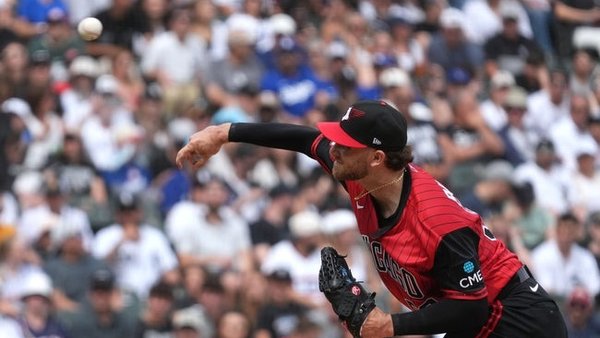
Guaranteed Rate Field hosts two strikeout-capable starters Tuesday, but the more telling detail is who isn’t in either lineup — Ramirez, DeLauter, and Murakami are all sidelined, gutting the run-scoring cores on both sides. The total is posted at 7 with the Under sitting at near-even juice (-104), a price that hasn’t fully absorbed three IL absences from the heart of both batting orders.
Parker Messick vs Sean Burke: Cleveland Guardians at Chicago White Sox Betting Preview
The market has posted this game at 7, with the Under priced at -104 — essentially a coin-flip on juice. That near-even price on a game featuring two of the AL’s better young starters, a pitcher-friendly park, and two lineups stripped of their most dangerous offensive contributors is where the value lives tonight. This isn’t about chasing a pitching duel narrative. It’s about recognizing that the lineup damage on both sides pushes actual run expectation below what the number implies.
Jose Ramirez is on the 10-Day IL with a hand injury. Chase DeLauter is out with ribs. Angel Martinez is shelved with a foot issue. On the Chicago side, Munetaka Murakami — their best hitter, a .938 OPS with 20 home runs in 200 at-bats — is on the IL with a hamstring strain. The two most impactful offensive players in this game are watching from the trainer’s room. That’s not a minor footnote; it’s the central structural fact that makes the Under compelling at a price that doesn’t fully penalize their absence.
After dropping the series opener on a walk-off Monday — Antonacci’s two-run single off Cade Smith in the ninth delivered the gut punch — the pitching matchup resets entirely. Parker Messick takes the mound against Sean Burke in a game where the run environment is already constrained by personnel, park, and probability.
Game Info & Betting Lines
- Date/Time: Tuesday, June 23, 2026 | 7:40 PM ET
- Venue: Guaranteed Rate Field | Park Factor: 0.98 (slightly run-suppressing)
- TV: MLB.TV, CLEGuardians.TV, CHSN
- Probable Starters: Parker Messick (CLE, 7-3, 2.70 ERA) vs Sean Burke (CWS, 4-4, 3.89 ERA)
- Moneyline: Cleveland -110 / Chicago -106
- Run Line: Chicago White Sox +1.5 (-192) / Cleveland Guardians -1.5 (+158)
- Total: 7 | Over -118 / Under -104
Why This Number Is Close
The market is doing its job. A total of 7 in an outdoor, non-Coors park with two starters who both carry sub-4.00 ERAs and 9-plus strikeouts per nine innings is not a line set carelessly. The books know Messick is good. They know Burke has been quietly solid. They’ve priced in the pitching quality.
The legitimate case for the Over: the raw projection sits at 8.5 to 8.6 combined runs. That’s a meaningful gap above 7. Chicago’s lineup — even without Murakami — features Colson Montgomery (.810 OPS, 20 HR), Miguel Vargas (.818 OPS, 16 HR), and Randal Grichuk, who clubbed a pinch-hit homer just last night. The White Sox have 107 home runs as a team. They don’t need Murakami to score runs; they need one bad inning from Burke not to give them back.
But here’s where the market is slightly off: a raw projection of 8.6 doesn’t account for the cumulative weight of three IL regulars — Ramirez, DeLauter, and Murakami — who represent the heart of their respective batting orders. Cleveland’s team OPS sits at .682, already one of the lower marks in the AL, and without Ramirez, that number drops into genuinely thin territory. The injury-adjusted reality pushes the true run expectation closer to 7 or below. At -104, you’re getting the Under at near-even money in a game the market is pricing as a pitcher’s duel. That’s the edge.
What Separates the Pitching
The gap between these two starters is real, but it’s not a chasm — which is itself a reason to lean on the total rather than a side.
Parker Messick is having a legitimately excellent season: 2.70 ERA, 1.096 WHIP, 9.45 K/9 over 86.2 innings. His four-seam fastball sits at 93.6 mph with a 23.8% whiff rate and an elite .218 xwOBA against — hitters aren’t squaring it up. The real weapon is his changeup, used 23.7% of the time at 85.3 mph, generating a 37.9% whiff rate. That’s a genuine swing-and-miss offering, and it’s what drives his strikeout profile. Messick’s sinker is the concern — a .416 xwOBA against suggests hitters can do damage when they get into it — but he uses it selectively at 16.7% of pitches. Against a Chicago lineup built on right-handed power (Montgomery, Vargas, Grichuk), Messick’s low-xwOBA fastball-changeup combination creates the kind of innings where swings come up empty.
Sean Burke doesn’t generate the same profile of dominance, but his 2026 numbers are a reasonable complement: 3.89 ERA, 1.222 WHIP, 9.0 K/9 over 81 innings. His four-seam sits at 94.5 mph with a 20.0% whiff rate and a .299 xwOBA — serviceable, not dominant. His best secondary is his slider: 17.0% usage, 30.6% whiff rate, .285 xwOBA. Burke has allowed 10 home runs in 81 innings (1.11 HR/9), and his changeup carries a .467 xwOBA against — a weapon he’s using sparingly at 4.3% for good reason. The concern against a Cleveland lineup that, even without Ramirez, features Travis Bazzana (.345 xwOBA overall, .375 xwOBA vs right-handed pitching) and Kyle Manzardo (.419 xwOBA) is that Burke can get touched up when his slider command wavers. But Manzardo’s 33.6% strikeout rate makes him a prime target for Burke’s slider-heavy approach.
The gap favors Messick clearly, but Burke’s 9.0 K/9 means he can navigate a depleted Cleveland lineup for six-plus innings without catastrophic damage. When both starters are capable of generating strikeouts at this rate, extra-base hits become the exception rather than the rule — and extra-base hits are what push games over totals.
The Pushback
I’m not going to pretend the friction here doesn’t exist. The numbers project 8.5 to 8.6 combined runs — that’s 1.5 to 1.6 runs above the posted total. The raw offensive output suggests the Over should be the play. Chicago’s lineup, even depleted, is legitimately dangerous: Colson Montgomery has 20 home runs and a .434 xwOBA, Miguel Vargas posts a .423 xwOBA, and Randal Grichuk — a .487 xwOBA overall with an .826 OPS — is capable of a multi-hit game against a left-handed starter. The White Sox have the power profile to blow this total open in a single inning.
Burke’s changeup vulnerability (.467 xwOBA against) is a real wildcard if Cleveland’s right-handed hitters dial in on it early. And Messick’s sinker (.416 xwOBA against) gives Chicago’s power-heavy lineup something to target if he leans on it in hitter’s counts. These aren’t hypothetical concerns — they’re pitch-level data points that could accelerate a crooked number in either half-inning.
But the raw projection is doing exactly what it sounds like: projecting raw. It doesn’t dynamically adjust for the fact that Murakami — Chicago’s best hitter at .938 OPS and 20 home runs — isn’t in the lineup. It doesn’t fully account for Cleveland operating without Ramirez and DeLauter simultaneously. The injury-adjusted run environment is meaningfully lower than what the projection spits out. At -104 on the Under, the market hasn’t fully repriced for that reality.
Run Environment & Game Shape
Guaranteed Rate Field carries a park factor of 0.98 — slightly below neutral, meaning the environment itself nudges run scoring down rather than up. Neither team is running hot: Cleveland is 4-6 over its last ten with a -8 run differential, and Chicago mirrors that at 4-6 with a -3 run differential. These are two .500-range clubs that have been grinding out tight games, not lighting up scoreboards.
The game shape points toward a low-scoring, starter-driven contest. Messick’s 2.70 ERA and 1.096 WHIP suggest he can hold Chicago to two or three runs across six-plus innings. Burke, despite his higher walk rate (1.222 WHIP), has the strikeout volume to keep Cleveland’s thinned-out lineup from stringing together multi-run innings. With both teams operating in a 4-6 recent stretch and the bullpens roughly neutral in their component splits, the most probable game shape is a 3-2 or 4-3 final — the kind of game that lands comfortably under 7.
The market expects a tight, pitcher-driven game with both starters going deep enough to keep the bullpens out of high-leverage situations until late. That structure benefits the Under. When you strip away Ramirez and Murakami — the two hitters most capable of single-handedly changing a run total with one swing — you’re left with lineups that need sustained rallies rather than individual power moments to push over 7. Sustained rallies against Messick and Burke, in this park, against these bullpens, is not the high-probability outcome.
The Pick
Under 7 (-104) | 2 Units | Moderate Confidence
Two injury-depleted lineups, two capable starters, and a slightly run-suppressing park add up to a run environment that sits below what the posted total implies. Ramirez and Murakami are the two hitters most likely to single-handedly push this game over 7 — and neither one is available. At near-even juice, the Under is the play.