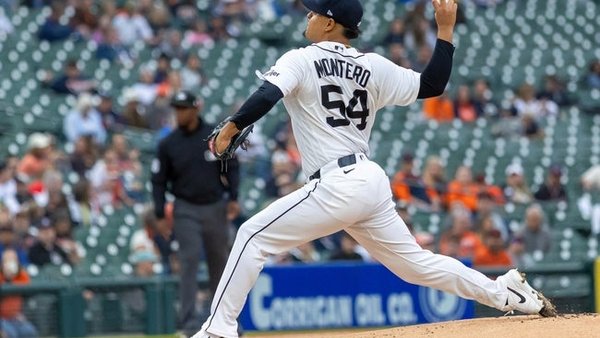
Messick’s 2.57 ERA has the market firmly behind Cleveland at -124, but the Guardians arrive 3-7 over their last ten with a -27 run differential while Detroit’s lineup — .727 OPS, 549 runs scored — has posted a +87 mark in that same stretch. The number is built on pitching narrative and head-to-head history; the offensive gap points somewhere else entirely.
Parker Messick vs. Keider Montero: Cleveland Guardians at Detroit Tigers Betting Preview
The easy read on this game is Cleveland at -124. Parker Messick is a legitimate ace candidate — 2.57 ERA, 136 strikeouts in 136.2 innings — and the Guardians have owned this Tigers roster all season, going 7-1 head-to-head with 12 wins in the last 14 meetings. The market is pricing that history into a number that asks you to lay real juice on a team trending downward.
Here’s the problem with that framing: Detroit’s offense is genuinely better than Cleveland’s by every meaningful measure. The Tigers carry a .727 OPS to the Guardians’ .684, have hit 145 home runs to Cleveland’s 117, and have scored 549 runs to Cleveland’s 483. That’s not noise — that’s a lineup that does real damage. Meanwhile, Detroit is 7-3 in their last ten games with a +87 run differential. Cleveland is 3-7 with a -27 mark in that same stretch.
The Guardians’ -124 price is an overreaction to a narrow pitching advantage in a game that projects as nearly a coin flip. Detroit at +115 is where the value lives.
Game Info & Betting Lines
- Date/Time: Thursday, August 13, 2026 | 1:10 PM ET
- Venue: Comerica Park | Park Factor: 0.99 (neutral)
- TV: MLB.TV, CLEGuardians.TV, Tigers.TV
- Probable Starters: Parker Messick (CLE) vs. Keider Montero (DET)
- Moneyline: Cleveland Guardians -124 / Detroit Tigers +115
- Run Line: Detroit Tigers +1.5 (-171) / Cleveland Guardians -1.5 (+141)
- Total: 8.5 (Over -103 / Under -117)
Why This Number Is Off
The market’s logic isn’t wrong — Messick is the better starter, Cleveland has dominated this series, and there’s real recency bias baked into Detroit’s recent form. Those are legitimate reasons to shade Cleveland. I understand the construction of this line.
The numbers project a near-coin-flip finish: Detroit 4.5, Cleveland 4.2, with a combined total right around 8.7 runs. That works out to roughly a 60 percent home win probability. At those odds, the fair moneyline on Detroit would hover around -150. Instead, you’re getting the Tigers at +115 — a 13-plus percent implied probability gap relative to where this game actually sits. That gap doesn’t get explained away by head-to-head records or recent optics.
The other side has a legitimate case. Messick is coming off a strong run, and Cleveland did just take last night’s game 6-4. But the Guardians were 3-7 coming into this series, and their offense at .684 OPS isn’t the kind that exploits a Montero mistake easily. The market is crediting Cleveland’s pitching advantage while underweighting Detroit’s lineup depth and home-field footing. That’s where the number is slightly wrong — not dramatically, but enough to matter at this price.
What Separates the Pitching
This is where the Cleveland case feels strongest, and I want to be honest about that. Parker Messick is operating at a genuinely elite level: 2.57 ERA, 1.04 WHIP, and 136 strikeouts in 136.2 innings. His four-seam fastball sits at 94.0 mph and produces a 23.0% whiff rate with just a .231 xwOBA allowed — a legitimate swing-and-miss weapon. His changeup is arguably the best pitch in his arsenal: 34.2% whiff rate with a .226 xwOBA. Against Detroit’s lineup, the concern is real. Dingler’s .442 xwOBA and Torkelson’s .412 xwOBA represent genuine contact-quality threats, but Torkelson posted a .394 xwOBA versus left-handed pitching — Messick is a lefty, which matters here. Torkelson is 1-for-5 with a homer against Messick in prior looks, but he’s also been struck out 3 times in those 5 PAs, and at a 29.2% strikeout rate on the season, the whiff angle is very real and exploitable.
Keider Montero‘s ERA sits at 3.38, and his WHIP of 1.01 actually edges Messick’s 1.04 — the surface ERA gap overstates the actual separation between these two arms. Montero’s slider generates a 26.4% whiff rate with just a .240 xwOBA against, and his changeup follows at 28.2% whiff and a .221 xwOBA — both legitimate put-away pitches. The concern with Montero is his four-seamer: 94.3 mph but only a 12.0% whiff rate and a .312 xwOBA against, meaning Cleveland hitters who put it in play are doing damage. José Ramírez holds a .353 xwOBA overall, and his .396 mark against lefties gives Cleveland’s best hitter a real angle if Montero leans on the fastball early.
The gap between these arms is real but narrower than the moneyline implies. Messick edges Montero in strikeout rate and ERA, but Montero’s WHIP and secondary arsenal keep him competitive in a near-even run environment.
The Pushback
The case against this ticket is genuinely uncomfortable. Start with the obvious: Cleveland is 7-1 against Detroit this season, including last night’s 6-4 win. That’s not a small sample — 8 games, with the Guardians winning 12 of the last 14 meetings overall. Those aren’t flukes; Cleveland has consistently found ways to beat this Detroit roster.
Messick is the real issue. A 2.57 ERA in 136.2 innings isn’t a product of luck or scheduling — that’s genuine ace-level execution. When you have someone this sharp on the mound, the 3-7 L10 record almost becomes irrelevant from a starting-pitching standpoint. He’s not the reason Cleveland has struggled recently.
Detroit’s bullpen situation is also troubling. Burch Smith, Vest, and Hurter are all on the 60-day IL — and it’s worth noting that’s Burch Smith, not Cleveland closer Cade Smith. That’s three legitimate relievers gone from Detroit’s backend, and late-inning leverage situations could get uncomfortable in a close game. This is a real variable that cuts against a Detroit ticket, and it would be dishonest to wave it away.
Run Environment
Comerica Park runs at a 0.99 park factor — essentially neutral, neither suppressing nor inflating offense. The total is posted at 8.5, and with a projected combined output sitting right around 8.7 runs, the market’s number is fair. There’s no significant lean on the total from a run-environment standpoint, which is why I’m not touching the over/under here. The edge in this game lives entirely on the moneyline side.
Joe Jensen’s Pick
Detroit Tigers ML (+115) — 2 Units
The numbers project this as a near-even game — Detroit 4.5, Cleveland 4.2 — which means the Guardians’ -124 price is built almost entirely on narrative: Messick’s ERA, the head-to-head record, and Cleveland’s home-away optics. Those factors are real, but they’re already baked into a line that’s overcorrected. Detroit at +115 gives you a meaningful implied probability edge on a team with superior offense, better recent form, and legitimate home-field footing.
I also considered the run line. Detroit +1.5 is available, but at -171 juice on a game projected to land within a fraction of a run, you’re paying a prohibitive price to cover a spread in what shapes up as a near-coin-flip contest. The juice simply doesn’t make sense when the moneyline at +115 already captures the edge more efficiently.
Detroit Tigers ML (+115) at 2 units is the play. The price is right, the offense is right, and the form is right — take the home dog and let the market’s narrative bias work for you.