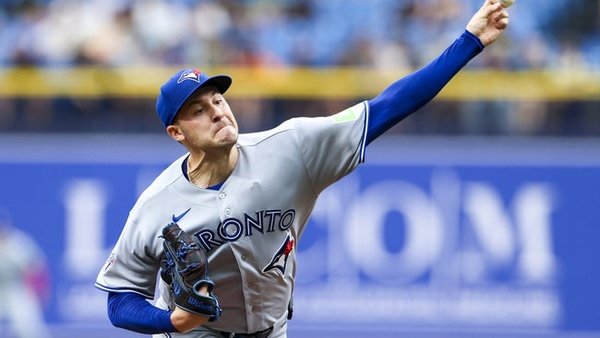
Atlanta’s organizational edge is real — the standings gap (41-20 vs. 29-32) and run differential (+110 vs. -8) say so plainly. But Grant Holmes has surrendered 11 home runs in 57 innings, and the matchup on the mound today is considerably tighter than -142 implies. The number leans on Atlanta’s resume; the starting pitching profiles lean somewhere else.
Patrick Corbin vs. Grant Holmes: Toronto Blue Jays at Atlanta Braves Betting Preview
After Tuesday night’s 4-3 Braves win — Matt Olson’s 17th homer snapping a sixth-inning tie — the series shifts to a Wednesday matchup where the pitching storyline changes significantly. The real question today isn’t whether Atlanta is the better team. They are, by almost every measure. The question is whether -142 is the right price to pay for a side with a genuine organizational edge but a starting pitching matchup that’s murkier than the line suggests.
Atlanta’s team OPS sits at .759 against Toronto’s .690 — a meaningful gap that reflects a lineup built around genuine power. The Braves have hit 85 home runs on the season compared to the Blue Jays’ 57. The Braves’ pitching staff ERA of 3.16 and WHIP of 1.154 dwarf Toronto’s 3.90 ERA and 1.273 WHIP. The organizational advantages are real. But -142 juice means I need to be highly confident to generate value, and the pitching matchup today — Corbin vs. Holmes — introduces enough noise that I’m holding back from a full unit commitment.
Game Info & Betting Lines
- Date/Time: Wednesday, June 3, 2026 | 7:15 PM ET
- Venue: Truist Park, Atlanta, GA | Park Factor: 1.01 (essentially neutral)
- TV: MLB.TV, BravesVision, Sportsnet One, TVA
- Away Starter: Patrick Corbin (2-1, 3.65 ERA, 1.358 WHIP, 49.1 IP)
- Home Starter: Grant Holmes (3-2, 3.95 ERA, 1.333 WHIP, 57 IP)
- Moneyline: Toronto Blue Jays +120 / Atlanta Braves -142
- Run Line: Atlanta Braves -1.5 (+146) / Toronto Blue Jays +1.5 (-178)
- Total: 8.5 (Over +102 / Under -124)
Why This Number Is Close
The market is pricing Atlanta as a clear favorite — and rightly so given the standings (41-20 vs. 29-32), the run differential gap (+110 for Atlanta, -8 for Toronto), and the home field edge. The Braves are a legitimate NL East frontrunner; books know that, and so does the public money flowing in on Atlanta. The -142 line is not an overreaction — it reflects a real organizational gap.
But here’s the problem: the starting pitchers today don’t represent that gap. Holmes carries a 3.95 ERA in 57 innings with 11 home runs allowed — a 1.74 HR/9 rate that is genuinely alarming given what Toronto can do against right-handed pitching when their lineup is healthy. Corbin’s 3.65 ERA in 49.1 innings actually looks slightly better on the surface, though his underlying contact profile raises separate concerns. The market is leaning on Atlanta’s organizational strength and home field — legitimate factors — but the starting pitching today doesn’t create a pricing gap that justifies -142 with confidence.
Where I think the market is slightly wrong: it’s front-loading Atlanta’s resume without fully discounting Holmes’s home run vulnerability against a lineup with real power potential. That said, Corbin’s own contact issues keep me from flipping this number entirely.
What Separates the Pitching
The arsenal comparison here is where things get genuinely interesting. Patrick Corbin leans heavily on a sinker (31.2% usage, 91.3 mph) that generates a brutal .415 xwOBA against — hitters are squaring it up consistently. His bread-and-butter weapon is actually his slider (25.2% usage, 78.5 mph), which produces a strong .187 xwOBA and a 36.6% whiff rate. That’s a legitimate put-away offering. His changeup (.274 xwOBA, 33.3% whiff) works as a secondary complement. The concern is his cutter — 18.0% usage at 86.1 mph but a shocking .548 xwOBA against. When Corbin reaches for his cutter in count leverage, Atlanta’s hitters can do damage.
And Atlanta’s lineup is primed for exactly that. Ronald Acuña Jr. carries a .457 xwOBA on the season with a 7.3% barrel rate. Against Corbin specifically, Acuña has gone 7-for-15 over 15 plate appearances (.462 average, 1 HR, 3 K) — one of the more significant BvP signals in this dataset. Ozzie Albies is 9-for-15 in 16 PA against Corbin with two home runs. Matt Olson (.466 xwOBA, 7.8% barrel rate) sits at .333 in 14 career PA, and Michael Harris II (.468 xwOBA, 39.0% hard-hit rate) has torched right-handed pitching this year at a .517 xwOBA clip.
Grant Holmes brings a more swing-and-miss profile — his slider is exceptional at 39.6% usage, 85.0 mph, with a 43.8% whiff rate and .297 xwOBA. His 94.3 mph four-seamer (32.2% usage) generates an 11.2% whiff rate, serviceable but hittable. The problem is Holmes has surrendered 11 home runs in 57 innings, and his cutter (.476 xwOBA against) and sinker (.384 xwOBA) are genuinely vulnerable. Toronto’s lineup hasn’t been consistent — averaging just 4.05 runs per game on the season, and cold in recent play — but Vlad Guerrero Jr. (30.1% hard-hit rate), Ernie Clement, and Yohendrick Piñango give them enough contact ability to get to Holmes’s weaker pitches.
The gap between these two starters is narrower than Atlanta’s overall pitching staff advantage implies. Neither arm is dominant; both are serviceable. That compression is what keeps this at lean territory rather than a strong play.
The Pushback
The strongest case against Atlanta here starts with Holmes’s home run rate. At 1.74 HR/9, he’s surrendering long balls at a rate worse than Corbin’s current clip, and Toronto — even in an inconsistent offensive year — has the lineup construction to punish elevated pitches. Guerrero Jr. owns a 30.1% hard-hit rate and has shown he can turn on mistakes from right-handers. If Holmes’s cutter (.476 xwOBA) leaks over the plate in the middle innings, Toronto has the personnel to make him pay.
There’s also a real question about whether Atlanta’s lineup can carry enough weight tonight without some of its depth pieces. The numbers lean Atlanta’s way at the top — Acuña, Harris, Olson, Albies — but the lineup thins out quickly after that core four, and Toronto’s bullpen situation is genuinely unclear given their recent rotation strain.
Injury Context
Atlanta enters tonight already reflecting a known lineup downgrade at the back end. Drake Baldwin — who has been the Braves’ best hitter this season by OPS (.931, 13 HR) — is on the 10-day IL with an oblique issue. His absence is already baked into the projected lineup: Sandy León starts at catcher, and Mauricio Dubón slides into the DH spot. This isn’t a hidden edge against the market — it’s a known degradation that the books have already priced into the -142 line. If anything, it strengthens the argument that the current price is fair compensation for Atlanta’s organizational advantage with a slightly compromised lineup, rather than an opportunity to fade the market on a surprise development. Sean Murphy (finger, 10-day IL) and Kyle Farmer (forearm, 10-day IL) are also out, adding to the positional depth concerns that keep this from being a high-confidence play.
Toronto’s injury picture is arguably worse at the rotation level — Max Scherzer (forearm), Dylan Cease (hamstring), and Jose Berríos (elbow) are all on the IL, which is a significant reason the Blue Jays are sending Corbin out in a critical spot. The bullpen depth issues that follow from a depleted rotation are a real factor in multi-inning games. Jesús Sánchez (wrist, day-to-day) is also a question mark in the outfield, though he appeared as a pinch hitter in Tuesday’s lineup data.
Run Environment
Truist Park carries a park factor of 1.01 — essentially neutral, not the launching pad that some hitter-friendly parks can be. The total sits at 8.5, with the over priced at +102, reflecting some expectation of moderate run scoring. Both starters carry WHIPs above 1.30, and neither is generating dominant strikeout numbers at the team-impact level. The conditions suggest a mid-range scoring game is plausible, which doesn’t materially shift the moneyline calculus but does explain why the run line at -1.5 (+146) requires more conviction than I have at this price point.
The numbers project Atlanta winning this game comfortably enough — the Braves’ 70.6% implied win probability from the aggregate data, +110 run differential, and superior pitching staff ERA all point the same direction. But implied probability and betting value aren’t the same thing, and -142 is asking me to lay a number that erodes the edge when I’m not fully confident in tonight’s specific starting pitcher.
Bottom Line
Atlanta is the right side here. The organizational gap is real, the BvP data on Acuña and Albies is genuinely encouraging, and Corbin’s cutter problem (.548 xwOBA against) is the kind of exploitable arsenal flaw this lineup is built to punish. I keep coming back to Atlanta’s side.
But -142 is past my value threshold for a full-unit play. Holmes’s 1.74 HR/9 introduces real variance, the lineup is carrying known absences already reflected in the price, and the starting pitching matchup doesn’t justify the full juice. This is a lean, not a strong play.
The Pick: Atlanta Braves ML (lean only) — 0 units. Do not bet this as a standalone wager at -142. If you’re playing it at all, attach it as a parlay leg or treat it as beer-money action only. The Braves are the better team tonight; the price just doesn’t give me enough room to back them with conviction.