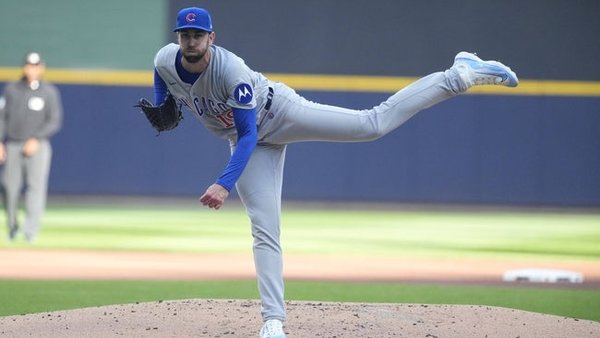
Dylan Cease’s 2.41 ERA and 51% changeup whiff rate represent one of the cleanest pitching edges on the slate — yet the moneyline has landed at -116, near pick’em pricing. David Peterson’s .432 xwOBA sinker and -0.9 WAR profile a starter who has actively cost his team wins, and the market is treating this gap like it barely exists.
Dylan Cease vs David Peterson: Toronto Blue Jays at Chicago Cubs Betting Preview
The market has priced this like a competitive game between two balanced clubs, and in some ways it is — the Cubs are the better overall team, they’re at home, and their lineup is legitimately dangerous. But when the starting pitchers are this far apart, the game’s opening act almost always tilts the outcome. Dylan Cease is one of the five best starters in baseball right now. David Peterson is, statistically, below replacement level. The price doesn’t come close to reflecting that gap.
Toronto arrives from Houston having won two of three, including a walk-off extra-inning win Wednesday. Chicago just swept the Dodgers and carries real momentum. The crowd at Wrigley will be loud, the Cubs will be confident, and the market knows all of this — which is exactly why -116 on the Blue Jays is where the line landed. The home team’s narrative is fully priced in. The pitching edge is not.
This is a starter-quality moneyline play, nothing more complicated than that. Cease limits innings depth and run exposure for Chicago while Peterson creates it for Toronto. At -116, you’re getting a dominant arm at near pick’em pricing.
Game Info & Betting Lines
- Date/Time: Thursday, August 6, 2026 | 2:20 PM ET
- Venue: Wrigley Field | Park Factor: 1.02 (slight hitter-friendly)
- TV: MLB.TV, Marquee Sports Net, Sportsnet, TVA
- Probable Starters: Dylan Cease (TOR) vs David Peterson (CHC)
- Moneyline: Toronto Blue Jays -116 / Chicago Cubs +108
- Run Line: Toronto Blue Jays -1.5 (+136) / Chicago Cubs +1.5 (-164)
- Total: 7.5 (Over -115 / Under -105)
Why This Number Is Off
The market is balancing two legitimate forces pulling in opposite directions. On one side: the Cubs are 66-49 with a +99 run differential, playing at home, coming off a sweep of the Dodgers with Pete Crow-Armstrong and Seiya Suzuki locked in. On the other: Toronto is a .470 ball club, below average offensively at a .680 team OPS, and carrying a -60 run differential. The home team’s case is real.
The concern is that the sportsbooks are weighting the Cubs’ overall team quality while underweighting the starting pitching delta. Bookmakers balance action and account for public money flowing to the home team fresh off a sweep — that’s part of why Toronto lands at -116 rather than -130 or -140. The market is partially right. This will likely be a close game. But “close” and “coin flip” are not the same thing, and a 2.41 ERA starter does not belong at -116 against a 5.52 ERA arm in any rational handicapping framework.
Where the market is slightly wrong: it’s giving too much weight to Chicago’s lineup strength in a vacuum without adjusting for what Cease does to even good lineups. His 13.1 K/9 suppresses innings where those dangerous hitters can do damage. Peterson’s volatility, meanwhile, creates multi-inning exposure that compounds Toronto’s already slim offensive chances.
What Separates the Pitching
The gap between these two arms isn’t a matter of degrees — it’s categorical. Cease’s arsenal is built around three legitimate put-away weapons: his 97.4 mph four-seamer sits at 35.8% usage and holds hitters to a .283 xwOBA with a 23.5% whiff rate. His slider at 89.2 mph generates a 41.5% whiff rate with a .214 xwOBA against. The changeup is even more devastating — 51.0% whiff rate, .199 xwOBA. He’s thrown 174 strikeouts in 119.1 innings this season, and his 4.49 WAR ranks among the elite arms in the sport.
Against Chicago’s top of the order, the BvP data is thin but directionally useful. Alex Bregman has gone to the plate 16 times against Cease with a .188 average and five strikeouts — that tracks with Cease’s ability to neutralize contact-first hitters. Seiya Suzuki is a legitimate offensive threat — he carries a .404 overall xwOBA and hits right-handers well at .389 xwOBA — but his BvP history against Cease tells a different story: three strikeouts in just five plate appearances. That whiff tendency aligns with what Cease does to right-handed bats in general. His slider and changeup play up dramatically against righties, and Suzuki’s 23.1% whiff rate suggests Cease’s spin-heavy, high-velo arsenal is exactly the kind of profile that can neutralize him even when the raw numbers say he should hit anyone.
Peterson operates in an entirely different universe. His primary weapon is a 91.9 mph sinker — thrown 30.6% of the time — that generates a .432 xwOBA against. That is not a typo. His four-seamer at 92.2 mph runs a .339 xwOBA with only a 16.9% whiff rate. His best offering is his slider (.254 xwOBA, 28.8% whiff), but it’s his fourth-most-used pitch. The result is a pitcher who lives on weak contact that isn’t coming — he’s allowed 11 home runs in 101 innings and owns a -0.9 WAR, meaning he has actively cost Chicago wins relative to a replacement-level arm.
Kazuma Okamoto carries a .409 xwOBA and a 26.8% hard-hit rate with a .417 xwOBA against right-handers — Peterson’s sinker and flat four-seamer profile him as exactly the kind of pitcher Okamoto can ambush. Jesús Sánchez sits at a .434 xwOBA vs RHP. Peterson has no answer for either of them.
The Pushback
Here’s where I slow down, because the Cubs’ case deserves honest treatment. Chicago is the significantly better team — 12 games over Toronto in the standings, with a run differential gap of 159 runs between these two clubs. That’s not noise. Pete Crow-Armstrong posted a .454 xwOBA this season with a .475 xwOBA against right-handers — he’s a legitimate MVP candidate and the most dangerous hitter Cease will face. Vlad Guerrero Jr. is listed day-to-day with a hamstring issue, which removes Toronto’s best bat from the equation and further depresses an already anemic offense. These are real countervailing forces, not cosmetic ones.
The Cubs also carry genuine bullpen depth concerns — seven relievers on the IL means Chicago’s ability to cover late innings is structurally compromised. That’s a structural edge for the Toronto side of this bet, not just a footnote. If Cease builds a lead through five or six innings, the Cubs have limited options to hold the line in reverse.
Rejected Angles
The run line at +136 is tempting given the pitching gap, but Toronto’s offense is too thin to trust for a two-run margin. A .680 team OPS against even a mediocre arm doesn’t inspire confidence in multi-run cushions, and Peterson’s volatility cuts both ways — he can implode, but he can also strand traffic. The -1.5 asks too much of a lineup this limited.
The total is equally complicated. Cease suppresses run scoring on one side, but Peterson’s .432 xwOBA sinker could get punished early, and Wrigley’s 1.02 park factor adds a tick of offensive variance. The over at -115 has a case, but the juice doesn’t justify layering a second bet on top of the moneyline when the primary edge is clean.
The Pick
The Cubs are the better team. The home crowd will be engaged. Crow-Armstrong is a problem Cease will have to solve. None of that changes the fundamental reality: a 2.41 ERA starter with a 51% changeup whiff rate and 174 strikeouts on the season does not belong at -116 against a below-replacement arm with a .432 xwOBA sinker. The pitching edge is the entire argument here, and it’s a clean one. Cease’s dominance anchors the moneyline case more cleanly than it anchors any other bet type on the board — the run line asks too much of Toronto’s offense, and the total carries too much two-way variance. The moneyline at -116 is the number, and it’s the right number to back.
Bet: Toronto Blue Jays moneyline -116 | 2 units | Moderate confidence