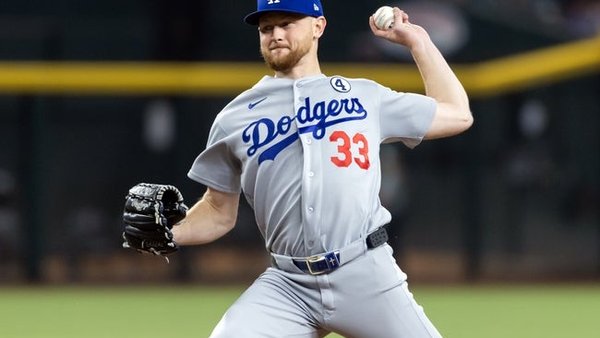
Eric Lauer has surrendered 20 home runs in just 82 innings, while Emerson Hancock carries a 3.16 ERA and a starter advantage the model pegs at -1.45 runs in Seattle’s favor — yet the market is still pricing the Dodgers at -152. The pitching profiles point one way; the number is lagging behind.
Emerson Hancock vs Eric Lauer: Seattle Mariners at Los Angeles Dodgers Betting Preview
Seattle comes into Dodger Stadium on the heels of a 7-6 victory last night, and while one game is noise, the pitching matchup tonight tells a cleaner story than last night’s bullpen slugfest did. The market has responded to the Dodgers’ 67-40 record, their home environment, and their lineup depth by installing them as -152 favorites. That price is understandable on the surface. What it doesn’t adequately reflect is the starter-level gap between Emerson Hancock and Eric Lauer — a gap that is both real and exploitable.
Hancock brings a 3.16 ERA, a 1.006 WHIP, and 2.37 WAR into this start. Lauer counters with a 4.83 ERA and has surrendered 20 home runs in just 82 innings pitched. The numbers project this game as essentially a coin flip — Seattle 4.5, Los Angeles 4.4 — which makes +128 on the Mariners not just acceptable but genuinely attractive. When the market is paying you plus money on the side that carries a 51.3% win probability, you take the number.
Yesterday’s under on this same matchup missed when the Dodgers’ bullpen allowed Seattle to score five home runs and push a 7-6 final — a reminder that pitching edges don’t always survive late-inning volatility. Tonight’s angle is different: it’s about getting the right side at a price that reflects the wrong starting pitcher advantage.
Game Info & Betting Lines
- Date/Time: Wednesday, July 29, 2026 | 10:10 PM ET
- Venue: Dodger Stadium | Park Factor: 0.98 (slight pitcher’s park)
- Probable Starters: Emerson Hancock (SEA) vs Eric Lauer (LAD)
- Moneyline: Seattle Mariners +128 / Los Angeles Dodgers -152
- Run Line: Seattle Mariners +1.5 (-154) / Los Angeles Dodgers -1.5 (+128)
- Total: 9.5 (Over -110 / Under -110)
Why This Number Is Off
The legitimate case for Dodgers -152 is straightforward: Los Angeles is a 67-40 juggernaut with a run differential of +154, a deep lineup featuring Shohei Ohtani (.907 OPS), Freddie Freeman (.872 OPS), and Max Muncy (.851 OPS), and the benefit of Dodger Stadium with a crowd that has watched their team win at one of the best rates in baseball. Add in home field — worth roughly 0.3 runs of expected margin — and the market’s -152 price is not irrational. The Dodgers are genuinely better than Seattle by most roster-construction metrics.
But here’s the problem: the market appears to be applying a roster-quality discount to Seattle while underweighting what Hancock vs. Lauer actually means for tonight’s run environment. The component breakdown puts the starter advantage at -1.45 runs in Seattle’s favor. That’s a significant gap. The Dodgers hold edges in offense (+0.47) and run prevention (+0.07), but neither overcomes the starter-level disparity. When those inputs still project the game as nearly dead even, and the market is pricing Seattle at +128, there’s 11.7% of implied probability sitting on the table. That’s not a marginal edge — it’s actionable.
The caveat is that Lauer can piece together a serviceable start. He’s done it. But the ceiling for Lauer’s performance doesn’t justify the market price the way Hancock’s floor does.
What Separates the Pitching
Hancock’s arsenal is built to suppress contact, not just miss bats. His 96.1 mph four-seamer — deployed on 43.8% of pitches — generates a .277 xwOBA against, which is elite. The pitch plays off a split-finger at 85.0 mph that produces a 27.6% whiff rate and an xwOBA of just .170. That combination of velocity and vertical separation creates the kind of swing-and-miss profile that holds up against lineup depth. His K/9 of 8.29 isn’t just a surface stat — it reflects a starter who can put sequences together and strand runners. The sweeper (33.3% whiff, .245 xwOBA) and knuckle curve (.175 xwOBA) give him late-count weapons as well.
Lauer is a different animal. His four-seamer runs at 97.7 mph with solid raw velocity, but the xwOBA against that pitch sits at a troubling .409 — hitters are doing real damage when they make contact. His slider and split-finger are legitimate weapons (38.3% and 34.2% whiff rates respectively, xwOBA .236 and .264), which is why he isn’t a complete liability. But the HR vulnerability — 20 home runs in 82 innings — isn’t bad luck. It correlates with that four-seam xwOBA, indicating hard contact when hitters square him up. With a Mariners lineup that already tagged this Dodger staff for five home runs last night, the exposure is real.
The Dodgers’ top of the order presents a genuine challenge for Hancock. Ohtani carries a .506 xwOBA and a 9.5% barrel rate — the most dangerous bat in this game. Freeman carries a .600 average in 7 plate appearances against Hancock (including 1 HR) and holds a .418 xwOBA overall. Muncy (.423 xwOBA, 7.4% barrel rate) has gone deep against Hancock in their limited history. These are legitimate threats. But Hancock’s split-finger (.170 xwOBA against) gives him a primary weapon to attack right-handed bats, and his 26 walks in 105.1 innings shows he can locate without gifting free bases. Lauer’s contact profile versus Seattle’s power bats — Dominic Canzone has hit his way to at least 18 home runs through July 28 (he hit his 16th on Sunday vs. Texas, then added two more in Tuesday’s win over Los Angeles), Randy Arozarena (.833 OPS), and Julio Rodríguez (.405 xwOBA) — is the mismatch that drives the value on the other side of this line.
Pushback: Why Seattle Might Not Cover the Narrative
The honest pushback here starts with Seattle’s offense. A team .690 OPS is not an imposing lineup. Hitting the ball out of the park five times last night was largely the product of an overextended Dodger bullpen and some favorable sequencing — not a sign that this Seattle lineup has suddenly become a high-powered attack. Josh Naylor, Weston Wilson, and J.P. Crawford are occupying the bottom third of this order, and none of them punish mistakes the way the Dodgers’ middle of the order does.
The Seattle bullpen is also a concern. Matt Brash and Cooper Criswell are both on the IL, and the backend got pushed hard in last night’s 7-6 win. If Hancock exits before the seventh, the bridge to closer Andrés Muñoz gets dicier. The Dodgers’ lineup depth — even against a tired pen — can generate rallies quickly.
And Ohtani is locked in. Nine plate appearances against Hancock with a .444 average. He’s the kind of bat who can single-handedly swing a coin-flip game, and his .506 xwOBA is the best in this lineup by a wide margin. This is not a spot to pretend the Mariners have an easy path.
Rejected Angles: Run Line and Total
The Dodgers -1.5 at +128 looks tempting given the roster gap, but the projected margin is less than half a run in Los Angeles’s favor — not nearly enough to justify laying runs in a game this close. If Hancock is sharp for six innings, Seattle likely keeps this within one. The run line asks for too much certainty in a coin-flip game.
The total at 9.5 is where the number gets genuinely interesting given both starters’ profiles, but there are too many variables working against a clean under ticket: Seattle’s bullpen depth concerns, Lauer’s HR rate, and the fact that a lineup featuring Ohtani and Freeman can erupt on any given pitch. The under requires catching both starters at their best simultaneously. I’d rather get paid to be right on the side.
Run Environment & Game Shape
Dodger Stadium’s 0.98 park factor is essentially neutral — it shaves a marginal fraction off run scoring but won’t meaningfully deflate this game on its own. The projected total of 8.9 sits below the posted 9.5, which creates mild under value in isolation, but the total is not the play here. The game shape favors a lower-scoring first five or six innings — Hancock’s contact suppression should keep the Dodgers in check early — with volatility increasing as both bullpens come into play in the sixth and beyond. The over requires the game to exceed a number that Hancock’s profile actively works against. His .170 xwOBA on the split-finger and .277 xwOBA on the four-seamer are legitimate suppression tools against even this Dodger lineup. The game shape leans toward a tighter, lower-scoring first half that keeps Seattle’s plus-money ticket alive deep into the contest — which is exactly the scenario where +128 pays off.
The play is Seattle Mariners moneyline at +128, 2 units, moderate confidence. The core thesis is simple: Hancock’s starter edge (-1.45 run component advantage) is significant enough to project this as a near-coin-flip, and the market is paying you plus money on the side that wins it 51.3% of the time. That’s 11.7% of implied probability the price hasn’t accounted for. The Dodgers are the better team — but better teams lose coin-flip games all the time, and +128 is exactly the kind of number you want when you’re on the right side of the matchup.
Bet: Seattle Mariners Moneyline +128 — 2 Units