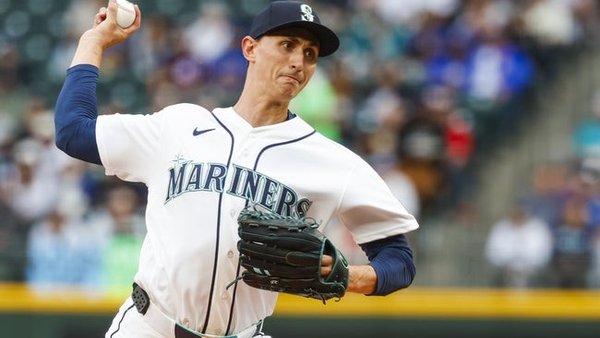
George Kirby’s 24-walk control profile against a dome that suppresses run scoring by 5% tells one story — the total sitting at 8.5 with flat -110 juice on both sides tells another. A depleted Seattle lineup missing Julio Rodriguez and Rob Refsnyder further tightens the run environment, yet the market has priced this as if both offenses are fully intact and operating at neutral.
George Kirby vs. Tyler Phillips: Seattle Mariners at Miami Marlins Betting Preview
Today’s matchup presents a fundamentally different puzzle from last night — not about who wins, but about how many runs actually cross the plate. The numbers project a combined 8.5 runs, sitting exactly on the posted number, with neither team holding more than a fractional edge. At -110/-110, there is zero market inefficiency priced into either side. That leaves the analysis entirely in the hands of the structural case, and right now, the structural case leans under.
Last night’s 6-5 walk-off in extras is the kind of result that pulls bettors toward the over. Don’t let it. A 10-inning game that needed an automatic runner and a bullpen meltdown to reach 11 combined runs is not a template — it’s a recency bias trap. Today’s matchup features a step up in starting pitcher quality on the Seattle side and a park that consistently suppresses scoring below neutral-park baseline. The fundamentals haven’t changed.
The core argument is straightforward: a 0.95 park factor dome, two competent starters, and a Seattle lineup missing Julio Rodriguez (concussion, 7-Day IL) and Rob Refsnyder (knee, 10-Day IL) creates a run environment that tilts toward the quieter side of 8.5. The question is whether the edge is real enough to act on at flat juice.
Game Info & Betting Lines
- Date/Time: Wednesday, July 8, 2026 — 6:40 PM ET
- Venue: loanDepot park (Dome) | Park Factor: 0.95 (run-suppressing)
- Probable Starters: George Kirby (SEA) vs. Tyler Phillips (MIA)
- Moneyline: Seattle Mariners -130 / Miami Marlins +110
- Run Line: Miami Marlins +1.5 (-154) / Seattle Mariners -1.5 (+128)
- Total: 8.5 (Over -110 / Under -110)
Why This Number Is Close
The market has priced this total at 8.5 for legitimate reasons. Miami’s offense is real — a team .742 OPS with 424 runs scored on the season, led by Otto Lopez (.346 AVG, .896 OPS) and a lineup that just tagged Seattle’s bullpen for a walk-off last night. The Marlins are 7-3 in their last 10 games and playing at home in a favorable environment. The market isn’t wrong to put 8.5 on the board.
Where I think the number is slightly off is in how it weights Seattle’s offensive capacity tonight. The Mariners carry a .693 team OPS — among the worst in the league — and now strip out Rodriguez (.747 OPS, 14 HR), their most dangerous everyday bat, plus Refsnyder from the DH depth. What’s left is a lineup featuring Weston Wilson in the three-hole with an xwOBA of .296 and a 31.1% strikeout rate. That is not a lineup built to score against a starter who can get outs.
The flip side of that is Phillips’ command issues, which genuinely threaten the under. His 32 walks in 69 IP create traffic even when he avoids hard contact. One crooked inning from Phillips — and there have been several this season — puts the over in play quickly. That’s the tension the market is accurately capturing. The under edge here is thin, not wide.
What Separates the Pitching
The gap between these two starters is real, and it runs in Seattle’s favor. George Kirby is one of the most command-oriented pitchers in the American League — 24 walks in 104 innings this season, a rate that translates to almost no free bases via the walk. His arsenal centers on a sweeper at 29.5% usage (87.1 mph, 26.3% whiff rate, .245 xwOBA against) that is legitimately elite at generating weak contact, paired with a 4-seam fastball sitting 96.7 mph at 29.0% usage. His sinker at 97.0 mph adds another look that generates ground balls. The changeup (33.3% whiff rate) is his put-away pitch against right-handed hitters in two-strike counts. Kirby creates inning-ending contact early and rarely manufactures traffic on his own. One qualifier worth noting: his WHIP of 1.317 reflects a hit-allowing rate that partially offsets the walk suppression — he’s not truly elite at keeping runners off base overall, just genuinely excellent at avoiding walks specifically. That distinction matters for the under case, but it doesn’t break it.
Against Miami’s lineup, the matchup is imperfect but manageable. Kyle Stowers presents the biggest threat — his xwOBA of .448 against right-handed pitching (.465 vsRHP) and 5.7% barrel rate put him in genuine danger-zone territory against Kirby’s hard stuff. Heriberto Hernández (.432 xwOBA, 6.2% barrel rate) is another arm to worry about. But Lopez, the most dangerous hitter in this lineup, sits at a 3-for-3 PA sample with a strikeout against Kirby — and his .381 vsRHP xwOBA is respectable, not terrifying.
Tyler Phillips operates with a different profile — and a more volatile one. His best pitches are a sweeper at 23.8% usage (.272 xwOBA, 34.8% whiff rate) and a split-finger at 23.1% usage (.267 xwOBA, 31.5% whiff rate). When those are working, they generate swing-and-miss and weak contact at quality rates. The problem is his sinker: 25.3% of his pitches, sitting 95.8 mph, with a .458 xwOBA against and a 3.7% whiff rate. That pitch gets hit hard when it catches too much plate. Against a gimped Seattle lineup — J.P. Crawford (.358 vsRHP xwOBA) and Randy Arozarena (.397 vsRHP xwOBA) are legitimate threats at the top — Phillips needs his secondary stuff to carry him, because his primary fastball won’t dominate.
The net of this matchup: Kirby suppresses traffic more reliably than Phillips, and that structural difference is what makes the under worth a look even at flat juice.
Run Environment & Game Shape
loanDepot park carries a 0.95 park factor — that 5% run suppression relative to a neutral venue isn’t dramatic, but in a game where the pitching matchup is already doing most of the heavy lifting for the under, every fractional edge accumulates. Closed roof, controlled environment, no wind, no humidity variables. The dome eliminates the outlier weather scenarios that inflate totals at open-air parks, and the run-suppression effect is consistent across the season’s sample here.
Game shape should follow the starters. Kirby profiles as a six-plus-inning arm who generates early contact and keeps pitch counts manageable — the kind of starter who doesn’t need to navigate jams because he doesn’t manufacture them. Phillips is capable of matching that efficiency when his sweeper and splitter are landing, though his sinker vulnerability means he could also hand Seattle two runs in the first three innings and be out by the fifth. Either way, if both starters exit with five or fewer runs on the board after five innings — which is the base expectation here — the game is squarely in under territory and the bullpens are dealing with a low-leverage maintenance scenario rather than a firefighting situation.
Bullpen context is relevant after last night. Miami’s ‘pen worked into extras in a 6-5 game, with Cade Gibson, Calvin Faucher, and Michael Rucker all logging appearances. That’s not a fresh bullpen heading into Wednesday. If Phillips exits early, McCullough is reaching into a taxed group. Seattle’s relievers also worked in extras, though the Mariners have been running a structured bullpen that doesn’t lean heavily on any one arm. Neither side has a pristine ‘pen tonight, which typically pushes run environments in one direction — but in a game where the starters are expected to carry five-plus innings, the bullpen degradation is more of a risk modifier than a primary driver.
The projected final sits at Miami 4.3, Seattle 4.2 — a combined 8.5 that lands right on the number. When the projection shades that close to the total, the structural lean becomes the tiebreaker. The dome suppression, the depleted Seattle lineup, and Kirby’s walk-suppression profile all point the same direction. That’s enough for a play, just not a hammer.
Pick: Under 8.5 at -110 | 2 units | Moderate confidence
The Pushback
Here’s where I stress-test the under case, because there are two genuine concerns that deserve direct engagement rather than dismissal.
First, Phillips’ walk rate is a real problem. A 1.38 WHIP and 32 walks in 69 innings means he is consistently putting runners on base even when he’s avoiding hard contact. The Mariners’ lineup may be depleted, but Crawford and Arozarena at the top of the order have the plate discipline to work counts and draw walks against a pitcher who struggles with command. If Phillips issues three walks in the first three innings and Seattle strings two together with a hit, you’re looking at a 3-0 deficit before Kirby has thrown 15 pitches. That scenario doesn’t need hard contact — it just needs Phillips to be Phillips.
Second, the walk-off result from Tuesday night matters for lineup psychology, if not the under thesis itself. Miami is playing loose, confident baseball — 7-3 in their last 10, a late-game comeback win last night, Otto Lopez leading the majors in batting average heading into the All-Star break. This is not a team that’s sleepwalking through a July series. They will be sharp at home tonight.
The counter to both concerns: Phillips’ walk rate creates traffic, but it doesn’t guarantee runs. The Mariners’ lineup post-Rodriguez has a .693 team OPS and limited power — converting walks into runs requires sequencing that a lineup with Weston Wilson (.296 xwOBA, 31.1% K rate) batting third isn’t built to execute reliably. And Miami’s emotional momentum is real but not quantifiable — the park factor and pitcher quality are.
The Rejected Angle
The over case rests primarily on last night’s game and Miami’s offensive form. I’ve looked at it seriously and set it aside for a specific reason: the recency trap.
Tuesday’s 6-5 game reached its total through extras and a walk-off off a tired bullpen. That is not the same game environment as Wednesday’s slate. The 10th-inning automatic runner that scored the walk-off run is a scoring mechanism that doesn’t exist in regulation. If you strip the extra innings from Tuesday, the score was 5-4 through nine — still over 8.5, but barely, and requiring a Mariners bullpen collapse to get there. Today’s game starts with Kirby, not the seventh-inning relief corps. The over play here is essentially betting that history repeats on a completely different pitching structure. I don’t find that convincing.
Miami’s offense being legitimate (.742 OPS, 424 R) is already priced into the 8.5 total. The question isn’t whether the Marlins can score — it’s whether they’ll score enough tonight, in this park, against this starter, to push the combined total past 8.5. The numbers say probably not.
The Bet
This is a situational under built on three converging factors: a dome park suppressing run scoring at 0.95, a Seattle lineup stripped of its two most productive bats, and a starting pitcher matchup that favors low-traffic innings over crooked numbers. The projection landing exactly on 8.5 tells you the edge isn’t enormous — it’s a tilt, not a gap. But tilts at flat juice are where the value lives in totals betting.
Bet: Under 8.5 (-110) | 2 units | Moderate confidence