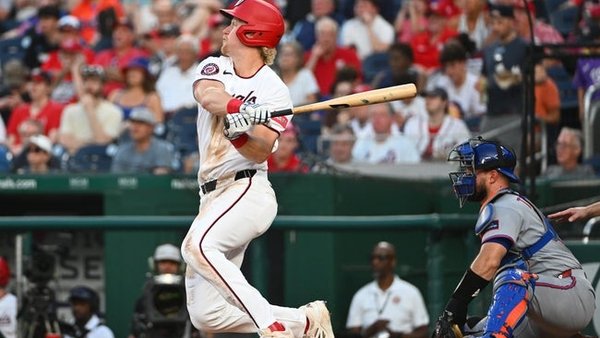
Emerson Hancock’s 2.74 ERA and multi-plane arsenal meets Miles Mikolas’s 2.06 HR/9 rate — a starter mismatch that points directly at the run environment. The posted total of 10 sits nearly a full run above the projected combined output, but Seattle’s thinning bullpen and Washington’s capacity for crooked numbers keep this a lean rather than a lock.
Emerson Hancock vs. Miles Mikolas: Seattle Mariners at Washington Nationals Betting Preview
The series has gone one game apiece — Seattle’s 10-2 blowout on Friday followed by Washington’s 8-3 answer Saturday — and now the rubber game lands on a starter mismatch that is about as clean as you’ll find in a Sunday afternoon slate. Emerson Hancock against Miles Mikolas is not a coin flip. The market knows it, which is why Seattle sits at -148. What the market may not have fully priced is where the total lands when a dominant arm faces a rotation piece actively bleeding home runs.
The numbers project this game at Seattle 4.8, Washington 4.4 — a combined 9.1 runs. The posted total is 10. That 0.9-run gap is not massive, but it’s consistent with what the pitching matchup actually creates: Hancock suppressing the Washington lineup, Mikolas’s inability to keep the ball in the yard inflating Seattle’s half-inning workload, and Nationals Park sitting at a 0.98 park factor that nudges the run environment slightly below neutral. The number that tells the story here is not the moneyline — it’s the total.
The win probability figures give Seattle a 67.5% implied edge against Washington’s 32.5%. The moneyline at -148 converts to roughly 59.7% implied probability in the market — meaning there’s an 11.8-point gap in Seattle’s favor. But chasing that edge at -148 juice when the total offers a cleaner, lower-friction expression of the same thesis is the sharper play.
Game Info & Betting Lines
- Date/Time: Sunday, June 14, 2026 | 1:35 PM ET
- Venue: Nationals Park | Park Factor: 0.98 (slight pitcher-friendly tilt)
- TV: MLB.TV, Mariners.TV, Nationals.TV
- Probable Starters: Emerson Hancock (SEA) vs. Miles Mikolas (WSH)
- Moneyline: Seattle Mariners -148 / Washington Nationals +126
- Run Line: Seattle Mariners -1.5 (+110) / Washington Nationals +1.5 (-132)
- Total: 10 (Over -104 / Under -118)
Why This Number Is Off
The total of 10 is doing the work of balancing two legitimate forces pulling in opposite directions. On one side, you have Hancock — a legitimate AL ace candidate posting a 2.74 ERA and 0.95 WHIP over 75.2 innings — whose profile screams low-scoring half-innings for Washington. On the other side, you have a Washington offense that averages 5.34 runs per game this season, which is a number the market cannot simply ignore.
The case for 10 holding is real: Washington’s lineup has legitimate firepower, and bullpen variance in the back half of games can erase a clean five-inning starter effort. Mikolas has enough ground-ball profile in his sinker to occasionally limit damage even when his ERA doesn’t suggest it. That’s why 10 exists instead of 8.5 or 9.
But here’s the problem: Mikolas has allowed 14 home runs in just 61 innings, a 2.06 HR/9 rate that turns any Seattle rally into a multi-run inning quickly. And Hancock’s profile is built to suppress exactly the type of lineup Washington fields — a group without true power bats in the middle of the order today (James Wood is out of this projected lineup). The 9.1 projected total is not a fluke number. It’s the consistent output of running Hancock’s suppression against Mikolas’s leaky ceiling. The Under at -118 is accessible juice for a 0.9-run edge.
What Separates the Pitching
The gap between these two starters is significant enough to shape the entire run environment. Hancock is operating with a five-pitch mix that creates genuine multi-plane problems for hitters. His sweeper — used 19.6% of the time — generates a 35.6% whiff rate and holds opposing hitters to a .198 xwOBA, making it arguably the most dangerous pitch in this game. His four-seam fastball sits at 95.2 mph with a 23.2% whiff rate and a .360 xwOBA against. The combination of a high-spin fastball up in the zone paired with a sweeper breaking sharply off the plate creates the kind of swing-and-miss sequencing that limits hard contact and multi-run frames.
Against Hancock’s arsenal, the Washington lineup that takes the field today has real limitations. Andrés Chaparro, batting second, carries a .241 xwOBA versus right-handed pitching specifically — a genuine mismatch against a righty like Hancock. For context, Chaparro’s overall xwOBA is .368, so he’s not a pushover hitter broadly, but the platoon split against righties is where the vulnerability lives, and Hancock exploits exactly that. CJ Abrams is the most dangerous Washington bat in this order, sitting at a .405 xwOBA overall, but he has just 3 plate appearances against Hancock with zero hits and a strikeout in that tiny sample.
Mikolas presents a completely different profile — and not in a good way for Washington. His four-seam fastball averages just 93.2 mph with a 15.7% whiff rate and a .366 xwOBA against. His changeup is the most alarming pitch: a .408 xwOBA against with a 0.0% put-away rate, meaning it generates contact but not outs. That changeup is essentially batting practice in high-leverage counts. For Seattle, Dominic Canzone is the most dangerous matchup — a .451 xwOBA overall with a 10.0% barrel rate and a .455 xwOBA versus right-handed pitching. Canzone has been one of the best contact-quality hitters in this Seattle lineup all season, and Mikolas’s inability to put hitters away with his secondary stuff makes that a genuine problem in the middle innings.
Pushback: Why the Under Could Fail
The honest case against this play has a few real components. First, bullpen attrition matters. Seattle’s relief corps is dealing with some injury wear — Matt Brash (15-Day IL, lat) and Cooper Criswell (15-Day IL, shoulder) are both unavailable, which compresses the back-end options if Hancock exits early or the game stretches. A shorter bullpen in July heat is a run-environment risk you can’t ignore. If Hancock is on a pitch count and turns it over in the sixth, the math changes.
Second, the Washington lineup — even without Wood — has proven capable of big innings this series. Saturday’s 8-3 win showed Washington can stack crooked numbers when the moment arrives. CJ Abrams (.405 xwOBA, .409 vs. RHP) is a genuinely dangerous hitter who could change the shape of this game with one swing. Daylen Lile (.391 xwOBA vs. RHP) and Dylan Crews provide lineup depth that keeps Washington from being a complete pushover even against a pitcher of Hancock’s caliber.
Third, the juice. At -118, you’re paying a modest premium for what amounts to a 0.9-run edge on the total. That’s not a slam-dunk number — it requires things to go reasonably right on both sides of the pitching matchup.
Run Environment & Game Shape
Nationals Park comes in at a 0.98 park factor, which is barely below neutral — a mild suppressor, not a dramatic one. This is not Coors Field inflating a total by two runs in either direction; it’s a subtle tilt that nudges the expected run environment just slightly below what you’d see at an average park. In the context of this matchup, that 0.98 factor complements the pitching story rather than carrying it. The run suppression case rests primarily on Hancock’s arsenal and Mikolas’s limitations, with the park providing a marginal assist.
Game shape matters here too. If Hancock is efficient — and his 0.95 WHIP over 75+ innings suggests he typically is — Washington will spend most of its at-bats in low-count, low-leverage situations that don’t generate crooked numbers. Seattle’s offense, meanwhile, is likely to put up runs against Mikolas in concentrated bursts given the homer-prone profile, but those bursts are more likely to be 2-3 run innings than 5-6 run explosions. The projected 9.1 total reflects a game that probably ends somewhere in the 4-3 to 5-4 range — competitive enough to stay interesting, quiet enough to stay under the number.
The Pick
I’m landing on the Under 10 (-118) as a lean play — small stake, parlay leg material, not a primary unit play. The 0.9-run gap between the projected total and the posted line is real, Hancock’s suppression profile is real, and Mikolas’s inability to limit damage is real. But -118 juice on a 0.9-run edge with legitimate bullpen and lineup variance on the other side is not a high-confidence position. I’m not hammering this number. I’m noting that the pieces fit well enough to make it a worthwhile lean when building a Sunday card.
The moneyline at -148 captures more of the same thesis — Seattle wins this game more often than not — but the juice ceiling makes it a worse value expression of the same information. The Under is the lower-friction play. Take it light, keep the stake modest, and let Hancock’s sweeper do the work.
Bet: Under 10 (-118) — lean only, small play