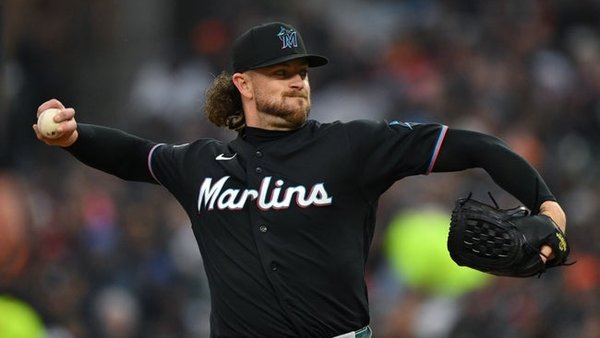
A nearly four-run ERA gap between starters screams blowout — yet the run line at +119 suggests the market hasn’t fully priced this pitching mismatch.
Chris Paddack vs Yoshinobu Yamamoto: Miami Marlins at Los Angeles Dodgers Betting Preview
The market understands what it’s pricing here — Yoshinobu Yamamoto’s elite form against Chris Paddack’s early-season struggles, wrapped in a Dodgers home environment where they’ve been methodical all year. What feels off is the reluctance to make this price truly prohibitive given the gap between these arms.
Yamamoto brings a 2.48 ERA and 0.89 WHIP into Monday’s 2026 start, numbers that represent legitimate ace-level performance through his first month. Paddack counters with a 6.38 ERA and 1.54 WHIP — the kind of early-season crater that makes you wonder if the Marlins are just hoping he finds something before they need to make a change.
The betting tension centers on whether Miami’s recent offensive life — they dropped 9 runs on San Francisco just three days ago — can exploit what should be a significant mismatch in starting pitching quality.
Game Info & Betting Lines
- Date/Time: Monday, April 27, 2026 | 10:10 PM ET
- Venue: Dodger Stadium (Park Factor: 0.98)
- Probable Starters: Chris Paddack vs Yoshinobu Yamamoto
- Moneyline: Miami Marlins +248 / Los Angeles Dodgers -314
- Run Line: Los Angeles Dodgers -1.5 (+119) / Miami Marlins +1.5 (-143)
- Total: 8.5 (Over -105 / Under -115)
Why the Run Line Makes More Sense Here
The market’s pricing this moneyline at -314 because the data supports it — Los Angeles sits at 19-9 with a +67 run differential while Miami struggles at 13-15 with zero run differential. That’s before you factor in the massive pitching gap or the Dodgers’ superior offensive foundation.
But here’s where the run line becomes compelling: when you have this large a starting pitcher gap and the home team projects to win by multiple runs, -1.5 at +119 offers significantly better value than laying over three-to-one on the moneyline. The model projects Los Angeles winning by 2.2 runs, creating a strong edge on the run line that doesn’t require paying prohibitive juice.
The legitimate case for Miami centers on their recent offensive explosion against quality Giants pitching, where they averaged over 4 runs per game in the series despite getting dominated in two of three contests. Xavier Edwards leads the National League at .343, and Liam Hicks has reached base safely in 10 straight games while hitting .314.
What Separates the Pitching
This matchup presents one of the largest ERA differentials you’ll see in a regular season game. Yamamoto’s 97.7 mph four-seamer sits 41.5% of his pitches and holds hitters to a .230 xwOBA, while his sweeper generates a ridiculous 40.0% whiff rate at 84.5 mph. The Japanese right-hander’s arsenal creates consistent weak contact and swing-and-miss, evidenced by his 0.85 WAR through five starts.
Paddack offers a stark contrast — his 94.2 mph four-seamer accounts for 32.7% of his mix but allows a .350 xwOBA, nearly 120 points higher than Yamamoto’s equivalent offering. His slider and changeup have shown effectiveness in small samples, but the control issues that produced that 1.54 WHIP create constant traffic that eventually breaks against quality lineups.
The gap extends beyond raw stuff to execution. Yamamoto has walked just 5 batters in 32.2 innings (1.38 per 9) while Paddack has issued 6 walks in 24 innings (2.25 per 9). While both starters have shown reasonable command, Yamamoto’s superior rate becomes critical against a Dodgers offense that features Shohei Ohtani’s .475 xwOBA and Freddie Freeman’s patient approach. When Paddack falls behind in counts, this lineup makes him pay.
The Run Line Value Play
The moneyline price creates obvious friction — -314 requires a 75.8% win probability to break even, which leaves almost no margin for the variance that defines early-season baseball. The Dodgers are also managing key injury concerns, with Mookie Betts on the IL and both Max Muncy and Will Smith listed as day-to-day.
But the run line shifts this equation entirely. At +119, you’re getting paid to take a team the model projects to win by multiple runs, with a starting pitching advantage that should compound as the game progresses. Even if Miami hangs tough early, Yamamoto’s superior arsenal profiles for sustained effectiveness while Paddack’s control issues typically worsen as he faces lineups multiple times.
Miami’s recent offensive surge can’t be ignored, but it came largely against starting pitching that doesn’t match Yamamoto’s class. Otto Lopez and Xavier Edwards have been consistently productive at the top of the order, showing they can capitalize when opposing starters struggle. However, Yamamoto’s 25.9% whiff rate on his four-seamer and devastating 52.9% whiff rate on his curveball represent a different level of challenge than what they faced in San Francisco.
Run Environment & Game Shape
Dodger Stadium’s 0.98 park factor slightly suppresses run scoring, which amplifies Yamamoto’s effectiveness while potentially masking some of Paddack’s control issues. The total sitting at 8.5 suggests the market expects a moderate-scoring game, likely in the 5-4 or 6-3 range.
This environment should favor the superior pitcher, and Yamamoto’s combination of stuff and command profiles perfectly for a park that rewards precision over power. Paddack’s walk issues become more problematic in a venue where you can’t rely on cheap runs to cover mistakes.
The projected game shape — likely competitive through five innings before the starting pitching quality differential takes over — suggests the team with the better starter should create separation in the middle to late innings when bullpens typically enter. This is exactly the scenario where run line value emerges.
Joe Jensen’s Pick
JENSEN’S PICK: Los Angeles Dodgers -1.5 (-140)
The pitching gap is legitimate and my numbers project a multi-run win, but paying -314 on the moneyline leaves no room for April variance. The run line offers proper compensation for taking a team that should win convincingly, creating value where the straight bet offers none. Yamamoto’s arsenal advantage combined with Los Angeles’s superior offensive foundation makes this the right side at the right price.