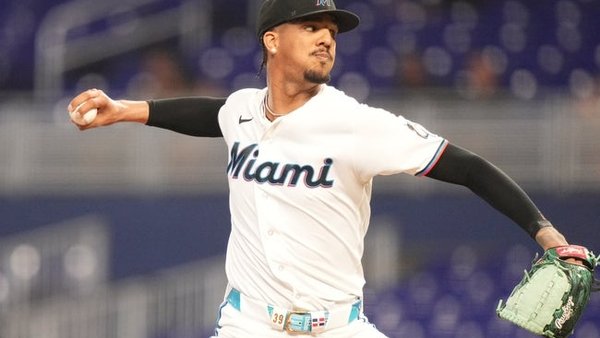
Lodolo’s 4.86 ERA and 1.46 WHIP across just 66.2 innings signal a pitcher getting away with things, not pitching well — and Great American Ball Park’s 1.10 park factor only amplifies that exposure. The market has this priced near even money at -119, but Perez’s 3.39 ERA and 1.11 WHIP over 116.2 innings tell a meaningfully different story.
Eury Perez vs. Nick Lodolo: Miami Marlins at Cincinnati Reds Betting Preview
After Saturday’s comeback — Miami trailing 4-3 in the eighth before exploding for five runs to win 8-4 — the Marlins close this series on Sunday with what I consider a legitimate pitching edge that the moneyline doesn’t fully account for. The market has this priced at Miami -119 / Cincinnati +111, a spread that suggests near-parity. That’s the noise. The signal is Eury Perez versus Nick Lodolo, and there’s nothing close about that matchup on paper.
Cincinnati’s home-field bump at Great American Ball Park (park factor 1.10) and Lodolo’s 3-2 record have kept the Reds from being bigger underdogs. But a pitcher’s win-loss record is one of the noisiest stats in baseball, and Lodolo’s underlying numbers — a 4.86 ERA and 1.46 WHIP in just 66.2 innings — signal a pitcher who has been getting away with things, not pitching well. Perez, by contrast, has been legitimate across 116.2 innings of work.
The run differential tells a similar story: Miami sits at +14 on the season; Cincinnati is at -80. That’s not a close contest in overall team quality. At -119, the juice clears my threshold comfortably, and the starting pitching gap makes this the correct lean.
Game Info & Betting Lines
- Date/Time: Sunday, August 16, 2026 | 1:40 PM ET
- Venue: Great American Ball Park (Park Factor: 1.10 — hitter-friendly)
- TV: MLB.TV, Reds.TV, Marlins.TV
- Probable Starters: Eury Perez (MIA, 6-9, 3.39 ERA) vs. Nick Lodolo (CIN, 3-2, 4.86 ERA)
- Moneyline: Miami Marlins -119 / Cincinnati Reds +111
- Run Line: Miami Marlins -1.5 (+128) / Cincinnati Reds +1.5 (-155)
- Total: 9.0 (Over -114 / Under -105)
Why This Number Is Off
The market is doing what it normally does with series finales: crediting the home team’s familiar environment, discounting the visiting team’s fatigue and getaway-day focus issues, and averaging out two lineups that have both been inconsistent offensively. The result is a line that lands close to even money. The logic isn’t wrong — it’s just incomplete.
The legitimate case for Cincinnati? The Reds’ lineup carries genuine power. Elly De La Cruz (20 HR, .825 OPS), Sal Stewart (26 HR, 91 RBI), and JJ Bleday (20 HR) give the Reds three legitimate power threats in the top three lineup spots, and Great American Ball Park will amplify any mistake. Perez has already surrendered 13 HR in 116.2 innings this season — he’s not untouchable in this environment.
But here’s where the market is slightly wrong: it’s treating Lodolo’s 3-2 record as evidence of competence when the underlying numbers scream regression. A 1.46 WHIP means Lodolo is consistently putting runners on base, and at a park with a 1.10 run factor, those runners eventually score. Miami’s offense — led by Griffin Conine (.921 OPS, .535 xwOBA) and a lineup that proved Saturday it can batter Cincinnati’s bullpen — is positioned to capitalize. The price at -119 doesn’t demand perfection. It just asks Perez to be the better pitcher, which the numbers strongly suggest he will be.
What Separates the Pitching
This is where the edge lives, and comparing these two starters head-to-head makes it clear why Miami is the correct side.
Eury Perez operates with a deep, high-velo arsenal anchored by a 98.2 mph four-seam fastball he throws 40% of the time, generating a 21.6% whiff rate and holding hitters to a .302 xwOBA. His sweeper at 83.7 mph produces a remarkable .215 xwOBA — the sharpest weapon in his mix — and his changeup at 89.9 mph leads his entire arsenal with a 44.6% whiff rate. That changeup is the pitch that separates him from a mid-rotation arm. Combined with a 3.39 ERA and 1.11 WHIP across 116.2 innings, Perez has been consistently efficient and hasn’t required much margin for error to succeed.
Nick Lodolo tells a different story. His primary pitch is a sinker thrown 28.5% of the time at 93.8 mph — but it generates just a 10.3% whiff rate and a troubling .486 xwOBA against. That number is alarming: hitters are making hard, quality contact on Lodolo’s most-used pitch. His curveball (25.2% usage) is genuinely effective at a .286 xwOBA and 39.6% whiff rate, but his changeup — thrown 21.7% of the time — produces a .359 xwOBA with only a 4.8% put-away rate. He’s not finishing hitters when he needs to.
The Reds’ top-order matchup against Perez adds nuance: De La Cruz is 0-for-8 in prior BvP encounters with 3 strikeouts, and Stephenson — though he carries a .461 xwOBA vs. right-handed pitching — is just 1-for-5 against Perez with a homer. Sal Stewart has had success (3PA, .667) in limited exposure, which is the main caution flag. The gap between these two starters, though, is less about individual matchups and more about the consistent contact quality Lodolo surrenders versus the tight zone management Perez maintains.
The Pushback
I want to be honest about where this play gets uncomfortable, because there are real concerns worth sitting with.
Great American Ball Park isn’t neutral ground. The 1.10 park factor matters when Lodolo’s .486 sinker xwOBA is already inviting hard contact before you factor in the wall distances. If Perez hangs a pitch to De La Cruz or Stewart in a leverage spot, this game can turn in one swing. That’s not a hypothetical — it’s a real amplification risk baked into this venue.
The Miami bullpen is also worth flagging. Andrew Nardi and Anthony Bender are both on the IL, and the relievers who covered 4⅓ scoreless innings Saturday did their job, but that’s a taxed group heading into a day game on the back end of a series. If Perez exits early, the margin for error shrinks.
And the Marlins’ own offensive inconsistency is real. They scored three or fewer runs in 10 of their previous 16 games before Saturday’s eruption. Saturday’s eight-run outburst was the exception, not the trend. Betting on that offense to do it again the very next day against a different arm carries its own kind of recency bias risk.
I keep coming back to the pitching gap, though. Perez’s 3.39 ERA and 1.11 WHIP over 116.2 innings isn’t a fluke — it’s a season-long body of work. Lodolo’s 4.86 ERA and 1.46 WHIP in 66.2 innings, paired with that .486 xwOBA against his primary pitch, points to a starter who is one bad inning away from unraveling. At -119, I’m not being asked to pay a steep premium for that advantage. The price is fair for the edge.
The Conine Factor
One specific matchup worth isolating: Griffin Conine against Lodolo. Conine’s .535 xwOBA overall and .563 xwOBA against right-handed pitching make him one of the more dangerous bats in this lineup against a right-hander like Lodolo. His 8.0% barrel rate and 31.1% hard-hit rate mean when he makes contact, it travels. Lodolo’s sinker — the pitch he’ll likely lean on most — is already getting hammered at a .486 xwOBA by the league. Conine is a well above-average hitter against righties. That’s a matchup the market isn’t separately pricing, but it’s a real weapon for Miami in the middle of their order.
The Lean
I keep coming back to the same place: this is a -119 moneyline on a team whose starter has a 3.39 ERA and 1.11 WHIP over 116.2 innings against a starter whose primary pitch is getting hit to the tune of a .486 xwOBA. The home park amplifies both sides, but it amplifies Lodolo’s vulnerability more than it neutralizes Perez’s strengths. The Marlins’ run differential advantage (+14 vs. -80) confirms what the pitching data suggests — this is the better team at the better price.
Two units on Miami feels right. Not a hammer, because the pushback is real. But a clear, confident lean.
Bet: Miami Marlins Moneyline -119 — 2 Units