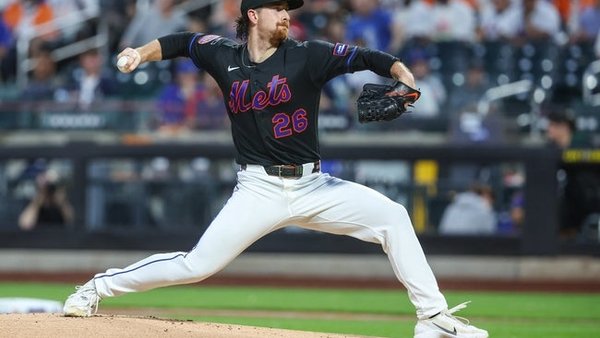
Nolan McLean brings 107.1 innings of 2026 data and a 3.52 ERA into Citizens Bank Park against Alan Rangel, a spot starter with fewer than 20 MLB innings and a 1.397 WHIP. The Mets are priced at -134 — above the comfort threshold for a team 17 games under .500 — which makes the structural pitching gap harder to act on cleanly.
Nolan McLean vs. Alan Rangel: New York Mets at Philadelphia Phillies Betting Preview
Today’s matchup flips the pitching dynamic from yesterday’s 6-1 Phillies win entirely. Philadelphia sends Alan Rangel — a spot starter with fewer than 20 MLB innings — against Nolan McLean, who has quietly built a legitimate full-season case with a 3.52 ERA and 107.1 innings logged in 2026. That’s not a marginal edge; that’s a structural gap the market is only half-accounting for.
The Mets are listed at -134 on the moneyline despite sitting 17 games under .500. The market is clearly weighing Philly’s home-field presence, a lineup that includes Schwarber, Harper, and Marsh, and the Phillies’ superior team record. That context is legitimate. But when you strip away the standings noise and focus on what actually happens between the lines Sunday, one starter has a proven track record and the other is essentially an audition.
The concern is the price — and it’s a real one. At -134, the Mets are above my -130 juice ceiling, and that’s not a rounding error. This is not a standalone play. The numbers point to the right side here, but -134 is -134, and I’m not handing over that kind of juice on a team that’s 17 games under .500 as a unit bet. Treat this as a lean — parlay leg or beer money only.
Game Info & Betting Lines
- Date/Time: Sunday, July 19, 2026 | 1:35 PM ET
- Venue: Citizens Bank Park | Park Factor: 1.02 (slight hitter-friendly lean)
- TV: MLB.TV, NBC Sports Philadelphia, SNY
- Probable Starters: Nolan McLean (NYM) vs. Alan Rangel (PHI)
- Moneyline: New York Mets -134 / Philadelphia Phillies +114
- Run Line: New York Mets -1.5 (+126) / Philadelphia Phillies +1.5 (-152)
- Total: 8.5 (Over -122 / Under +100)
Why This Number Is Close
The market has done its homework, and the Phillies lineup is where your respect has to go first. Kyle Schwarber leads the majors with 33 home runs and carries an xwOBA of .544 — that’s not just a counting-stat story, that’s elite contact quality that shows up in every pitch-level metric. At 34.9% hard-hit rate and an 8.7% barrel rate, he punishes mistakes regardless of who’s on the mound. Bryce Harper (.863 OPS, .444 xwOBA) and Brandon Marsh (.294 AVG, .812 OPS) extend this order well past the cleanup spot. The betting implication is straightforward: even with a command-challenged starter, the Phillies have enough firepower to manufacture runs in clusters, which is exactly the kind of variance that eats into a -134 favorite’s equity.
The Phillies are 55-44, playing at home in a park with a 1.02 run factor. The +114 on Philly isn’t charity — it reflects a legitimate team with real run-scoring upside getting a genuine shot to win outright. That’s why -134 on the Mets isn’t a layup even with the pitching edge.
But here’s where the market is slightly miscalibrated: it’s treating both pitching matchups as closer to equivalent than the evidence supports. McLean has 107.1 innings of 2026 data behind him. Rangel has 19.1 innings with a 1.397 WHIP and 9 walks allowed — a control problem that tends to compound quickly against a lineup built to get on base. The Mets carry a .303 OBP and have legitimate threats at the top of the order who don’t need to barrel the ball to cause damage.
Where the market is slightly wrong is in how it’s discounting Rangel’s small sample against McLean’s proven durability. A 4.19 ERA in 19 innings isn’t necessarily a true-talent signal, but the walk rate and WHIP suggest a pitcher who hasn’t found his command at this level. That’s the inefficiency the -134 line is incompletely pricing — but it’s not enough of an inefficiency to justify handing over the juice as a standalone bet.
What Separates the Pitching
The gap between these two arms is less about raw stuff and more about depth, control, and track record. McLean’s arsenal is built around a sinker-first approach — he throws the pitch 33.6% of the time at 95.0 mph, generating weak contact (xwOBA .272) and a ground-ball shape that limits big innings. His curveball is his best put-away pitch, producing a 34.5% whiff rate and an xwOBA of just .145 against it. He can beat hitters in multiple ways: the sinker induces soft contact, the curveball generates swings-and-misses, and his four-seamer at 96.1 mph with a 24.5% whiff rate gives him something to elevate when needed.
Rangel’s arsenal looks different on paper. His four-seamer sits at 93.1 mph and generates only a 6.8% whiff rate — that’s a fastball that hitters are squaring up, not missing. His changeup is better (36.7% whiff, xwOBA .271), and his slider carries some deception (.160 xwOBA). But the command issue is what makes the Statcast profile matter less. Nine walks in 19.1 innings means traffic, and traffic compounds against a Mets lineup that has hitters like Juan Soto (.452 xwOBA, 8.7% barrel rate) and Francisco Alvarez (.420 xwOBA, 8.4% barrel) waiting in the middle of the order.
Soto’s split against right-handed pitching is particularly relevant here — his vsRHP xwOBA sits at .499, an elite number against exactly the type of arm Rangel is. Alvarez against righties shows a .410 xwOBA. The Mets don’t need Rangel to collapse; they just need him to fall behind in counts and give the lineup something to work with, which his walk rate suggests is a genuine risk.
McLean, by contrast, is the more reliable inning-creator. His 1.118 WHIP and 10.48 K/9 mean he limits baserunners while racking up outs efficiently. The Phillies’ order is dangerous — Schwarber’s .544 xwOBA is a real threat regardless of pitcher — but McLean has the track record to navigate it.
The Pushback Case
Before leaning too hard into the pitching gap, a few things need honest accounting. Schwarber went 0-for-6 in limited BvP against McLean with no strikeouts — which sounds relevant until you remember it’s 6 plate appearances, far too small to weight heavily. What matters more is that .544 xwOBA and 33 home runs; McLean’s cutter (xwOBA .430 allowed) is a potential vulnerability against a left-handed pull hitter like Schwarber, and that’s worth watching.
The Mets’ offense also arrived at this series cold. They’re 17 games under .500 at 41-58, their run differential sits at -67, and they’ve managed to score just 5 runs across the first two games of this series despite Thursday’s win. Eric Wagaman is penciled in at first base with Mark Vientos on the IL — a meaningful depth downgrade in the middle of an already-thin lineup. The Mets are not a team you’d choose to ride at -134 if the pitching matchup weren’t the driving factor.
The Phillies bullpen also has legitimate relief depth concerns — Lou Trivino, Tanner Banks, and Brad Keller are all on the IL. If McLean exits early and the Mets need to piece together late innings, that’s a real risk on the other side of the ledger too. Both bullpens are managing attrition.
Run Environment & Game Shape
The total is set at 8.5, and the run environment context here is important. Citizens Bank Park carries a 1.02 park factor — just barely hitter-friendly, not a significant amplifier. The projected run total of 8.9 sits just above the line, suggesting a slight lean toward runs, but the bigger shaping factor is how these two starters figure to manage workloads.
McLean has the profile of a starter who keeps games manageable — his sinker-heavy approach limits hard contact, his ground-ball tendency suppresses the big inning, and his 1.118 WHIP means he’s not putting men on base in clusters. If he’s working efficiently, this shapes as a game where the Mets grab a lead and try to hold it. The risk is Schwarber or Harper getting to one of his elevated cutters and doing damage in a single at-bat — Citizens Bank Park doesn’t need much help turning a warning-track fly into a souvenir.
Rangel’s profile points the other direction. A starter who walks nine batters in 19.1 innings tends to work from behind in counts, which inflates pitch counts and limits innings. If Rangel exits before the fifth, the Phillies’ bullpen — already short-staffed with Trivino, Banks, and Keller unavailable — has to cover a lot of ground. That’s not a death sentence for Philadelphia, but it does tighten the margin of error in a game where the Mets’ top of the order (Soto, Lindor, Alvarez) is capable of doing real damage against a tired or mismatched reliever.
Game shape most likely looks like this: Mets build a modest lead early while Rangel battles his command, McLean works into the sixth or seventh keeping the Phillies’ big bats in check, and both bullpens are tested in the middle innings. That’s a game the Mets are positioned to win — but the margin is thin enough that one Schwarber moment changes everything.
The Pick
I like the Mets in this game. The pitching matchup is genuinely lopsided — 107 innings of proven production against a 19-inning audition with a walk problem — and Soto’s .499 vsRHP xwOBA gives New York a lineup weapon perfectly suited to exploit Rangel’s command issues. The structural edge is real.
But -134 exceeds my juice ceiling of -130, and that’s not a line I’ll cross for a standalone unit bet on a team that’s 17 games under .500. The Mets are the right side here. The price is wrong. Those two things can both be true at the same time.
This is a LEAN — Mets ML. Not a unit play. If you’re building a parlay and need a leg that makes analytical sense, this qualifies. If you’re looking to drop beer money on a Sunday afternoon game, the Mets are the side. But do not treat this as a standalone bet at -134. The juice kills the value that makes this lean worth mentioning in the first place.
Lean: New York Mets Moneyline (-134) — Parlay leg or beer money only. Not a standalone unit play.