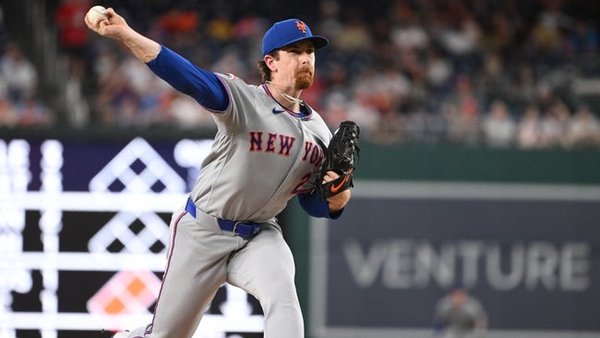
Sean Newcomb has allowed just 2 home runs in 70 innings and draws a Mets lineup stripped of Soto, Vientos, and Polanco — yet the market still prices New York as the favorite at -108. The pitching edge and the depleted road roster point one way; the moneyline price points another. That gap is the story.
Nolan McLean vs Sean Newcomb: New York Mets at Chicago White Sox Betting Preview
After the Mets exploded for 10 runs on Saturday night, the market has rewarded New York with a modest favorite price at -108. The narrative writes itself: momentum, confidence, a team that’s 12-5 in its last 17 games walking into the finale. But narratives don’t win bets — pricing does. The numbers project this game at Chicago White Sox 4.5, New York Mets 4.3, a virtual dead-heat that makes getting the White Sox at plus money the cleaner side of the same near-even matchup.
The core argument isn’t complicated. Sean Newcomb carries a 2.44 ERA and 1.10 WHIP over 70 innings and is pitching in front of a lineup with two legitimate 29-HR threats in Murakami and Vargas. The Mets, meanwhile, are without Juan Soto, Mark Vientos, and Jorge Polanco — three meaningful contributors stripped from a lineup that already sits at a modest .699 OPS. You’re being offered plus money on the home team with the better starting pitcher and the more complete lineup. That’s the bet.
The Saturday blowout is real noise, but this is a series finale with a completely different pitching matchup. The starters today are the story, not the relievers who got shelled yesterday. The price has drifted toward New York on momentum, and that drift is the opportunity.
Game Info & Betting Lines
- Date/Time: Sunday, August 23, 2026 | 2:10 PM ET
- Venue: Guaranteed Rate Field | Park Factor: 0.98 (neutral)
- Probable Starters: Nolan McLean (NYM) vs. Sean Newcomb (CWS)
- Moneyline: New York Mets -108 / Chicago White Sox +101
- Run Line: Chicago White Sox +1.5 (-182) / New York Mets -1.5 (+150)
- Total: 8.0 (Over -117 / Under -103)
Why This Number Is Off
The market is doing something reasonable here: it’s pricing the Mets as a slight favorite based on McLean’s superior resume (9-8, 3.34 ERA, 142.2 innings, 10.22 K/9) and the momentum of a 10-5 blowout win the night before. That’s a defensible line. McLean is a legitimate arm — his 162 strikeouts and .156 xwOBA against his curveball represent genuine put-away capability. The market isn’t wrong for leaning New York.
But here’s the problem: -108 on a 59-71 road team that’s missing three of its most impactful hitters is soft pricing. Soto, Vientos, and Polanco aren’t fringe contributors — they’re lineup cornerstones. What remains is a group that averages .236 and .699 OPS as a unit, and they’re stepping into Rate Field against a pitcher who has allowed just 2 home runs in 70 innings. The market is crediting New York for Saturday’s explosion, but Saturday featured a different pitcher in a completely different context.
A 60.1% home win probability implies the White Sox should be priced closer to -150. Getting them at +101 represents a meaningful gap — roughly a 10-point implied probability advantage. That’s where the bet lives.
What Separates the Pitching
McLean vs. Newcomb is a matchup where the credentials favor McLean on volume and strikeout rate, but the underlying quality metrics tell a more nuanced story.
McLean’s sinker is his primary weapon at 32.6% usage, sitting at 95.1 mph with a .273 xwOBA against — that’s a ground-ball inducer. His curveball (14.6% usage) generates a 36.0% whiff rate and holds hitters to a .156 xwOBA, making it his true put-away pitch. But the gaps in his arsenal are real. His four-seam fastball (20.4% usage, 96.1 mph) carries a .388 xwOBA against — a hittable pitch when hitters sit on it. His sweeper and cutter are both producing xwOBAs above .390. Against a White Sox lineup featuring Munetaka Murakami (.511 xwOBA, 11% barrel rate, 37.1% hard-hit rate) and Miguel Vargas (.427 xwOBA), those vulnerable pitches become leverage points. McLean has also surrendered 15 home runs in 142.2 innings, and Murakami’s left-handed profile against right-handers (.528 xwOBA vs. RHP) is the single biggest mismatch in this game.
Newcomb’s arsenal tells a different story. His four-seamer (35.7% usage, 94.4 mph) holds hitters to a .252 xwOBA with a 26.0% whiff rate. His slurve (32.1% usage) generates a 28.9% whiff rate at a .264 xwOBA — two pitches that consistently suppress quality contact. Fair disclosure: his sinker (22.7% usage) is a genuine vulnerability, posting a .417 xwOBA with only a 7.0% whiff rate. That’s a pitch the Mets can attack, and sharp readers looking at the Statcast sheet will spot it. But the two-pitch foundation of his four-seamer and slurve does most of the heavy lifting, and most critically, just 2 home runs allowed in 70 innings is the stat that anchors the entire thesis. Against a Mets lineup sitting at .236 average with Soto, Vientos, and Polanco on the IL, Newcomb doesn’t need to be dominant — he just needs to be himself. The gap between a 2-HR-in-70-IP pitcher facing a depleted lineup and McLean facing a White Sox lineup with two legitimate 29-HR threats in Murakami and Vargas is where the value compounds.
The Pushback
The honest case against this bet starts with Saturday night. The Mets scored 10 runs, Luis Robert Jr. hit two home runs against his former team, and the White Sox bullpen got carved up in front of their own fans. Momentum in baseball is often overstated, but a 10-5 blowout the day before does create real psychological carry-over — especially for a club that’s 12-5 in its last 17 games. New York is playing its best baseball of the season.
And McLean is legitimately good. His 10.22 K/9 is elite, and the White Sox lineup strikes out at a high clip — 1,177 punchouts on the season. If McLean locates his curveball and buries it against the top of the Chicago order, he can neutralize the power threat that Murakami and Vargas represent. Newcomb’s sinker vulnerability (.417 xwOBA) is also worth acknowledging — if the Mets identify it early and attack it with the contact-oriented hitters left in their lineup, Newcomb could find himself in trouble before his better pitches take over. These are real friction points, not invented ones.
The counter to all of it comes back to the price. At -108, the Mets would need to be the clearly superior side for the bet to make sense. They’re not — they’re a 59-71 road team missing three starters, facing a pitcher who has allowed two home runs all year. The line should look closer to even or lean slightly toward Chicago. Instead it leans New York, and that’s the market gap.
Run Line Consideration
I looked at the run line. The case for Chicago +1.5 at -182 falls apart quickly when you look at what the numbers actually project: White Sox 4.5, Mets 4.3. That’s a 0.2-run separation — essentially a coin flip with no credible multi-run separation path attached. To lay -182 on a run line, you need confidence that the margin will be two or more runs, and a projected score this tight offers no such confidence. The juice doesn’t come close to reflecting the actual probability of a multi-run Chicago win. The moneyline at +101 gives you the same directional exposure — White Sox win — without requiring a specific margin that the projected score simply doesn’t support. That’s why the moneyline is the cleanest instrument here.
Pick: Chicago White Sox Moneyline (+101) — 1 unit | Lean