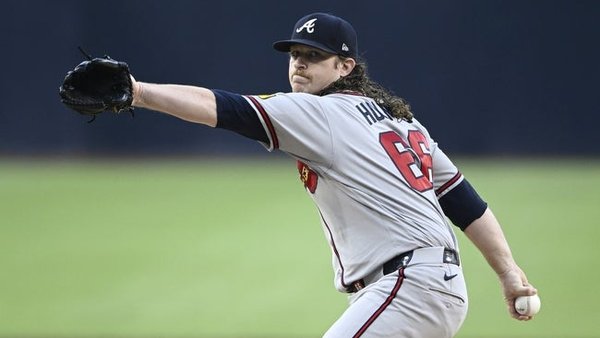
Grant Holmes carries a 3.79 ERA and a slider generating a 39.8% whiff rate into a matchup where the combined projection lands at 9.4 — one tick below the posted 9.5 total. The under is priced at -106, essentially pick, yet the pitching gap between these two starters is anything but even. There is a starter health caveat that changes everything if it resolves the wrong way.
Jake Irvin vs. Grant Holmes: Washington Nationals at Atlanta Braves Betting Preview
Here’s where this gets complicated fast: Jake Irvin, listed as Washington’s probable starter at a 5.23 ERA, is also listed on Washington’s 60-Day IL with a shoulder injury in the same dataset. That’s the most important sentence in this entire preview. Before wagering a dollar on this game, confirm who is actually taking the ball for Washington tonight. If it’s a bullpen game, the run environment changes dramatically — and so does the under case.
Assuming Irvin does take the mound (which the game note from the Mets recap explicitly confirms as the scheduled matchup), the thesis centers on Grant Holmes as a genuine mid-rotation arm holding down Atlanta’s half of the ledger, and a combined projection of 9.4 runs against a posted total of 9.5. The under at -106 is essentially pick — minimal juice on a slight lean. The market has this priced almost exactly right, which is precisely why the pricing matters: you’re not paying for value you don’t have.
Atlanta comes in having split a doubleheader in New York, while Washington dropped their series finale to Toronto 5-2. Both offenses have gone cold relative to their season baselines recently, adding texture to the under lean — though early-season variance and small samples mean we can’t anchor too heavily on recent scoring runs.
Game Info & Betting Lines
- Date/Time: Thursday, July 30, 2026 | 7:00 PM ET
- Venue: Truist Park | Park Factor: 1.01 (essentially neutral)
- TV: ESPN
- Probable Starters: Jake Irvin (WSH) vs. Grant Holmes (ATL) — VERIFY IRVIN STATUS BEFORE BETTING
- Moneyline: Washington Nationals +124 / Atlanta Braves -146
- Run Line: Atlanta Braves -1.5 (+130) / Washington Nationals +1.5 (-156)
- Total: 9.5 (Over -114 / Under -106)
Why This Number Is Close
The market has priced this total as a near-toss-up for good reason. Washington’s pitching ERA sits at 4.75 on the season — a legitimate over signal whenever their starters are on the mound. Atlanta’s lineup, while underperforming expectations at an OPS of .732, still features Matt Olson (28 HR, .869 OPS), Drake Baldwin (.855 OPS), and Michael Harris II (.824 OPS) capable of putting up a crooked number on any given night.
The legitimate case for the over: if Irvin is compromised or exits early, Washington’s battered bullpen — with Mitchell Parker, Richard Lovelady, Brad Lord, and PJ Poulin all on the IL — could get exposed deep into a game. That’s a real structural fragility the total reflects.
But here’s where the market may be slightly off: Holmes is not a league-average arm. His 3.79 ERA over 97.1 innings and 1.33 WAR represent genuine run suppression on Atlanta’s half of the scoring equation. The numbers project a combined 9.4 — one run below the line — and with Truist Park playing neutral (1.01 factor), there’s no environmental inflation to push the number higher. The under at -106 requires almost no edge to have positive value. You’re not laying significant juice on a razor-thin lean.
What Separates the Pitching
The gap between these two arms is real and consequential. Holmes leans heavily on a slider that generates a 39.8% whiff rate and holds hitters to a .287 xwOBA — that’s a genuine swing-and-miss weapon at 85.2 mph with plus break. He pairs it with a 94.1 mph four-seamer thrown 30.5% of the time, though that pitch allows a .387 xwOBA and gets whiffs at only 11.3% — meaning Holmes works ahead with the fastball and finishes with the slider. His curveball (.216 xwOBA, 33.8% whiff) gives him a third legitimate pitch. The profile creates innings where he generates easy outs when the slider is working, and labors through walks when it isn’t — he’s issued 43 free passes in 97.1 innings (roughly 3.98 BB/9). That’s the command ceiling on his upside.
Irvin’s arsenal tells a different story. His sinker — thrown 23.7% of the time at 91.9 mph — is being punished at a .474 xwOBA, which is alarming. His four-seamer is thrown 27.5% of the time and carries a .325 xwOBA, making it his most manageable offering, but it generates whiffs at just 22.1%. His cutter carries a .449 xwOBA. The weapons that work are his curveball (.230 xwOBA, 42.7% whiff) and his changeup (.141 xwOBA, 33.3% whiff) — but those are his secondary pitches, not his primary attack. Against Atlanta’s lineup, Matt Olson owns a .470 xwOBA vs. right-handed pitching and carries a .211 average in 21 BvP plate appearances against Irvin with 2 home runs — the small sample includes damage. Michael Harris II is hitting .318 in 24 BvP plate appearances. Holmes has a clear ERA and WAR advantage; Irvin is working with a negative WAR and a shoulder that may not be fully sound. That gap matters when projecting how each half-inning shapes up.
The Pushback
The concern starts before the first pitch: if Irvin is not actually starting — and the injury data explicitly lists him on the 60-Day IL — a Washington bullpen game would represent a fundamentally different betting environment. Long relievers absorbing four or five innings against James Wood (.603 xwOBA vs. right-handed pitching, 11.0% barrel rate, with a projected xwOBA in this matchup of .572), CJ Abrams (.423 xwOBA vs. RHP), and Luis García Jr. (.428 xwOBA vs. RHP) would be a genuine structural threat to the under. Washington’s offense ranks among the better units in the NL this season — 159 team home runs, .776 OPS, 594 runs scored. They’re not a soft touch.
On the Atlanta side, Holmes walks too many batters (43 BB in 97.1 IP) and his four-seamer (.387 xwOBA) is hittable when he can’t locate the slider. Washington’s top of the order can do real damage against right-handed pitching, and a Holmes command hiccup in the middle innings could put runs on the board fast.
The other structural pushback: Truist Park plays neutral, but it’s not a suppressor. A 1.01 park factor adds no friction to run-scoring, so there’s no environmental tailwind reinforcing the under thesis.
Joe Jensen’s Pick
The numbers project 9.4 combined runs against a line of 9.5, with a park factor that adds nothing and a genuine pitching edge on Atlanta’s half of the equation via Holmes. The juice at -106 is minimal. This isn’t a screaming edge — it’s a disciplined lean on a number that’s priced one tick above what the underlying data supports.
The conditional remains critical: verify Irvin is actually pitching before placing this bet. If he’s scratched and Washington goes to a bullpen game, the under thesis evaporates.
JENSEN’S PICK: Under 9.5 (-106) — 2 Units
If Irvin takes the mound as scheduled, the combined 9.4 projection, Holmes’s slider-driven run suppression, and minimal juice make the under the right side at this number.