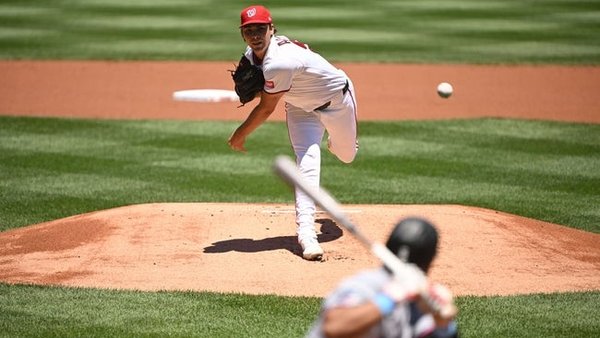
Adrian Houser’s 5.49 ERA and -0.81 WAR are on full display against a Washington lineup that has hit 86 home runs — yet the Nationals are priced at -104, nearly a coin flip. The market is leaning on Alvarez’s 20.1-inning sample to keep this line tight, but a two-run ERA gap between starters rarely prices this close for long.
Andrew Alvarez vs. Adrian Houser: Washington Nationals at San Francisco Giants Betting Preview
The betting market is telling you this is a toss-up. Washington Nationals at -104, San Francisco Giants at -112 — practically a pick’em. That pricing might make sense if these starters were even remotely comparable. They aren’t. Andrew Alvarez carries a 3.54 ERA against Adrian Houser’s 5.49 ERA, a gap that nearly spans two full runs. When the better pitcher on the better team is priced at juice you’d take without blinking, that’s the kind of soft number the market rarely leaves on the table this long.
After Monday’s 4-3 comeback win — where the Nationals rallied in the ninth against closer Keaton Winn to steal the series opener — Washington arrives with momentum and the cleaner arm on the mound. San Francisco at 27-40 with a -49 run differential isn’t just a bad team going through a rough stretch. That run differential signals systemic failure, both in run creation and prevention.
The Nationals at 34-33 are an above-.500 club with legitimate lineup depth. Getting them at near-even money in a pitcher-driven environment at Oracle Park, against a starter who has cost his team wins by WAR metrics, represents a genuine pricing inefficiency.
Game Info & Betting Lines
- Date/Time: Tuesday, June 9, 2026 | 9:45 PM ET
- Venue: Oracle Park | Park Factor: 0.92 (pitcher-friendly)
- Probable Starters: Andrew Alvarez (WAS) vs. Adrian Houser (SF)
- Moneyline: Washington Nationals -104 / San Francisco Giants -112
- Run Line: Washington Nationals -1.5 (+164) / San Francisco Giants +1.5 (-200)
- Total: 8.5 (Over -105 / Under -115)
Why This Number Is Off
The market is likely anchored on Oracle Park’s suppressive environment and Alvarez’s limited track record — just 20.1 innings this season. Those are legitimate inputs. A pitcher with fewer than 21 innings pitched commands less confidence, and the books know bettors are reluctant to hammer small samples hard. That hesitation is why the line stays this close.
The flip side of that is Houser’s résumé isn’t ambiguous. In 60.2 innings — a meaningful sample — he’s posted a 5.49 ERA, 1.58 WHIP, and allowed 10 home runs. That’s 1.48 HR/9, a rate that lines up poorly against a Washington lineup that has launched 86 team home runs. His 24 walks in that span (3.56 BB/9) compound the damage; free baserunners and a power-hitting lineup are a dangerous combination at any park.
The legitimate case for the Giants sits in their contact-heavy lineup — Arraez and Lee are among the better pure hitters in baseball at making contact — and in Alvarez’s volatility risk. But the market is pricing this as if those factors neutralize a pitcher who is actively destroying his team’s win expectancy. A -0.81 WAR means Houser has been a net negative relative to a replacement-level arm. You don’t ignore that at pick’em pricing.
Washington’s record advantage — seven games above San Francisco — isn’t noise. It’s the cumulative result of better pitching, better run production (5.31 R/G vs. 4.10), and a lineup with a higher OPS ceiling.
What Separates the Pitching
The gap between these two starters goes deeper than ERA. Alvarez works with a seven-pitch mix built around deception and shape. His cutter sits at 87.8 mph and leads his arsenal at 29.7% usage, generating a 16.7% whiff rate — a solid contact-suppressor, though its .353 xwOBA against puts it closer to league average in terms of contact quality allowed. The more dangerous weapon is his split-finger, which he deploys at just 6.6% usage but draws a 35.4% whiff rate and holds hitters to just .219 xwOBA — that’s a true swing-and-miss out pitch. His changeup (33.3% whiff, .266 xwOBA) compounds the problem for right-handed bats. Against a Giants lineup that leans on contact over power, Alvarez’s ability to generate whiffs with his offspeed mix is meaningful.
Houser’s arsenal is a different story. His four-seamer accounts for 45.4% of his pitches at 93.5 mph, but it’s generating just a 17.0% whiff rate and a .367 xwOBA against. That’s a fastball hitters are squaring up. His slider draws a solid 33.7% whiff rate, but the .375 xwOBA against that pitch tells you contact quality remains elevated when hitters do connect. His knuckle curve is his sharpest offering by whiff rate (40.6%), but its .410 xwOBA against suggests it’s being punished when it catches too much of the zone.
The concern about the Giants’ contact ability is real — Arraez’s .297 xwOBA against Alvarez reflects a hitter who simply doesn’t miss, and his 0.2% barrel rate means he’s not a power threat against any pitcher. But James Wood sitting at a .598 xwOBA with a 12.1% barrel rate and 35.6% hard-hit rate is the type of bat that punishes a fastball-heavy, HR-prone starter. CJ Abrams at .406 xwOBA adds another legitimate threat in a lineup Houser will struggle to navigate cleanly.
The Pushback
Here’s where this bet almost falls apart: 20.1 innings. That’s the entirety of what we have on Alvarez this season, and small samples in baseball carry real variance. His 3.54 ERA could be masking some fortunate sequencing. The books aren’t wrong to price in that uncertainty.
The Giants’ contact duo is a legitimate concern as well. Jung Hoo Lee is riding a 16-game hitting streak and owns a .323 average on the season. Luis Arraez at .323 with a 4.2% strikeout rate is the kind of hitter who simply refuses to give you outs — his 7.7% whiff rate against Alvarez means the split-finger and changeup won’t automatically neutralize him the way they might against a free-swinger.
On the pitching vulnerability side, it’s worth being precise: Alvarez’s sinker carries a .313 xwOBA against — the softest contact number among his fastball variants — while his cutter sits at .353 xwOBA, which is closer to league average. The cutter isn’t a liability, but it’s not a swing-and-miss weapon at that contact quality level either. If the Giants’ contact hitters are going to do damage, they’re more likely to do it against the cutter than the sinker, which actually plays as a soft-contact pitch by the numbers.
There’s also bullpen volatility to consider on both sides. San Francisco’s relief corps has multiple arms on the IL, and their closer Keaton Winn just threw on three consecutive days — including Monday’s blown save against this same Washington lineup. That’s a thin safety net for Houser if he labors early.
Total: No Edge Here
The 8.5 total reflects Oracle Park’s suppressive factor (.92 park factor) and Alvarez’s ability to keep run environments manageable. The projected total lands right around that number, and with both bullpens carrying uncertainty, there’s no clean edge in either direction. I’m passing on the total entirely.
Run Environment & Game Shape
Oracle Park’s .92 park factor does dampen run scoring at the margins, and that context favors the side with the superior starting pitcher — which is exactly the environment where the pitching gap between Alvarez and Houser becomes most pronounced. Suppressed run environments reward pitchers who can miss bats and limit hard contact. Alvarez’s split-finger (.219 xwOBA, 35.4% whiff) and changeup (.266 xwOBA, 33.3% whiff) are built for that context. Houser’s fastball-heavy approach, with a .367 xwOBA against his primary pitch, is not. When the park is working against offense, the team that can sustain a quality start has a structural advantage — and tonight, that’s Washington.
The Nationals rallied from behind to win Monday’s series opener against this same bullpen, the run differential gap between these clubs is 54 runs, and Washington is getting near-even money against a starter sitting at -0.81 WAR. That’s the inefficiency. Back the Nationals moneyline at -104.
Bet: Washington Nationals Moneyline -104 — 2 Units (Moderate Confidence)
The pitching edge, lineup depth advantage, and pricing inefficiency created by Houser’s -0.81 WAR all converge at a number that undervalues Washington by a meaningful margin.