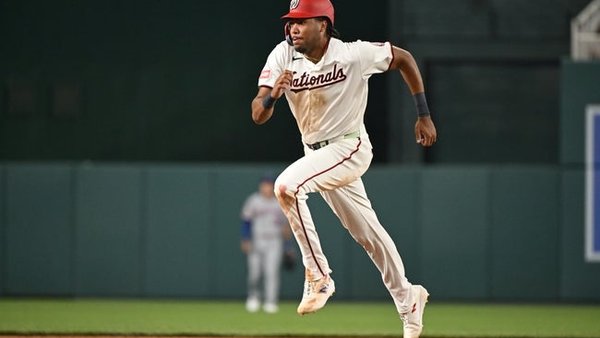
Mikolas’ 6.17 ERA and 11 home runs allowed in under 47 innings make Washington’s offense look dangerous on paper — but that production came against Bibee and Cantillo, not Gavin Williams. With Cleveland’s lineup posting a .693 OPS near the bottom of the league, the two sides of this total are not being built the same way, and the number has not fully sorted that out.
Miles Mikolas vs Gavin Williams: Washington Nationals at Cleveland Guardians Betting Preview
The surface-level read on this game is straightforward: Mikolas has been historically bad (6.17 ERA, -0.65 WAR), the Nationals just scored 16 runs in two games against Cleveland’s rotation, and Washington is 19-11 on the road riding a four-game winning streak. If you walked in cold, you’d probably lean toward the Nationals outright or at least expect runs to flow freely. That instinct isn’t wrong — it’s just incomplete.
The variable that rewrites the equation is Gavin Williams. His 3.25 ERA and 10.9 K/9 aren’t flukes — they’re backed by a Statcast arsenal that genuinely suppresses lineups. The question the under is really asking isn’t whether Mikolas holds up. It’s whether Williams can keep Washington quiet long enough that Cleveland’s anemic offense — a team-wide .693 OPS and just 234 runs scored — can win a game that stays in the 4-5 run range on each side.
The core thesis: Williams is a legitimate ace-level suppressor, Progressive Field plays neutral-to-slightly-pitcher-friendly at 0.98 park factor, and Cleveland’s lineup is one of the weakest in baseball. The numbers project this game around 9.0 combined runs, but the real ceiling is lower than the market suggests — and at 8 with the under at -120, there’s enough edge to act.
Game Info & Betting Lines
- Date/Time: Wednesday, May 27, 2026 | 1:10 PM ET
- Venue: Progressive Field | Park Factor: 0.98 (neutral-to-pitcher-friendly)
- Probable Starters: Miles Mikolas (WAS, 1-3, 6.17 ERA) vs Gavin Williams (CLE, 7-3, 3.25 ERA)
- Moneyline: Washington Nationals +154 / Cleveland Guardians -184
- Run Line: Cleveland Guardians -1.5 (+118) / Washington Nationals +1.5 (-142)
- Total: 8 (Over -102 / Under -120)
Why This Number Is Close
The market has set this total at 8 with the under juiced to -120, and that pricing tells you exactly what books are thinking: Williams is good enough to suppress Washington’s side, but Mikolas is bad enough to leave Cleveland’s half of the ledger messy. That’s a reasonable balance. The -120 juice on the under reflects genuine market respect for Williams — this isn’t a number the books are offering cheaply.
The legitimate case for the over is real. Mikolas has allowed 11 home runs in just 46.2 innings, and Washington features James Wood (.939 OPS, 15 HR) and CJ Abrams (.925 OPS, 12 HR) — two legitimate power threats who punished Cleveland’s rotation all series. Washington’s offense isn’t cold; their run output this week reflects a lineup fully capable of big outputs.
But here’s where the market is slightly off: that Washington offensive production came against Tanner Bibee and Joey Cantillo — not Williams. Mikolas is bad, but Cleveland’s offense is so structurally limited (.693 OPS, bottom-tier run totals) that even a generous 4-5 runs off Mikolas doesn’t automatically push the combined total past 8. The -120 price is a modest premium to pay for the pitching anchor Williams provides.
What Separates the Pitching
The gap between these two starters is significant, and it drives the entire betting thesis. Gavin Williams sits at a 3.25 ERA with a 1.11 WHIP across 69.1 innings — those aren’t empty numbers. His four-seam fastball operates at 96.3 mph with a 25.1% whiff rate. It’s worth noting the 4-seam carries a .392 xwOBA against — it isn’t an elite pitch on its own — but it serves a critical function: it sets up his sweeper and curveball by forcing hitters to stay honest up in the zone. That’s where the real damage gets done. The sweeper is thrown 26.3% of the time and generates a staggering 48.2% whiff rate while holding hitters to a .255 xwOBA. His curveball compounds that at 26.8% whiff with a .267 xwOBA against. Together, those three pitches give Williams a multi-tier attack that produces swing-and-miss at every level of the zone.
Against Washington’s lineup, the matchup signals are mixed but manageable for Williams. James Wood posts a .590 xwOBA overall and .605 against right-handers — a genuine threat. But Wood’s 30.5% whiff rate suggests Williams’ sweeper can get him to expand. Abrams sits at .418 xwOBA with a 25.7% whiff rate — dangerous, but not a mismatch that bends things dramatically. The bottom half of Washington’s order (Crews, Lile, Young, Nuñez) posts xwOBA figures below .360 — exactly the profile Williams carves up with his 10.9 K/9 arsenal.
Miles Mikolas is a different story entirely. His four-seam sits at 92.9 mph with only a 17.0% whiff rate and a .402 xwOBA against — below-average by any measure. His changeup is generating a .430 xwOBA against with zero put-away value. The one relative bright spot is his sinker (.301 xwOBA, 16.7% put-away), but Cleveland’s lineup — featuring low barrel rates across the board — won’t punish that pitch the way Washington’s middle-of-order bats might.
The strikeout differential alone (10.9 K/9 for Williams vs 5.98 K/9 for Mikolas) summarizes the gap. Williams creates short innings and stranded runners; Mikolas creates traffic and damage control situations. That asymmetry is what keeps the combined total in check.
The Pushback
The honest concern here isn’t small. Mikolas has been genuinely terrible — a 6.17 ERA across 46.2 innings isn’t a cold stretch, it’s a structural problem. His 11 allowed home runs in under 47 innings is the kind of damage rate that can blow up a total in one inning. Wood hit his 15th homer of the season on Tuesday, homering in back-to-back games against Cleveland. He has a 12.2% barrel rate and a .605 xwOBA against right-handers. That’s not a hitter Williams neutralizes easily — that’s a genuine collision between an elite bat and a below-average pitcher.
The other pushback is the juice itself. Paying -120 on an under when the offensive floor is this uncertain requires Williams to work deep into the game or the bullpen to be clean. If Williams exits early — a real possibility against a lineup that has seen Cleveland’s staff multiple times this series — the under loses its structural backbone. I’m not pretending this is a comfortable play. The -120 threshold means a push or a bad inning from Mikolas wipes the value entirely.
That said, I keep coming back to Cleveland’s lineup. Travis Bazzana (.362 xwOBA), Petey Halpin (.292 xwOBA), David Fry (.748 OPS) — this is a lineup that Mikolas, even in his current form, can manage to keep in the 3-4 run range. The Guardians rank near the bottom of the league in runs scored with just 234 on the season. Their side of the ledger is the quietest part of this game, and that’s the structural underpinning of the under even when Mikolas is the opposition’s arm of concern.
Run Environment
Progressive Field’s 0.98 park factor is quiet reinforcement rather than a headline driver — this isn’t a dome or a bandbox skewing results dramatically. But a park playing fractionally below neutral does apply meaningful downward pressure on a total already sitting at 8. In a game where the pitching matchup is this lopsided — a legitimate ace on one side, a below-average innings-eater on the other — a neutral-to-pitcher-friendly park becomes a tiebreaker rather than a wildcard. The environment isn’t manufacturing the edge here; it’s reinforcing what the pitching math already suggests. Combined with Cleveland’s structurally weak offense, the run environment quietly applies downward pressure on the total and makes 8 a number worth attacking from the under side rather than chasing the over on the back of Mikolas’ track record alone.
The Pick
Under 8 (-120) — 2 Units — Moderate Confidence
The thesis comes down to this: Gavin Williams is a legitimate ace-caliber arm with a sweeper-curveball combination that produces elite whiff rates and suppresses even dangerous lineups, and Cleveland’s offense is one of the weakest in baseball — a .693 OPS team that won’t punish Mikolas enough to blow this total open on its own. Washington’s big offensive outputs this series came against Bibee and Cantillo; Williams is a different animal entirely, and the bottom two-thirds of the Nationals’ lineup (.332 xwOBA or lower) is exactly the profile he buries with a 10.9 K/9 arsenal.
The -120 juice is the honest friction in this play, and I’m not going to pretend otherwise — this isn’t a soft number. But at 2 units with moderate confidence, the under at 8 represents a real edge: one dominant starting pitcher anchoring the under side, a historically weak Cleveland offense limiting the damage Mikolas can cause on the other, and a neutral park that doesn’t give the over any structural help. Back the under, manage the juice, and let Williams do the work.