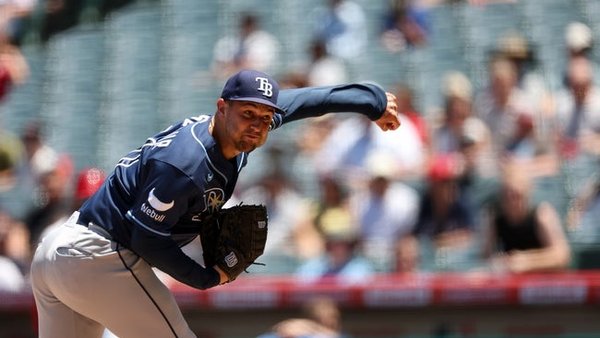
Cade Cavalli was scratched yesterday with illness and remains a genuine question mark, while Ian Seymour’s 4.93 ERA offers no shutdown insurance — yet Tropicana Field’s 0.95 park factor and Tampa Bay’s suppressed .379 team slugging tell a specific story about run environment. The number sits at 8.5, and the matchup structure points one way even if the margin is thin.
Cade Cavalli vs Ian Seymour: Washington Nationals at Tampa Bay Rays Betting Preview
The market has set this total at 8.5, and on the surface that looks perfectly calibrated for two offenses that don’t mash. But the real tension here isn’t the number itself — it’s everything clustered underneath it. Cavalli was scratched yesterday due to illness and is a genuine question mark as to whether he can deliver quality innings tonight. Seymour is 3-0 but carries a 4.93 ERA. Neither starter inspires confidence as a shutdown arm, yet the park, the bullpens, and the offensive profiles all point the same direction.
Tropicana Field plays as a pitcher’s park — a 0.95 park factor — and the dome eliminates every weather variable that can inflate run totals in outdoor venues. The Rays own a 3.95 ERA and 1.244 WHIP as a pitching staff, one of the cleaner collective units in baseball, and their home record (25-9) reflects a process that holds up at Trop. Washington’s rotation has been ravaged by injuries — Gray, Irvin, and Waldichuk are all on the IL — and even when Cavalli is healthy, he’s a mid-rotation arm, not an ace.
Yesterday’s game in this exact environment finished 5-2, a tidy seven total runs. That’s anecdotal, but it rhymes with what the structure of this matchup suggests. The numbers project 4.4 Nationals and 4.3 Rays — essentially a coin flip on outcome, but a clear read on the run environment. The question is whether the total comes in under 8.5 at -115 juice.
Game Info & Betting Lines
- Date/Time: Saturday, June 20, 2026 | 4:10 PM ET
- Venue: Tropicana Field (Park Factor: 0.95 — pitcher-friendly dome)
- TV: ESPN Unlmtd, MLB.TV, Rays.TV, Nationals.TV
- Probable Starters: Cade Cavalli (4-4, 3.98 ERA) vs Ian Seymour (3-0, 4.93 ERA)
- Moneyline: Washington Nationals +102 / Tampa Bay Rays -120
- Run Line: Washington Nationals -1.5 (+168) / Tampa Bay Rays +1.5 (-205)
- Total: 8.5 (Over -105 / Under -115)
Why This Number Is Close
The market isn’t wrong to set this at 8.5. Both offenses have legitimate pop — James Wood is hitting .277 AVG with a .954 OPS and 20 home runs, and CJ Abrams is right behind him at .284 AVG, .874 OPS. Yandy Díaz is hitting .317 with a .900 OPS for Tampa Bay, and Junior Caminero brings a .855 OPS with 15 home runs. The 8.5 isn’t set by accident — the lineups have enough to reasonably reach it.
The legitimate case for the over rests almost entirely on Cavalli’s health. If he’s pulled after two or three innings due to lingering illness effects, Washington’s bullpen — already overworked from a depleted rotation — absorbs innings that the Rays’ lineup can exploit. The market is pricing in a functional Cavalli start. If that assumption is wrong, the total is too low.
But here’s where I think the market is slightly off: the Rays’ offensive profile is genuinely low-ceiling. Their team SLG of .379 and just 58 home runs on the season is well below average for a contender. They manufacture runs more than they create them in bunches. Against an ailing Cavalli who has held hitters to reasonable contact rates — his knuckle curve generates a 39.2% whiff rate and .269 xwOBA — even a limited version of Cavalli may be enough to keep them from a crooked number. The -115 juice is reasonable for that setup.
What Separates the Pitching
This matchup pits two arms with real flaws against each other, which is exactly why the total — not the side — is the sharpest angle.
Cavalli’s arsenal is genuinely interesting. His 96.6 mph four-seamer sits at 35.2% usage, but the pitch that defines his profile is the knuckle curve — 28.5% usage, 39.2% whiff rate, .269 xwOBA allowed. That’s a put-away offering when he commands it. His sweeper adds another breaking option at 25.4% whiff. The concern tonight isn’t the pitch mix — it’s whether an ailing pitcher can maintain command deep enough into the game to keep the Rays lineup manageable. His WHIP of 1.39 suggests some baserunner traffic even at full health.
Seymour is the more structurally vulnerable arm. His changeup is genuinely elite — 33.6% usage, 38.7% whiff rate, .241 xwOBA, 27.3% put-away rate — and his sweeper matches it at 38.0% whiff and .265 xwOBA. Those two pitches make him a real threat to chew through a lineup. But his sinker is a problem: 14.9% usage with a .451 xwOBA allowed is the kind of pitch hitters can ambush when they sit on it. Wood’s Statcast profile — .593 xwOBA, 12.0% barrel rate, 36.1% hard-hit rate — sets up a dangerous matchup against any fastball-heavy count Seymour finds himself in. His four-seamer sits 91.7 mph, below average velocity, which Wood’s contact quality would punish.
The gap here isn’t one starter clearly dominating the other — it’s that both carry structural weaknesses that create baserunners without necessarily creating crooked numbers. That profile points toward a game that grinds, not one that blows open.
Sides: Why the Moneyline and Run Line Don’t Hold Up
The projected score is essentially dead even — 4.4 Nationals, 4.3 Rays. When the margin is that thin, you’re not getting compensated for the coin-flip risk on the moneyline at -120, and the run line at -205 for the Rays to cover 1.5 runs asks you to pay heavy juice for a team that projects to win by a fraction of a run. There’s no credible blowout path here. Neither offense has the ceiling for a five- or six-run game against a functional opposing starter, and the dome environment suppresses exactly the kind of variance that produces lopsided totals. The side is a pass.
Pushback
I want to be honest about the friction in this ticket. The projected total of 8.7 is only 0.2 runs above the posted 8.5 — that’s noise-level. At that margin, a single walk that scores, one extra-base hit, or one bullpen implosion is the difference between a winner and a loser. I’m not pretending this is a high-conviction number.
The Cavalli illness wildcard cuts both ways. Yes, a compromised Cavalli could hand the Rays extra runs and push the total over. But it also means there’s a version of this game where he gets pulled early, Washington’s bullpen enters a pitcher’s park against Tampa Bay’s low-power offense, and the Rays still can’t manufacture enough to crack 8.5. The illness risk isn’t a clean over argument — it’s a two-way sword. I keep coming back to the under because the Rays’ offensive structure is genuinely suppressed: .379 team SLG, 58 home runs, a lineup that depends on sequencing rather than power. Even if Cavalli is a late scratch or exits early, the path to clearing 8.5 runs requires Tampa Bay to do something their offensive profile says they rarely do.
You can find the best available juice on this total at Everygame, where the under -115 is currently listed. Shop the number — a half-point matters if this lands exactly on 8.
Run Environment & Game Shape
Tropicana Field’s 0.95 park factor is a quiet but consistent suppressor — not dramatic enough to turn a high-scoring game into a pitcher’s duel on its own, but meaningful at the margins when the offensive profiles already lean toward the under. The dome eliminates the humidity, wind, and atmospheric variance that can juice run totals in outdoor parks. What you see in the numbers is exactly what you’d expect: a venue that shaves a few percent off expected offense, keeps the ball from carrying, and rewards pitching staffs that can work weak contact. The Rays’ staff — 3.95 ERA, 1.244 WHIP — is built for this environment, and their 25-9 home record isn’t a fluke.
The game shape here is a grinder. Neither lineup has the home-run ceiling to manufacture a five-run inning out of nowhere. Tampa Bay’s 58 home runs as a team is one of the lowest power outputs in the league for a contender. Washington has more pop — 96 home runs, Wood’s .593 xwOBA looming over every Seymour at-bat — but their lineup behind Wood drops off quickly. Curtis Mead (.393 xwOBA), Dylan Crews (.384), and CJ Abrams (.396) are solid, not dangerous. The Rays’ lineup against Cavalli is similar: Yandy Díaz and Junior Caminero are legitimate threats, but Jonny DeLuca’s 1.8% barrel rate and Cedric Mullins’ .268 xwOBA represent real outs in the middle of the order. Both teams are likely to piece together runs in twos and threes rather than fours and fives — which is precisely the game shape that keeps totals under 8.5 in a dome with a sub-1.0 park factor.
The Pick
Under 8.5 (-115) | 2 Units | Moderate Confidence
The core thesis is straightforward: dome suppression trims the run environment at the margins, Tampa Bay’s low-power offense (.379 SLG, 58 home runs) lacks the ceiling to carry a high-scoring game even against a compromised Cavalli, and Cavalli’s illness — while a genuine wildcard — is a two-way risk that doesn’t cleanly flip the script to the over. The numbers project 8.7 total runs, which is close enough to the line that I’m not pounding this, but at -115 I’ll take the lean. Two units, moderate confidence, and an understanding that a single Seymour meltdown or Cavalli early exit could flip this the other way.
Bet: Under 8.5 (-115) — 2 Units