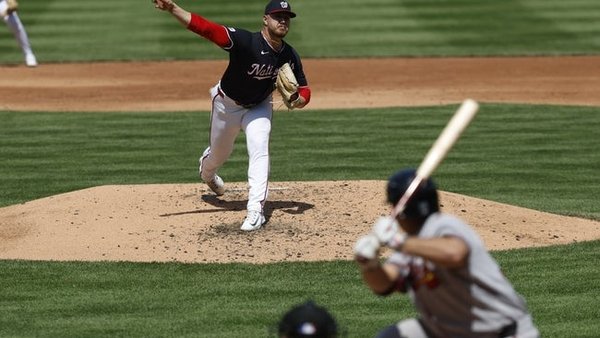
Coors Field is posting a 1.38 park factor against a bullpen-taxed backdrop — the same series produced 15 combined runs Monday, and tonight features a rookie with just 14.1 MLB innings facing a Nationals order where James Wood runs a .578 xwOBA and CJ Abrams has homered in three straight. The posted total of 11.5 sits more than a full run below the 12.6 projected combined score, and the market has barely blinked.
Cade Cavalli vs. Gabriel Hughes: Washington Nationals at Colorado Rockies Betting Preview
The 11.5 total on this game is doing a lot of heavy lifting for a Tuesday night environment that just produced a fireworks show. Colorado took the finale of Monday’s slate 8-7 in a game loaded with lead changes, home runs, and spent bullpen arms on both sides. Tonight, Washington sends Cade Cavalli to the mound against Rockies rookie Gabriel Hughes, whose entire MLB résumé spans 14.1 innings. The posted line has barely moved — Over -104, Under -118 — which tells you the market sees this as genuinely close. I disagree.
The core argument for the Over isn’t complicated: Coors Field amplifies run scoring by roughly 38% versus a neutral park, Hughes is an unknown quantity pitching in one of the most unforgiving environments in baseball, and both bullpens are operating with significant injury attrition. The numbers project 12.6 combined runs against a posted total of 11.5 — a 1.1-run gap that, at altitude, matters more than it would in a pitcher’s park.
After yesterday’s over on this same game cashed at 15 combined runs, the market adjusted the total slightly upward, but not enough to close that projected gap. That’s the opening.
Game Info & Betting Lines
- Date/Time: Wednesday, July 22, 2026 | 3:10 PM ET
- Venue: Coors Field, Denver | Park Factor: 1.38 (hitter-friendly)
- Probable Starters: Cade Cavalli (6-4, 3.78 ERA) vs. Gabriel Hughes (0-1, 3.14 ERA)
- Moneyline: Washington Nationals -136 / Colorado Rockies +116
- Run Line: Washington Nationals -1.5 (+112) / Colorado Rockies +1.5 (-134)
- Total: 11.5 (Over -104 / Under -118)
Why This Number Is Off
The market is balancing two legitimate forces: a high-octane park that screams Over, and a Cavalli who has been genuinely effective in 104.2 innings this season. The Under at -118 suggests books are leaning toward lower scoring, likely pricing in Cavalli’s 10.2 K/9 and the possibility that Hughes’ 3.14 ERA is more than smoke. That’s a reasonable position — the market isn’t asleep here.
But here’s the problem: the -118 juice on the Under means you’re paying up to fade a park that has seen its last three games produce 15, 10, and 15 combined runs. The Coors correction the market is applying doesn’t go nearly far enough when you factor in two compromised bullpens.
The Under only wins if Cavalli carves through a Rockies lineup that is striking out at the highest rate in this matchup (880 SO on the season) AND Hughes somehow replicates his 3.14 ERA sample against a dangerous Washington order. That’s two things that both need to go right simultaneously. The Over only needs the environment to behave like it consistently does — and both starters to be mortal.
The Over at -104 is essentially a coin-flip price on what projects as a 1.1-run gap in its favor. That’s not a massive edge, but the directional lean is clear and the price is not punishing.
What Separates the Pitching
The gap between these two arms is real, but it points toward run-scoring rather than away from it — and that’s the key distinction.
Cavalli’s four-seam fastball sits at 96.7 mph and generates an 18.3% whiff rate, and his knuckle curve is his best weapon: 37.7% whiff rate with a .252 xwOBA against. He’s a legitimate arm. The concern at Coors isn’t his stuff — it’s his sinker (.370 xwOBA against) and his changeup (.362 xwOBA against), two pitches that generate contact and live in the “hittable” tier of his arsenal. His WHIP of 1.3089 in a neutral environment means traffic, and traffic at altitude becomes runs. He’s already surrendered 9 home runs on the season — bring him to a park with a 1.38 run factor and those sinkers and changeups become invitation balls for Hunter Goodman (.477 xwOBA), who’s already hit 31 home runs.
Hughes is the bigger variable. His four-seamer sits at 93.0 mph — three-and-a-half ticks slower than Cavalli’s — and while his sweeper generates a .151 xwOBA against in a tiny sample, his changeup is a genuine liability: 0.0% whiff rate and a .669 xwOBA against in his 14.1 innings. Against a Nationals lineup where James Wood posts a .578 xwOBA overall and a .610 xwOBA against right-handed pitchers, and CJ Abrams has homered in three consecutive games and now sits at 24 home runs on the season, the margin for error is essentially zero. Hughes hasn’t faced a lineup with this kind of top-of-order quality in his brief professional exposure. The innings Hughes creates — moderate-velocity fastballs with an exploitable offspeed pitch — are exactly the kind a dangerous lineup feasts on at elevation.
Neither starter projects as someone who goes deep into this game without damage. The bullpen question becomes live by the fifth inning for both sides.
The Pushback
The honest case for the Under starts with Cavalli’s strikeout rate. At 10.2 K/9, he has genuine swing-and-miss stuff, and his knuckle curve (.252 xwOBA, 37.7% whiff rate) is a pitch that can neutralize any lineup. If he’s locating that pitch in the upper-thirds of games, the Rockies — who punch out 880 times on the season — could be chasing all afternoon. Cavalli has shown he can dominate at altitude before, and a 6-4 record with a 3.78 ERA isn’t luck.
The other friction point is price. The Over at -104 isn’t giving you much room. If both starters give you six clean innings — not likely, but possible — you’re looking at a combined 8-9 runs and a sweaty Under cash. The juice differential between Over (-104) and Under (-118) means the market is only mildly leaning toward low scoring, and that mild lean exists for a reason: Cavalli is legitimately good.
I’m not dismissing those arguments. I’m just not weighting them over a 1.38 park factor, a 12.6 projected combined total, and two bullpens that have already been emptied out across this series.
Rejected Angles
Moneyline (Washington -136): The model projects Washington with a 52.2% win probability, which translates to roughly -109 in fair-value terms. Paying -136 for a 52% edge exceeds my juice ceiling. Pass.
Run Line (Washington -1.5 at +112): This one is tempting given the positive price, but the 6.3-6.3 projection split tells me this game is genuinely coin-flip territory on margin. Yesterday’s 8-7 final is the exact blueprint for a game that goes Over the total but doesn’t cover a run line. The run line requires both the win AND the margin — I’m not stacking that risk when the straight Over at -104 accomplishes the same goal with less exposure.
Run Environment & Game Shape
The model projects this as a 6.3-6.3 game, which on its face looks like a tight, even contest. But that split is deceptive — two teams scoring over six runs apiece at Coors isn’t a pitcher’s duel, it’s a track meet. The park factor of 1.38 means every base hit, every walk, every hit-by-pitch is playing in an environment that amplifies its damage by 38% compared to a neutral venue. The air is thinner, the ball carries, and outfield fences that would be warning-track outs in most parks become souvenirs here.
Colorado’s bullpen is already showing significant attrition heading into this game. Blas Castano (pectoral), Welinton Herrera (elbow), Jaden Hill (shoulder), and Jeff Criswell (shoulder) are all on the IL. That’s four relievers unavailable, meaning the Rockies will be leaning heavily on whoever is left standing after Hughes exits — likely in the fourth or fifth inning given his inexperience and the environment he’s walking into.
Washington’s bullpen situation is equally stressed. Mitchell Parker (elbow), Richard Lovelady (triceps), Brad Lord (side), and PJ Poulin (forearm) are all on the IL — four relief arms gone before a pitch is thrown tonight. That depth erosion means Cavalli’s leash is shorter than his 104.2 innings of track record might suggest. The moment he hits traffic in the fourth or fifth, Washington’s manager is reaching into a depleted bullpen, and those replacement-level arms facing a Goodman-Carrigg-Castro lineup at altitude is exactly the scenario that blows a 9-8 game into 12-10 territory. Both teams are forced into their bullpens earlier than they’d like, and the arms they’re deploying are the ones who survived the IL wave — not the ones who were supposed to be closing out innings in July.
That’s the structural case for the Over beyond the starting pitching matchup: it’s not just that Hughes is inexperienced and Cavalli has hittable secondary stuff. It’s that the backend of both rosters is operating at reduced capacity, the park punishes every mistake, and the last time these two teams played, they combined for 15 runs with fresh bullpens. Tonight those bullpens are thinner. The over at 11.5 doesn’t need a blowout — it just needs the environment to do what it does.
The Pick
Over 11.5 at -104 — 2 units.
Coors Field with a 1.38 park factor, a rookie making just his second career start in one of baseball’s most unforgiving environments, and four relievers missing on each side — the 12.6 projected combined total isn’t a stretch, it’s what this game looks like on paper. The Over at near-even money on a 1.1-run projected gap is the play.