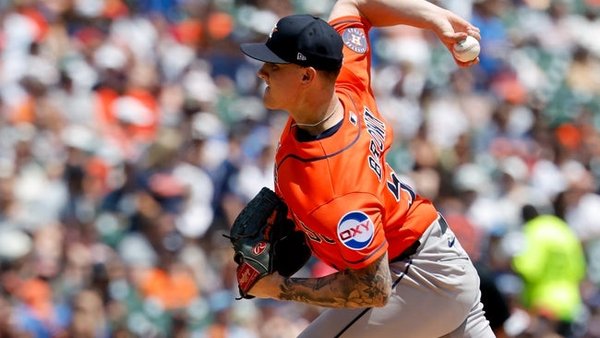
Kyle Bradish and Hunter Brown are both posting ERAs in the mid-3.50s, and neither offense — Baltimore’s .720 OPS or Houston’s .728 — is built to beat that kind of pitching in an enclosed park. The Under has been pressed to -124 while the Over is still sitting at +102, a juice gap that signals something beyond random market drift.
Kyle Bradish vs Hunter Brown: Baltimore Orioles at Houston Astros Betting Preview
The Under has been hammered to -124 while the Over sits at +102 for today’s series finale at Daikin Park — a price gap that doesn’t happen without meaningful sharp action. Two quality starters, an enclosed dome, and two offenses that aren’t exactly lighting the league on fire. When the line moves that decisively in one direction on a total this close to the projected number, it’s worth understanding why before you act on it.
The core thesis isn’t complicated. Kyle Bradish and Hunter Brown are both legitimate mid-rotation arms posting ERAs in the mid-3.50s. Baltimore’s offense sits at a .720 OPS. Houston’s is barely better at .728. Neither team is a high-powered scoring unit, and this series has already played out in exactly the low-scoring fashion you’d expect — Friday was 3-2, Saturday was 4-2. The pattern is real, and the pitching matchup today reinforces it.
The numbers project a combined 8.6 runs — one-tenth above the posted total of 8.5. That’s essentially a coin flip at the number, but combine it with two quality starters, a pitcher-friendly park factor of 0.96, and a roof overhead, and the lean becomes clear enough to act on at moderate size.
Game Info & Betting Lines
- Date/Time: Sunday, July 19, 2026 — 2:10 PM ET
- Venue: Daikin Park (Minute Maid Park), Houston, TX — Dome | Park Factor: 0.96 (slightly pitcher-friendly)
- Probable Starters: Kyle Bradish (BAL) vs Hunter Brown (HOU)
- Moneyline: Baltimore Orioles -102 / Houston Astros -116
- Run Line: Houston Astros +1.5 (-194) / Baltimore Orioles -1.5 (+160)
- Total: 8.5 — Over +102 / Under -124
Why This Number Is Close
The market is doing its job here — 8.5 is a fair number. The legitimate case for the Over exists: Baltimore is riding a six-game win streak and scoring enough to win games, Yordan Alvarez is an absolute force capable of changing a game’s complexion in one swing, and Brown’s 35.1-inning sample is small enough to carry real uncertainty. The Over side also gets a discount at +102, meaning you don’t have to lay juice to fade the Under.
But here’s the problem with the Over case: the juice disparity is doing the talking. When sharp money presses a total down to -124 on the Under — paying meaningful price for a line sitting just one-tenth above projection — that’s not random noise. The market is reflecting something: two legitimate starters in an enclosed environment against two offenses that rank among the quieter units in the American League. Baltimore’s .720 OPS and Houston’s .728 OPS aren’t inspiring numbers against quality arms.
The caveat is obvious — 8.6 projected against an 8.5 total is razor-thin. This is not a screaming edge. But the structural elements (dome, park factor, starter quality, offense profile) all push in the same direction, and the price confirms the lean. That’s enough to play at 2 units, not 4.
What Separates the Pitching
Hunter Brown owns the more electric raw stuff of the two starters. His four-seam fastball sits at 96.1 mph and holds hitters to a .205 xwOBA with a 24.3% whiff rate — that’s a genuine swing-and-miss pitch. His changeup, thrown 9.9% of the time at 87.4 mph, generates a 51.2% whiff rate — elite by any measure. The knuckle curve adds a third weapon at 31.0% whiff. Brown’s 9.9 K/9 is the headline number, and the Statcast arsenal explains it. Pete Alonso, Baltimore’s most dangerous bat with a .462 xwOBA and 6.4% barrel rate, has gone 0-for-8 with two strikeouts in his limited look against Brown — a small sample, but directionally relevant.
Where Brown gives the edge back is command. His 1.3867 WHIP in 35.1 innings reflects 22 walks — a concerning rate that can inflate pitch counts and force early exits. The concern is that Brown walks his way into trouble and hands Baltimore’s lineup extra runners before the bullpen inherits a mess.
Kyle Bradish works differently. His four-seam sits at 94.3 mph with an 18.0% whiff rate, but his best weapon is a slider thrown 14.5% of the time — generating a 41.8% whiff rate and a .248 xwOBA against, the cleanest pitch in his arsenal. His split-finger at 84.7 mph adds another swing-and-miss option at 21.4% whiff. Bradish’s 8.9 K/9 across 107.1 innings is a legitimate full-season sample. Alvarez, the Astros’ only genuine terror at a 1.065 OPS and .553 xwOBA, has only 3 PA against Bradish — too small to mean anything. That’s the wildcard Bradish can’t fully neutralize.
Head-to-head, Brown is the higher-ceiling arm with the superior raw stuff but the shakier control. Bradish is the more proven commodity at four times the innings. Both create pitcher-favorable innings, which is exactly what an Under needs.
The Pushback
The strongest argument against this Under is Yordan Alvarez, full stop. He’s leading the AL with a .320 average, 31 home runs, and 72 RBI — and his .553 xwOBA against right-handed pitching is borderline historic. In Friday’s game he finished 2-for-3 with two walks. In Saturday’s game he hit a tying double in the 10th. Bradish cannot simply game-plan around him; Alvarez punishes both mistake pitches and anything close to the zone. One at-bat from him can swing the total by itself.
Brown’s walk rate is the secondary concern. At 22 walks in 35.1 innings, he can manufacture traffic without Baltimore doing much. Henderson (.354 xwOBA) and Rutschman (.362 xwOBA) are capable of punishing walks, and the middle of Baltimore’s order — Alonso at .462 xwOBA, Basallo at .429 xwOBA — doesn’t need Brown to throw strikes to do damage.
One note worth flagging here: Blaze Alexander is on the 10-Day IL with a hand fracture suffered July 12. He is not available today. That removes what had been a .312 average and .807 OPS from Baltimore’s potential lineup options, and it further caps the Orioles’ offensive ceiling. Christian Encarnacion-Strand slides into the three-hole at third base. This isn’t a catastrophic loss for the Under thesis, but it is a meaningful depth reduction — one fewer bat capable of doing real damage against Brown’s slider-heavy mix — and it modestly supports the low-scoring lean.
The other pushback: Ryan Helsley is on the IL (elbow), which weakens Baltimore’s late-inning relief options. If Bradish exits early and the Orioles need to bridge innings, the bullpen depth is thinner than it was a week ago. That cuts both ways — a weaker Orioles pen could allow Houston to tack on runs in the seventh or eighth. Worth monitoring but not enough to flip the thesis on its own.
Run Environment & Game Shape
The dome removes every weather-related variable — no wind, no humidity shifts, no afternoon sun conditions. What you’re left with is a controlled environment where the park factor (0.96) does modest but real work suppressing run scoring relative to league average. Over the course of a game, that 4% run suppression isn’t dramatic, but it’s directionally consistent with the Under.
The series context reinforces the shape: Friday went 3-2, Saturday went 4-2. Both games were decided by quality pitching and opportunistic offense rather than extended offensive barrages. The Astros’ lineup outside of Alvarez is genuinely mediocre — Nick Allen (.250 xwOBA) leads off, and outside of Paredes (.314 xwOBA) and Altuve (.322 xwOBA), the bottom third of Houston’s order is punchable. Bradish’s slider is precisely the kind of pitch that keeps lineups like this from stringing together runs.
The one structural risk to game shape is bullpen transition. Both starters carry workload concerns — Brown at 35.1 innings this season is still building up, and Bradish at 107.1 innings and a 1.35 WHIP isn’t dominant enough to guarantee length. Every bullpen transition is a leverage point where runs can score in clusters, and with both teams operating at roughly .500 and playing meaningful late-July baseball, expect both managers to push their starters deep rather than handing off early to thinner relief corps.
The math here is simple: two starters with legitimate swing-and-miss arsenals, a pitcher-friendly enclosed environment, two offenses that rank in the bottom half of the AL in OPS, a depleted Baltimore lineup without Alexander, and sharp money already sitting on the Under at -124. The projected total of 8.6 barely clears the number. That margin of error is why this is 2 units and not a max play — but it is a play.
Bet: Under 8.5 — 2 Units — Moderate Confidence. Two legitimate starters, a dome that neutralizes variance, and two quiet offenses with Baltimore missing a key lineup piece all point the same direction. The juice confirms the lean — lay the -124 and take the Under.