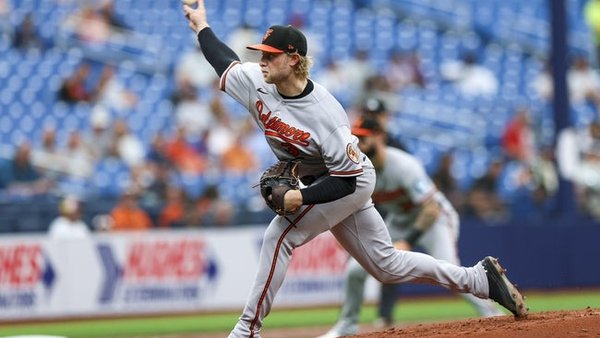
Sutter Health Park’s 0.93 park factor suppresses the blow-out ceiling, and that’s exactly the kind of environment that keeps a struggling Athletics offense in games it has no business winning. Jack Perkins carries a 6.68 ERA into a matchup where the number sits at -148 — a price that acknowledges the gap without fully accounting for how far Perkins has drifted from league-average.
Shane Baz vs. Jack Perkins: Baltimore Orioles at Athletics Betting Preview
After Baltimore’s 4-3 walk-off win in extra innings on Friday night, the pitching matchup for Saturday shifts dramatically in the Orioles’ favor. Yesterday’s game was a grind — extra innings, intentional walks, a manufactured 10th-inning rally — but tonight’s setup is more straightforward on the surface. Shane Baz takes the ball for Baltimore against Jack Perkins, and the gap between those two arms is the central argument here.
The market has Baltimore at -148 on the moneyline. That’s not an accident. The books are pricing a legitimate pitching edge against a team sitting at 53-82 with a run differential of -186 on the season. The thesis isn’t complicated: a struggling Athletics rotation, a Baltimore club at 66-69 still chasing wild card position, and a park that plays below average for run-scoring.
But the price is exactly where this gets uncomfortable. I like the side. I don’t love the number, and that tension shapes every decision I’m making in this game.
Game Info & Betting Lines
- Date/Time: Saturday, August 29, 2026 | 10:05 PM ET
- Venue: Sutter Health Park | Park Factor: 0.93 (pitcher-friendly, below average for runs)
- Probable Starters: Shane Baz (BAL) vs. Jack Perkins (OAK)
- Moneyline: Baltimore Orioles -148 / Athletics +122
- Run Line: Baltimore Orioles -1.5 (+110) / Athletics +1.5 (-132)
- Total: 9.5 (Over -113 / Under -106)
Why This Number Is Close
The market is doing something reasonable here. Baltimore at -148 reflects a real pitching edge and a real talent gap, but it also bakes in the fact that Baz hasn’t been dominant — his ERA sits at 4.74 on the season with a 1.55 WHIP and only 6.2 K/9. That’s not a profile that commands heavy chalk. The books know Baz is inconsistent, which explains why this isn’t -175.
On the other side, the Athletics have shown they can manufacture runs. They beat Minnesota twice in their last series and won yesterday’s opener before Baltimore pulled ahead in extra innings. Their lineup isn’t built on power — the xwOBA numbers across their top of the order are modest — but they put the ball in play and they’re not automatic outs.
Where I think the market is slightly wrong is in how it weights the Perkins factor. A 6.68 ERA isn’t just bad — it’s historically bad for an active starter. That’s a number that should be moving the line further, and the fact that it’s sitting at -148 suggests the market is either respecting Oakland’s home environment or discounting how far Perkins has been from league-average. The gap between these two starters is real, and -148 feels like it’s undercharging for it — just not by enough to make this a comfortable standalone play.
What Separates the Pitching
The honest comparison here isn’t flattering to either guy, but the distance between them matters. Baz leans heavily on his sinker — 38.1% usage at 91.8 mph — generating soft contact rather than swing-and-miss. The pitch holds hitters to a .341 xwOBA, which is functional but not dominant. His best weapon is actually his sweeper, which sits at just 5.8% usage but carries a 34.2% whiff rate and a .252 xwOBA against. The concern with Baz is that he relies on a pitch mix that punishes bad contact rather than generating strikeouts — 6.2 K/9 and 26 walks in 74 innings isn’t a profile built for blow-out wins. He’s capable of a quality start and equally capable of a five-walk, five-run disaster.
Now look at what Perkins brings to this. A 6.68 ERA with a 3-9 record on a team that loses constantly isn’t just volume-driven — it reflects genuine inability to keep hitters off base. Against a Baltimore lineup that features Christian Encarnacion-Strand (.477 xwOBA, .744 xwOBA vs. left-handed pitching) and Coby Mayo (.589 xwOBA vs. lefties), if Perkins is a southpaw or works off a weak fastball, those splits become dangerous in a hurry. Pete Alonso anchors the middle of this order with a .486 xwOBA and 32 home runs — he’s the kind of hitter who punishes mistake pitches regardless of handedness.
The innings each pitcher creates look different. Baz generates pitcher-controlled plate appearances — contact on his terms, soft grounders, limited damage. Perkins creates hitter-controlled chaos — elevated hard contact, walks that compound into runs. That’s the gap the price should reflect more aggressively than it does.
The Pushback
Here’s the problem: Baltimore’s offense has been inconsistent. The numbers don’t show an offensive shutdown — the Orioles scored 8 runs Wednesday, 5 Thursday, and 4 Friday — but that Wednesday game tells a cautionary tale. Baltimore built a seven-run lead against St. Louis and nearly blew the whole thing, eventually needing a ninth-inning Encarnacion-Strand double to escape 8-7. Friday’s win required extra innings and a manufactured two-out rally to hold a 4-3 lead. This isn’t a locked-in offense; it’s a team capable of big innings and equally capable of squandering them. Ryan Mountcastle is on the 60-Day IL with an oblique injury, Tyler O’Neill is out with a shoulder issue, and the lineup is leaning on younger contributors like Alexander and Beavers rather than its full complement of proven bats.
The concern with Baz specifically is his 1.55 WHIP. That number tells you he’s putting runners on base consistently, and against a team that won’t be overwhelmed by his 6.2 K/9 rate, there’s a real path to a competitive game on Oakland’s side. Sutter Health Park plays below average for runs — a 0.93 park factor — which suppresses the blow-out ceiling and keeps the Athletics’ modest offense relevant. A 4-2 or 5-3 Baltimore win is the most likely game shape here, which makes the run line at +110 an interesting alternative structure, but the juice on the Athletics’ side at -132 makes the +1.5 feel like a trap in the other direction.
Baltimore is also 66-69 on the season with a -23 run differential, which isn’t the profile of a team that steamrolls anyone. They’re in the hunt, but barely.
Joe Jensen’s Pick
I like Baltimore’s side in this game. The pitching gap is real, the matchup advantages in the middle of the order are real, and the Athletics at 53-82 with Perkins on the mound aren’t a team I’m backing at plus money either. The direction here is right.
But -148 is the problem. That price demands roughly 59.7% implied probability, and when your starter has a 1.55 WHIP and your offense just needed extra innings to hold off a team with a -186 run differential, I’m not confident enough in a dominant performance to lay that kind of juice as a standalone bet. The side is right. The number doesn’t clear the bar.
This is the textbook definition of a beer-money spot or a parlay leg — somewhere you’re adding Baltimore to grab a better combined number rather than committing real units on its own. If you’re building a two-teamer and you need a directional lean on a lopsided pitching matchup, this is your anchor. As a standalone full-unit play at -148? I’m passing.
Pick: LEAN Baltimore Orioles moneyline — parlay leg or small-stakes play only. Not a standalone full-unit bet at -148.