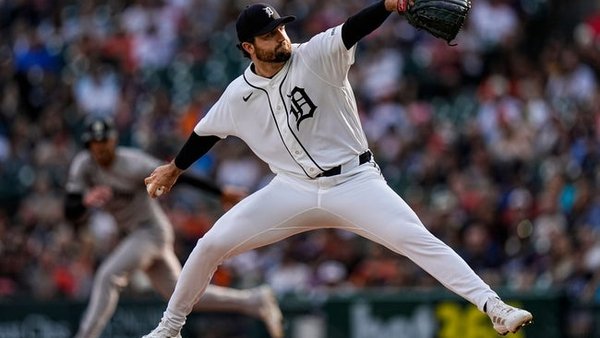
Casey Mize’s 0.99 WHIP and elite multi-pitch arsenal lines up against Mitch Bratt, a necessity starter carrying a 1.84 WHIP and a walk rate approaching 6.5 BB/9 across just 20.2 innings. The market has San Diego at -122 — a price that treats this like a near coin-flip when the starter gap is anything but.
Casey Mize vs. Mitch Bratt: San Diego Padres at Arizona Diamondbacks Betting Preview
After Tuesday’s 9-4 demolition of the Diamondbacks, San Diego rolls into Game 3 with the kind of momentum that isn’t manufactured — it’s earned over an 8-2 run in their last 10 games. But momentum only gets you so far. What makes this number actionable is the pitching matchup, and the gap here is not subtle.
Casey Mize — a legitimate top-of-rotation arm — is being asked to go toe-to-toe with Mitch Bratt, a necessity starter filling a rotation cratered by injuries. The market has landed San Diego at -122, a price that suggests modest favoritism. Given the starter disparity, that number looks like it’s doing the Diamondbacks a favor.
Arizona’s home crowd and a potential emotional bounce-back spot after getting shelled are real factors. This is not a team you dismiss at home in a division matchup. But the question isn’t whether Arizona can win — it’s whether the price on San Diego reflects the true gap in starting pitching. My read: it doesn’t, and that’s the edge.
Game Info & Betting Lines
- Date/Time: Wednesday, August 5, 2026 | 9:40 PM ET
- Venue: Chase Field (Park Factor: 0.97 — neutral-to-slightly-pitcher-friendly, covered dome)
- Probable Starters: Casey Mize (SD) vs. Mitch Bratt (ARI)
- Moneyline: San Diego Padres -122 / Arizona Diamondbacks +104
- Run Line: San Diego Padres -1.5 (+122) / Arizona Diamondbacks +1.5 (-146)
- Total: 9.5 (Over +102 / Under -124)
Why This Number Is Close
The market is doing legitimate work setting this at -122. Arizona came into Tuesday’s game leading San Diego by two games in the NL wild-card race, and even after the loss they’re still 60-54 — a game ahead of the Padres. Home field, crowd energy, and a natural bounce-back motivation all make the Diamondbacks a defensible +104 play. The market isn’t wrong to keep this close.
There’s also the Arizona offense to consider. The D-backs carry a team OPS of .706 and have scored 517 runs this season — slightly ahead of San Diego’s .696 OPS and 482 runs. Corbin Carroll (.813 OPS, 16 HR) and Ketel Marte (19 HR, .751 OPS) are genuine threats capable of punishing any starter who leaves pitches in the zone.
But here’s where the market leans on narrative rather than substance: the actual quality of Bratt’s starts, the command volatility he’s shown, and the stark contrast with what Mize brings to the mound represent a pitching gap that a -122 price hasn’t fully priced in. The line feels like it’s weighting Arizona’s home-field familiarity and offensive tools — and leaving Bratt’s severe command issues as a secondary footnote rather than the primary concern they deserve to be.
What Separates the Pitching
This is where the analysis gets decisive. Casey Mize owns a 2.70 ERA and 0.99 WHIP across 86.2 innings — a sample large enough to trust. His strikeout rate sits at 8.8 K/9 with only 19 walks and 5 home runs allowed all season. That’s elite control with genuine swing-and-miss capability. His arsenal is built on deception and movement: his cutter (22.7% usage, 90.1 mph) generates a whiff rate of 18.4% and holds hitters to a .286 xwOBA. His slider is even more dangerous — 25.4% whiff rate with a .215 xwOBA against, the sharpest weapon in his kit. He mixes in a sweeper at 31.2% whiff and a changeup at 31.7% whiff, giving him multiple ways to put hitters away.
Against that arsenal, Arizona’s top of the order faces tough sledding. Ketel Marte carries a .367 xwOBA against right-handed pitching — respectable, but Mize’s slider sits in the zone where right-handed bats with pull tendencies struggle. Corbin Carroll checks in at .407 xwOBA vs. RHP, and his BvP against Mize (5 PA, .200 average, 2 strikeouts) is too small to lean on but doesn’t raise alarm bells about a dominant history.
Now flip to Mitch Bratt. In just 20.2 innings, he’s posted a 5.23 ERA, 1.84 WHIP, 15 walks, and 4 home runs allowed. That’s a walk rate approaching 6.5 BB/9 — nearly one free baserunner every two innings. His four-seam fastball at 91.6 mph is his primary weapon at 43.3% usage, but it generates only a 10.8% whiff rate and carries a .448 xwOBA against — hittable. His curveball (19.2% usage) is even more alarming with a .653 xwOBA against, meaning hitters are doing serious damage when they connect. His changeup (.197 xwOBA) is his only reliable weapon. Against a Padres lineup that, even depleted, includes Ty France (.405 xwOBA, 28% hard-hit rate) and Gage Workman (.520 xwOBA, 8.8% barrel rate), Bratt’s command issues become an express lane to a crooked inning.
The Pushback
The concern worth taking seriously is Bratt’s sample size. 20.2 innings is nothing — his ERA and WHIP could stabilize, and early-season variance in either direction doesn’t always hold. There’s a version of tonight where Bratt settles in, leans on his changeup (.197 xwOBA), and competes deep into the game. Small-sample volatility cuts both ways, and dismissing him entirely because of a rough 20-inning stretch oversimplifies what we actually know about his stuff.
There’s also a legitimate bullpen concern on the San Diego side. The Padres have leaned heavily on their relief corps during this 8-2 run, and with Jason Adam (60-Day IL, shoulder) and David Morgan (15-Day IL, knee) already unavailable, the depth behind Mize is thinner than the surface-level roster suggests. If Mize exits early for any reason, the pen attrition is a real variable. Arizona’s bullpen, by contrast, is relatively fresh after Brandon Pfaadt’s 6.1-inning outing Monday.
I hear that case. But even granting Bratt’s best-case scenario and Arizona’s bullpen advantage, you still need Mize to falter — and his numbers (2.70 ERA, 0.99 WHIP, 19 walks in 86.2 innings) don’t suggest that’s a likely outcome. The pushback is real, but it’s not a reason to flip sides. It’s a reason to stay off the run line.
Why I’m Passing on the Run Line
San Diego -1.5 at +122 is superficially tempting — you’re getting plus money on a team the numbers favor by a wide margin. But the bullpen attrition concern and Bratt’s small-sample unpredictability cut against laying the extra half-run. A 2-1 or 3-2 final covers the moneyline. It doesn’t cover the run line. The juice isn’t worth the exposure when the same reasoning that makes the moneyline attractive — pitching gap, command advantage, momentum — also argues for keeping the margin requirement tight. I want the win. I don’t need the margin.
The Bet
The numbers project a combined score of 8.9 with San Diego winning roughly 65% of simulations at this matchup profile. That translates to an implied probability advantage of nearly 14 points over the -122 price, which prices the Padres closer to a coin flip than a genuine edge. With a 2.70 ERA starter against a 5.23 ERA starter, in a neutral-to-pitcher-friendly dome, on a team that has won 8 of its last 10 — the market is giving you a gift at -122.
Chase Field’s 0.97 park factor is essentially neutral, so there’s no meaningful run-suppression or run-inflation adjustment to make here. This is a pitching edge playing out in a context that doesn’t distort it.
Bet: San Diego Padres Moneyline (-122) — 2 Units | Moderate Confidence