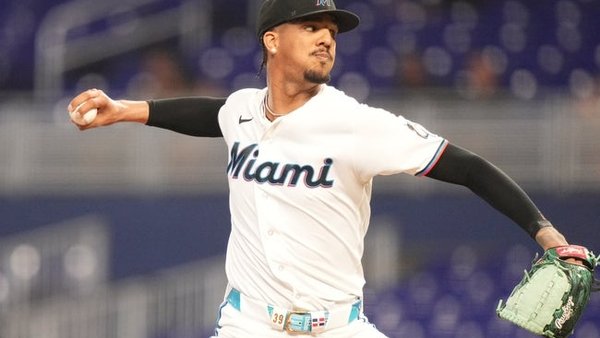
Eury Perez carries a 34.5% sweeper whiff rate and a genuine strikeout advantage over JP Sears — yet the Marlins arrive on a ten-game losing streak with no visible mechanism to reverse it. The market prices this as a routine home-favorite spot at -134, but nothing about a team in full systemic collapse is routine.
JP Sears vs. Eury Perez: San Diego Padres at Miami Marlins Betting Preview
The surface read here is straightforward: Eury Perez is the better pitcher, Miami is the home team, and the Marlins are priced as a modest favorite at -134. The market has done its job pricing the pitching gap. What it may not have fully accounted for is that a team in genuine systemic collapse — ten consecutive losses, not a rough three-game stretch — doesn’t suddenly flip the switch because they’re at home on a Saturday afternoon.
San Diego comes in at +114. That number clears the juice ceiling with room to spare on a team that is functionally .500 and just beat this exact Marlins club 4-2 last night, drawing seven walks and manufacturing runs without a dominant offensive performance. The value angle isn’t that the Padres are a great team — they’re not. It’s that +114 on a functional road squad against a team in freefall is a price worth taking.
The Perez matchup is real and deserves honest treatment. But the line is essentially pricing this as a standard home-favorite spot. The problem is nothing about Miami right now is standard.
Game Info & Betting Lines
- Date/Time: Saturday, July 25, 2026 | 4:10 PM ET
- Venue: loanDepot park (Dome) | Park Factor: 0.95 — neutral to slightly pitcher-friendly
- Probable Starters: JP Sears (San Diego, 2-3, 4.38 ERA) vs. Eury Perez (Miami, 5-7, 3.53 ERA)
- Moneyline: San Diego Padres +114 / Miami Marlins -134
- Run Line: Miami Marlins -1.5 (+158) / San Diego Padres +1.5 (-192)
- Total: 8.0 (Over -110 / Under -110)
Why This Number Is Off
The market is doing something reasonable here: it sees Perez as a legitimate frontline arm with 91.2 innings of track record, a 3.53 ERA, and a Marlins team playing at home with a bounce-back opportunity. That’s a coherent argument for -134. Home field, better starter, motivated club. The line makes sense on paper.
But here’s the problem — the Marlins’ 0-10 skid isn’t just variance. Their last win came before the All-Star break. They’ve been swept in three-game series, dropped close games and lopsided ones. The 0-10 represents a systemic breakdown across starters, relievers, and situational hitting. A home game doesn’t cure that.
The flip side of that is that the market may already be discounting Miami somewhat, which is why the Padres are only +114 underdogs rather than +130 or higher. The line isn’t dramatically wrong — this isn’t a market overreaction in one direction. It’s a situation where the price on San Diego reflects a slight discount for being road dogs against a better starter, but doesn’t fully penalize the Marlins for a collapse of this magnitude. That gap — not a chasm, but a gap — is where the value lives at +114.
What Separates the Pitching
The honest answer is that Perez is the better arm, and by a meaningful margin on track record. But the degree of that gap is what the market is weighing, and it’s worth examining carefully.
Perez works with a 98.2 mph four-seam fastball that he throws 43% of the time, holding hitters to a .316 xwOBA against it — functional but not dominant. His true weapons are a sweeper generating a 34.5% whiff rate and an xwOBA of just .220 against, and a changeup that hitters whiff at 42.1% — easily his best swing-and-miss offering. Against a San Diego lineup posting a .229 average and 868 strikeouts on the season, those numbers are legitimately dangerous. Tatis Jr. carries a .414 xwOBA overall, but against right-handed pitching specifically, it drops to .409 — still a threat, but Perez’s sweeper/changeup combination is designed to neutralize exactly that profile. Jase Bowen at cleanup is the real vulnerability: his K rate of 36.1% and whiff rate of 30.3% set up poorly against Perez’s arsenal.
Sears is a different equation. His 4.38 ERA comes across just 24.2 innings — a sample so small it tells us almost nothing reliable. What the Statcast data does show is a four-seam fastball at 92.9 mph with a 22.9% whiff rate and a sweeper generating a 33.3% whiff rate — the latter is his best put-away pitch at 46.2%. The concern with Sears isn’t his stuff; it’s Heriberto Hernández, who carries a .462 xwOBA and 8.1% barrel rate against left-handed pitching in particular (.523 xwOBA vs. LHP). Sears is a lefty. That matchup is the single biggest threat to this bet.
The pitching gap is real — Perez has the edge in volume, strikeout rate (10.2 K/9 vs. 7.3 K/9), and WHIP (1.11 vs. 1.26). But Sears’ small sample makes his ERA unreliable as a ceiling estimate, and Perez’s 5-7 record on a .500 team suggests the gap doesn’t always translate to wins.
The Pushback
The strongest case against this lean is Eury Perez himself. He’s not just a paper advantage — he’s a genuine strikeout weapon posting 104 strikeouts in 91.2 innings with a 1.11 WHIP. Against a San Diego lineup with a .689 OPS and 868 punchouts on the season, this is a real matchup problem. The Padres aren’t a lineup that grinds out runs against elite strikeout pitchers; they grind out walks and wait for mistakes. Perez doesn’t make many.
There’s also a legitimate bounce-back narrative here. Miami is at home, they’ve lost 10 straight, and the law of averages suggests a team this talented eventually wins a game. The Marlins were 10 games over .500 as recently as July 9. This isn’t a bad team — it’s a team in a bad stretch. That distinction matters when you’re laying +114 on their opponent.
The San Diego bullpen is also a genuine concern. Jason Adam, Jeremiah Estrada, and David Morgan are all on the IL. Mason Miller closed last night and faces usage limits after logging his 26th save. If Sears gives up early runs and gets pulled, the bridge to Miller gets very thin very fast. That’s not a token risk — it’s a structural one that the numbers support.
Rejected Angles
Miami moneyline (-134): Dismissed. The price requires laying juice on a team that has lost ten in a row, and the Marlins have shown no repeatable mechanism to end the skid — not lineup construction, not bullpen performance, not situational hitting. Laying -134 on a 0-10 team in a collapse this systemic is not a bet I can make regardless of the starter advantage.
San Diego run line (+1.5, -192): The -192 price on the run line is a juice trap. You’re essentially paying -192 for insurance that isn’t needed at +114 moneyline. If the Padres win, the moneyline pays better. If they lose by one, you’ve given up enormous value getting there. Hard pass.
Total (Over 8.0, -110): The park factor at loanDepot is 0.95 — slightly pitcher-suppressing — and the over/under of 8.0 is sitting at a price that doesn’t offer enough edge to chase. Perez has the swing-and-miss profile to keep this game under, and Sears’ small sample makes him hard to project confidently as a run-giver. The total is skippable.
Projected Score and Game Shape
The numbers put this game at roughly Miami 4.5, San Diego 4.0 — a close, low-leverage outcome where the pitching gap shows up marginally but doesn’t blow the game open. That game shape matters for how I’m sizing this: it’s not a spot where San Diego runs away; it’s a spot where they compete, hang in, and let the Marlins’ inability to generate clutch production catch up with them in the late innings. Last night’s blueprint — draw walks, survive the middle innings, and capitalize on a bullpen mistake — is repeatable even if it’s not pretty.
The Hernández vs. Sears matchup (.523 xwOBA vs. LHP) is the most likely way this bet loses. If Hernández goes deep early, Sears exits, and San Diego’s thin bullpen starts patching innings together, the game shape flips. That’s the specific scenario I’m accounting for by keeping this to a lean.
Joe Jensen’s Pick
San Diego Padres moneyline +114 — 1 unit, lean.
The +114 price compensates for the real pitching gap, the real bullpen risk, and the real bounce-back narrative. What it doesn’t have to compensate for is a Miami team with any visible mechanism to end this skid — and ten losses in a row without one is not a trait that disappears because the calendar flips to Saturday at home. The Padres don’t need to be good here; they just need to be functional at a number that gives them room to be imperfect. That’s exactly what +114 provides. One unit, lean confidence, San Diego moneyline.