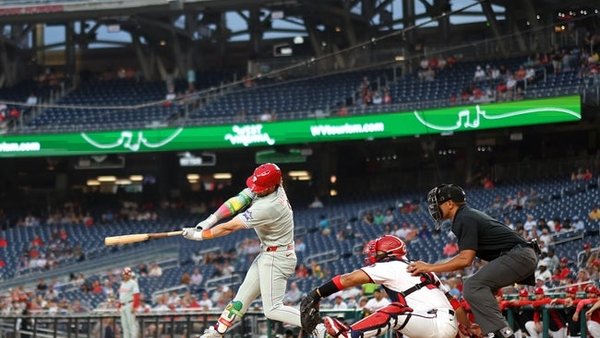
Zack Wheeler carries a 2.11 ERA and 0.878 WHIP into Citi Field while the Mets have yet to name a starter — a structural mismatch the total at 8 (-105 under) is not fully accounting for. The Phillies’ recent offensive explosion came against the worst bullpen in baseball, not against a Wheeler-caliber run environment, making that context noisy rather than predictive.
Zack Wheeler vs TBD: Philadelphia Phillies at New York Mets Betting Preview
When one team sends an ace and the other sends a question mark, totals tend to behave predictably. Zack Wheeler is the most dominant known variable in this game — a 2.11 ERA, 0.878 WHIP, and a 7-1 record across 68.1 innings in 2026. He doesn’t just suppress runs, he controls game tempo, limits baserunners, and eats deep into ballgames. The market knows this, which is why the Phillies are priced at -162 on the moneyline — a number that blows past any reasonable juice threshold and takes the outright win off the table from a value perspective.
What the total price doesn’t fully account for is this: the Mets have not confirmed a starter. A TBD arm — whether it’s a spot starter, a bullpen game, or an emergency call-up — does not inflate totals by default. In fact, unannounced starters typically create controlled, lower-scoring environments because managers protect volatile arms with shorter leashes and more bullpen bridges. The Phillies’ half of the scoring is the one with a real question mark. Wheeler’s half is nearly locked.
The Phillies arrive from Washington having won three straight games, including a 10-run explosion on Thursday. But those wins came against the Nationals’ bullpen — the worst in baseball. Citi Field and Wheeler’s arm are a different environment entirely. The under at -105 is essentially a market neutral — and that’s where the value lives.
Game Info & Betting Lines
- Date/Time: Friday, June 26, 2026 | 7:10 PM ET
- Venue: Citi Field | Park Factor: 0.97 (mild run suppressor)
- Probable Starters: Zack Wheeler (PHI) vs. TBD (NYM)
- Moneyline: Philadelphia Phillies -162 / New York Mets +136
- Run Line: Philadelphia Phillies -1.5 (+106) / New York Mets +1.5 (-128)
- Total: 8 (Over -115 / Under -105)
Why This Number Is Close
The market has set 8 as an honest total, and I understand why. The Phillies come in hot — three consecutive comeback wins, including a 10-5 blowout against Washington’s relief corps. Schwarber leads the majors in home runs at 29, Harper is sitting on a .877 OPS, and Marsh has been one of the hottest bats in baseball at .321 average. A Phillies lineup capable of 10-run nights is a real over threat on its own.
The flip side of that is who they scored those runs against. Washington’s bullpen is historically bad, and the Phillies were in comeback mode each time — a different game shape than what Wheeler starts typically produce. The concern is that the Phillies’ recent offensive context is noisy rather than predictive, built on matchup-specific softness rather than elite contact quality.
The market is pricing 8 as if the TBD Mets arm is neutral — somewhere between competent and shaky. That’s where I think the number is slightly off. A TBD starter almost never means a pitcher who dominates — it means the Mets don’t have confidence in who’s starting, which creates a shorter leash, more early bullpen exposure, and ultimately a less run-productive environment, not more. Combine that with Wheeler nearly locking in sub-4 runs on his side, and 8 combined is a ceiling that looks more comfortable than it should.
What Separates the Pitching
The gap between these two pitching situations is not subtle. On one side, Zack Wheeler is operating at an elite level in 2026. His four-seam fastball sits at 95.3 mph with a 22.8% whiff rate and an xwOBA-against of .238 — one of the cleaner contact-suppression profiles in the sport. His split-finger generates a 42.5% whiff rate, his sweeper clocks in at 33.3%, and his K/9 of 9.09 means opposing lineups face genuine swing-and-miss threats across his entire arsenal. He’s allowed just 8 home runs across 68.1 innings — a rate that reflects consistent command at the edges of the zone.
Against this Mets lineup, the matchup data shows real vulnerability on New York’s side. Francisco Alvarez carries a 29.0% whiff rate and is hitless across 7 career PA against Wheeler with 3 strikeouts. Bo Bichette sits at .278 across 20 career PA against Wheeler with 5 strikeouts — a meaningful sample that confirms Wheeler’s command of that at-bat. Even Juan Soto, the Mets’ best hitter at a .449 xwOBA, has managed a .306 average across 46 PA against Wheeler but with 9 strikeouts — he makes contact but Wheeler keeps him from doing damage at scale. The Mets’ team offense ranks below average at .231 AVG and .675 OPS, and the absence of Semien, Robert, Polanco, and Taylor removes whatever middle-of-the-order depth they had.
On the other side: no name, no stats, no scouting report. That’s not a pitching advantage for New York — it’s structural uncertainty. The Phillies lineup will see an unknown arm with Bryce Harper posting an xwOBA of .461 and Marsh at .426. Wheeler controls his half of the run environment. The TBD arm does not.
The Pushback
Here’s the problem: the Phillies have been relentless offensively in recent weeks, and their ceiling against a mystery arm is genuinely high. Harper, Marsh, and Schwarber are the kind of hitters who can take an unvetted pitcher apart inside two innings. Marsh’s .426 xwOBA and Harper’s .461 represent real over exposure if the TBD starter can’t find the zone early. And Wheeler, for all his dominance, has surrendered 8 home runs this season — he’s not untouchable, just excellent. Soto’s .449 xwOBA and 8.9% barrel rate, plus Alvarez’s own 8.9% barrel rate, mean the Mets have the raw pop to cash an over on any single mistake. The structural TBD argument is real, but it assumes the bullpen game stays controlled — and bullpen games can unravel fast when a lineup smells blood on an opener.
That’s a genuine counterargument. But here’s why I’m staying on the under side: the Mets are 2-8 in their last 10 games and carry a -47 run differential on the season. They just got outscored 51-24 in a four-game sweep by the Cubs — a six-game losing streak that’s left their lineup depleted, their confidence shattered, and their roster running on fumes. The Phillies’ recent offense is context-dependent noise. Wheeler’s run suppression is signal.
Run Environment & Game Shape
Citi Field plays at a 0.97 park factor — a mild but real run suppressor. It’s not a dramatic edge, but in a game where the under sits at -105, every decimal point of run suppression matters. Wheeler’s 0.878 WHIP means fewer baserunners and fewer multi-run innings — the kind of clean, efficient outings that keep combined totals in the 6-to-8 range rather than pushing toward 9 or 10. On the Mets’ side, the TBD structural argument actually cuts both ways for game shape: a bullpen-managed game tends to produce more pitching changes, more traffic early, but also more careful sequencing once the opener exits. The Phillies will see strikes eventually, but the Mets won’t be handing anyone a run environment to feast in.
Put it all together: Wheeler dominates his half of the run total with a historically sharp 2.11 ERA and elite swing-and-miss stuff across five distinct pitches. The Mets counter with a TBD arm that introduces structural uncertainty rather than run production. The Mets’ lineup is banged up, skidding hard, and facing the worst possible opponent for a team in crisis. Citi Field takes a tick off the run environment. The numbers across the board point to a game that stays in check.
The Pick
This is a moderate-confidence play, not a hammer. The TBD variable is real, and the Phillies’ ceiling against an unknown arm keeps this from being a lock. But at -105, the under is priced fairly for a game where one elite starter is nearly certain to hold his half of the total under 4 runs, and the other team is in free fall. That’s enough for me to commit two units.
Bet: Under 8 (-105) — 2 units — Moderate Confidence