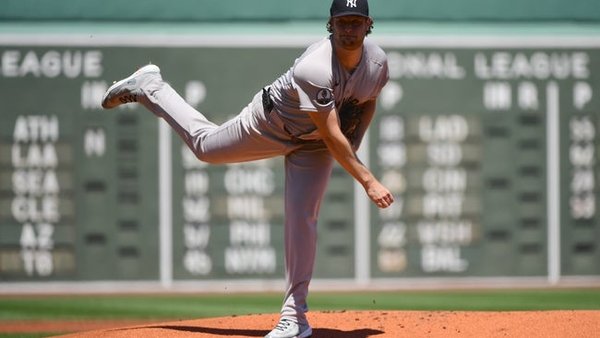
Gerrit Cole’s 1.16 WHIP and three swing-and-miss offerings face a Pirates lineup stripped of three .800-plus OPS bats — yet the total sits at 9.5, barely above a projected combined 9.7. The pitching gap is real, the lineup gap is real, and the number has not moved far enough to reflect either one.
Mitch Keller vs Gerrit Cole: Pittsburgh Pirates at New York Yankees Betting Preview
Yesterday’s game in this series ended without a result on the scoreboard — both teams were zeroed out in available data — but the Monday context matters: a bench-clearing incident, Jazz Chisholm homering twice, and an 8-5 Yankees win that exposed Pittsburgh’s bullpen and confirmed New York’s lineup still has teeth even without its two biggest power bats. The series tension carries into today, and that edge could affect pitch counts and aggression.
The core thesis here is not that the Yankees win easily — it’s that 9.5 runs is too many for this particular game environment. You have an elite starter in Gerrit Cole suppressing one half of the total, a Pirates lineup decimated by three meaningful IL placements, and a New York offense missing Aaron Judge and Giancarlo Stanton — two of their three biggest run-producing threats. The numbers project NYY 5.1, PIT 4.6, a combined 9.7 that barely clears the line. When the projected score is that close to the number, you don’t need a blowout under — you just need normal Cole.
The Yankees moneyline at -178 is walled off by juice — not playable at that price regardless of the matchup quality. That funnels the action toward the total, and the under at -122 is where the real argument lives today.
Game Info & Betting Lines
- Date/Time: Wednesday, July 22, 2026 | 1:05 PM ET
- Venue: Yankee Stadium | Park Factor: 1.05 (marginally hitter-friendly)
- TV: MLB.TV, YES
- Probable Starters: Mitch Keller (PIT) vs Gerrit Cole (NYY)
- Moneyline: Pittsburgh Pirates +150 / New York Yankees -178
- Run Line: New York Yankees -1.5 (+114) / Pittsburgh Pirates +1.5 (-137)
- Total: 9.5 (Over +100 / Under -122)
Why This Number Is Close
The market set 9.5 for a reason. Yankee Stadium carries a park factor of 1.05 — nothing extreme, but it does tilt the environment slightly toward offense. Pittsburgh’s season-long numbers show a legitimate attack: .263 batting average, .768 OPS, and 5.33 runs per game as a baseline. The Yankees, for their part, have 146 home runs on the season and a lineup that still includes Ben Rice (.966 OPS, 29 HR) and Paul Goldschmidt (.804 OPS). There’s a credible case for 9.5 runs in a park that doesn’t suppress.
The market is also accounting for Mitch Keller’s volatility. A 5.14 ERA and 1.33 WHIP suggest a starter who can hand a Yankees lineup a crooked number before the fourth inning ends. Combine that with a 6.7 K/9 — well below league average for a starter expected to eat innings — and the over feels reachable if Rice and Goldschmidt get to him early.
But here’s the problem: the market is pricing a healthier Pittsburgh lineup than the one showing up today, and it’s not fully reflecting what Cole does to opposing offenses over six-plus innings. The line looks fair on paper. It isn’t, given who’s missing from the Pirates’ batting order and what Cole’s Statcast profile actually projects.
What Separates the Pitching
Gerrit Cole and Mitch Keller are not close. Cole’s 96.8 mph four-seamer, deployed 44.1% of the time, generates a .289 xwOBA against and a 25.0% put-away rate — elite numbers for a primary offering. His slider sits at 89.5 mph with a 24.7% whiff rate and a .254 xwOBA, meaning opposing hitters are making poor contact on two of his three main pitches. His changeup checks in at .249 xwOBA against, which makes three distinct swing-and-miss offerings that work independently of each other. When you back that arsenal with a 9.0 K/9, only 12 walks in 55 innings, and a 1.16 WHIP, you get a starter who limits baserunners and doesn’t manufacture his own trouble. Cole doesn’t walk leadoff hitters; he doesn’t give up the sequence of single-walk-single that inflates innings. His 3.93 ERA is the product of consistent execution.
Keller is the inverse. His four-seamer sits at 93.4 mph and generates a .373 xwOBA — hitters are doing real damage against it. His sinker is worse: .434 xwOBA, which is contact-quality territory that leads directly to extra-base hits. The sweeper (25.0% whiff rate, .289 xwOBA) and curveball (32.1% whiff, .300 xwOBA) are genuine weapons, but they only account for 26.2% of his usage combined. When Keller falls behind in counts — which his 35 walks in 103.1 innings suggests happens frequently — he’s forced into the four-seamer and sinker against a lineup that still carries Rice, Goldschmidt, and Cody Bellinger. Rice has a .488 xwOBA against right-handed pitching. Goldschmidt is hitting .300 with 1 HR and 7 K over 33 PA against Keller — a meaningful sample that shows he makes consistent contact against him. Bellinger carries a .377 vsRHP xwOBA, which isn’t a monster number, but in the context of Keller’s vulnerable fastball/sinker mix, it’s enough to make damage real.
The gap between these two starters is roughly 1.2 runs of starter advantage per the component breakdown. That gap is why the under has a structural edge even in a slightly hitter-friendly park.
Pittsburgh’s Lineup Problem
Pittsburgh’s offense on paper is deceptive. Their .768 OPS and .263 average reflect a full-strength roster that is not showing up today. Oneil Cruz (60-Day IL, hand) is gone — that’s 14 home runs and an .822 OPS out of the middle of the order. Spencer Horwitz (10-Day IL, hamstring) removes another .842 OPS bat from first base. Endy Rodriguez (10-Day IL, lower body) eliminates a catcher posting .858 OPS in limited action. Three bats in the .800-plus OPS range are simply not available today.
What replaces them? Ryan O’Hearn gets the first base slot — he’s posting a .383 xwOBA overall and a .403 vsRHP xwOBA, with a .125 average in 16 PA against Cole specifically. That’s a significant step down from Horwitz. Rafael Flores Jr. catches, and Jake Mangum starts in center. This isn’t a Pittsburgh lineup that can manufacture five or six runs against an elite arm. The ceiling is lower than the season averages suggest.
Bryan Reynolds is the one legitimate threat remaining. His .413 vsRHP xwOBA gives him the profile to do damage against Cole, and his 5-PA BvP sample (.250, 0 HR, 2 K) is too small to read directionally. Nick Gonzales leads off and carries a .377 vsRHP xwOBA — better than his overall .358 mark, but Cole’s changeup (.249 xwOBA) and slider (.254 xwOBA) profile well against a contact-first approach. Esmerlyn Valdez is the wild card — his .537 vsRHP xwOBA is a legitimate power threat — but Cole doesn’t have an exploitable pitch that Valdez has seen often enough to project a multi-hit game.
The Pushback Case (Genuine Friction)
I won’t pretend the under is a lock. There are three real arguments for the over that deserve honest treatment.
First, Keller has a ceiling for damage that is not just theoretical. His .434 xwOBA on the sinker and .373 on the four-seamer mean that any early-count mistake against Rice, Goldschmidt, or Bellinger can snowball. One crooked inning — a walk, a single, and a Rice or Goldschmidt barrel — puts four or five Yankees runs on the board before the fifth inning. That scenario doesn’t require Keller to be historically bad; it just requires him to be exactly as volatile as his ERA and WHIP say he is.
Second, the Yankees bullpen is not intact. Max Fried and Carlos Rodon are both on the IL with elbow issues. That strips New York of two high-leverage arms they’d typically deploy in a close game. If Keller exits early with a lead, Pittsburgh’s relievers — already exposed in Monday’s 8-5 loss — are pitching to a Yankees lineup that has hit 146 home runs. Bullpen innings in a tight game can inflate totals fast.
Third, and this is the wildcard nobody wants to model: the bench-clearing incident from Monday. Dennis Santana got heated with José Caballero after a double play, and both benches emptied. Nobody threw a punch and nobody got ejected, but that energy doesn’t just disappear overnight. If it surfaces again today — a hit batter, a stare-down, elevated pitch counts from an agitated Keller — you’re in a different game than the one you handicapped.
I’ve considered all three. The first two are real but already partially embedded in a 9.5 total that accounts for Keller’s volatility and some bullpen exposure. The third is genuine noise — it could flip a quiet game or have zero effect. On balance, the projection landing at 9.7 barely clearing the line, combined with Cole’s suppression profile and Pittsburgh’s depleted lineup, still points under. The friction is real; it just doesn’t outweigh the structural case.
Run Environment & Game Environment
Yankee Stadium’s 1.05 park factor is the mildest possible nudge toward offense — think one or two extra hits per 100 plate appearances, not a launching pad. This is not Coors Field or Great American Ball Park; the park factor here adds marginal context but doesn’t change the thesis. A 1.05 environment means the under isn’t fighting the venue, it’s simply accounting for it.
From a team run-environment standpoint, New York is averaging fewer runs than Pittsburgh on the season — 475 runs scored versus 538 — despite having more home runs (146 vs. 130). That’s a lineup that runs hot on the long ball but doesn’t grind out multi-run innings through contact and baserunning the way a high-average club does. With Judge and Stanton out, the Yankees are more reliant on Rice, Goldschmidt, and Bellinger to carry the offense. That’s a fine core, but it’s a narrower path to six-plus runs than New York’s season aggregate suggests.
Pittsburgh’s run environment is similarly constrained today. Their team ERA of 4.30 and WHIP of 1.315 indicate a rotation and bullpen that leaks runs consistently — but Keller is their starter, not their bullpen, for the first five or six innings. The concern is the handoff. Pittsburgh’s relief corps is already operating without Devenski (60-Day IL) and Evan Sisk (15-Day IL), and Monday’s game showed exactly what happens when their pen is asked to hold a lead late. If Keller exits before the sixth with Pittsburgh trailing, those relievers could add to the Yankees’ total — but they’d need to actually be in the game in a meaningful spot first.
On the Yankees’ side, the bullpen depth loss of Fried and Rodon matters more in a multi-day series context than in tonight’s box score. Cole is projected for six-plus innings, and in a game where New York leads or is tied through five, they won’t need three high-leverage arms. The bullpen concern is real for the run line; for the total, it’s secondary to what Cole does in the first 18-21 outs.
The honest summary of the game environment: a slightly hitter-friendly park, two injury-shortened rosters, one elite starter and one volatile one, and a total set at a number that the projection barely clears. That’s not a screaming edge — it’s a lean backed by process. Midday weekday games at Yankee Stadium also tend to play in moderate conditions without significant wind-aided carry, which further supports keeping the park factor at its face value rather than inflating it.
If you’re shopping openers on this divisional matchup, Everygame has consistently offered competitive lines on afternoon totals and is worth a check before the 1:05 ET first pitch.
The Pick
Under 9.5 at -122 for 2 units — moderate confidence. Gerrit Cole’s three-pitch suppression profile limits Pittsburgh’s depleted lineup to a low ceiling, and the combined projection of 9.7 barely clears the total — meaning you’re not asking for a blowout under, just Cole doing what his ERA, WHIP, and Statcast arsenal say he does most starts.
Bet: Under 9.5 (-122) | 2 Units | Moderate Confidence